Jens Juel (1745–1802)
Seated Chinese Man in Mandarin Dress, 1780s
Oil on canvas
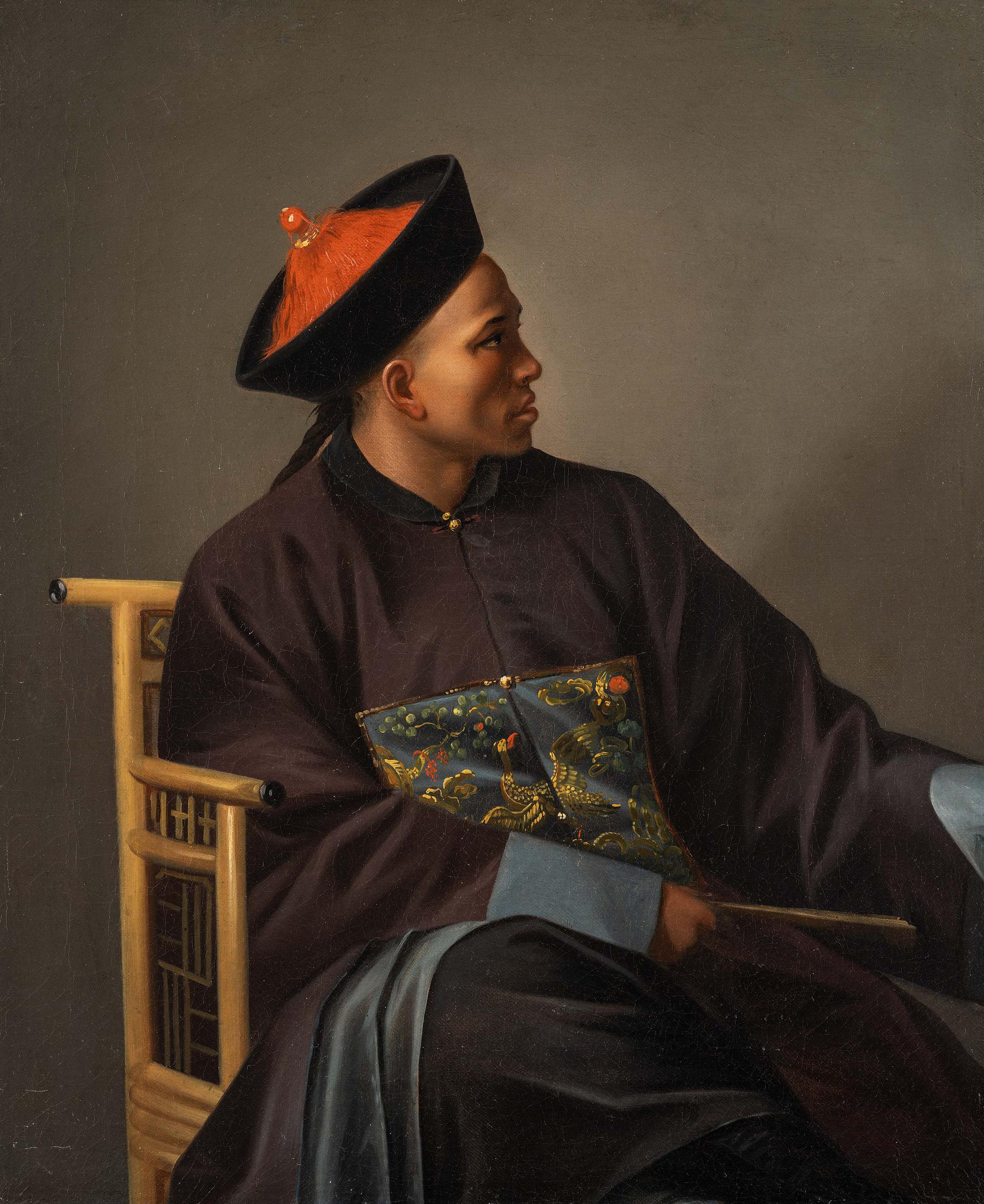
The robes are rendered in rich and meticulous detail, vividly representing the embroidery and the weight of the fabrics. The outfit constitutes the official dress of a Chinese government official, or mandarin. The rank badge on his chest, with a bird at its centre, identifies him as a civil official. The bird, a golden pheasant, denotes the second-highest rank. His headwear is a xiaomao, a winter cap worn by mandarins during the Qing dynasty (1644–1912). The red finial also denotes the second-highest rank.1
Research suggests, however, that the Chinese sitter was in fact a sailor, probably a junior officer aboard a Danish East Indiaman.2 In other words, the portrait is staged, with dress used to construct an identity. It is also an excellent example of the eighteenth-century European fascination with the East. The Chinese man is presented here both as an individual and as the embodiment of a type: the mandarin. In his elegant official robes, he becomes a symbol of Chinese culture, status and refinement, qualities that would have conjured up visions of an enchanting, distant land unfamiliar to European viewers at the time.
Seated Chinese Man in Mandarin Dress is one of at least three portraits Juel painted of the same Chinese sitter, probably in Copenhagen, where the first Chinese sailors arrived aboard Danish merchant ships in November 1783.3 Meeting these men, and the prospect of being able to paint one of them, must have aroused the artist’s curiosity. Opportunities to work with a Chinese model were rare in Denmark at the time. Juel’s repeated return to the subject suggests a sustained interest in exploring and experimenting with forms of representation beyond the portraits he usually produced for the Danish elite (B 348). The portrait also reflects a growing awareness of the global connections that shipping, trade and cultural exchange brought to Copenhagen in the late eighteenth century.
Publiceret i
Publiceret i
Udstilling af maleren Jens Juels arbejder, Kunstforeningen, Copenhagen 1909, p. 2, cat. 228 (exhibited as En kinesisk mandarin / A Chinese Mandarin);
V. Winkel and P. Magnussen: Kunst i privat Eje, vol. 2, Copenhagen 1945, p. 205;
Herman Madsen: 200 danske malere og deres værker, vol. 1, Copenhagen 1946, p. 40;
Jørgen Schou-Christensen (ed.): Københavnsk kultur 1700-tallet, Københavns Bymuseum, Copenhagen 1966, pp. 78-79, pl. 12, cat. 215 (exhibited as Fornem kineser / Noble Chinese Man);
Ellen Poulsen and Kasper Monrad (eds.): Jens Juel. Malerier i privat eje, Kunstforeningen, Copenhagen 1982, p. 32, cat. 37 (exhibited as En siddende kineser, i mandarindragt / Seated Chinese Man in Mandarin Dress, dated 1782?);
Ellen Poulsen: Jens Juel. Malerier og pasteller = Jens Juel. Paintings and Pastels, vol. 1, Copenhagen 1991, p. 94, no. 263 (exhibited as En kineser i mandarindragt / Chinese Man in Mandarin Dress);
Ellen Poulsen: Jens Juel. Malerier og pasteller = Jens Juel. Paintings and Pastels, vol. 2, Copenhagen 1991, pp. 198, 564, no. 263 (exhibited as En kineser i mandarindragt / Chinese Man in Mandarin Dress);
Peter Nisbet: Danish Paintings of the Nineteenth Century from the Collection of Ambassador John L. Loeb, Jr., Busch-Reisinger Museum, New York 1994, p. 3, cat. 13;
Danish Paintings of the Nineteenth Century from the Collection of Ambassador John L. Loeb Jr., Bruce Museum of Arts and Science and The Frances Lehman Loeb Art Center at Vassar College, Poughkeepsie 2005, pp. 14, 32-33, cat. 1;
Patricia G. Berman: In Another Light. Danish Painting in the Nineteenth Century, London 2007, fig. 12, pp. 26-27;
Patricia G. Berman and Thor J. Mednick: Danish Paintings from the Golden Age to the Modern Breakthrough. Selections from the Collection of Ambassador John L. Loeb, Scandinavia House, New York 2013, pp. 92-93, cat. 22;
John L. Loeb Jr. et al.: The Ambassador John L. Loeb Jr. Danish Art Collection, New York 2017, pp. 258-259, cat. 67;
John L. Loeb Jr.: Reflections, Memories and Confessions, New York 2017, pp. 420, 553.
Fodnoter
Fodnoter
Benjamin Asmussen and Anders Ravn Sørensen, ‘En ny elite’, in Anna Krogh-Rosenlund (ed.), Jens Juel. Under huden, Kunstmuseum Brandts, Fuglsang Kunstmuseum and Ribe Kunstmuseum, Odense, 2025, pp. 104–106.
In recent research, Benjamin Asmussen and Anders Ravn Sørensen have proposed a possible identification of the Chinese sailor who sat for another of Juel’s portraits, Portrait of a Chinese Man in Mandarin Dress (1780s). They point out that the high mortality among European sailors on long ocean voyages often left ships short-handed, prompting the recruitment of Chinese sailors for the return voyages to Europe. The resemblance between Portrait of a Chinese Man in Mandarin Dress and the portrait in the David Collection is striking, suggesting that both depict the same sitter. See Benjamin Asmussen and Anders Ravn Sørensen, ‘En ny elite’, in Anna Krogh-Rosenlund (ed.), Jens Juel. Under huden, Kunstmuseum Brandts, Fuglsang Kunstmuseum and Ribe Kunstmuseum, Odense, 2025, pp. 104–6. For further information on Chinese sailors, see also Benjamin Asmussen, Kinafarerne. Mellem kejserens Kina og kongens København, Copenhagen, 2019, pp. 184–190.
The full-length Portrait of a Chinese Man in Mandarin Dress, 1780s, is in the collection of Georg-August-Universität Göttingen. The present whereabouts of a bust-length portrait sold at Juel’s estate sale are unknown. See Ellen Poulsen, Jens Juel. Malerier og pasteller = Jens Juel. Paintings and Pastels, vol. 1, Copenhagen, 1991, no. 263.