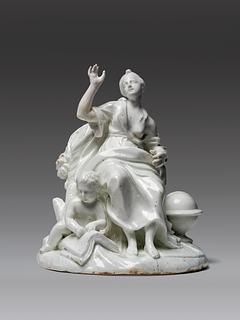
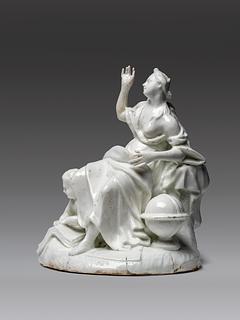
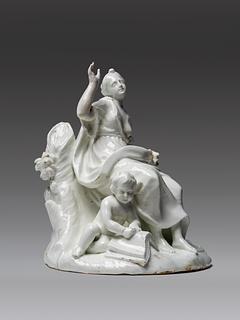
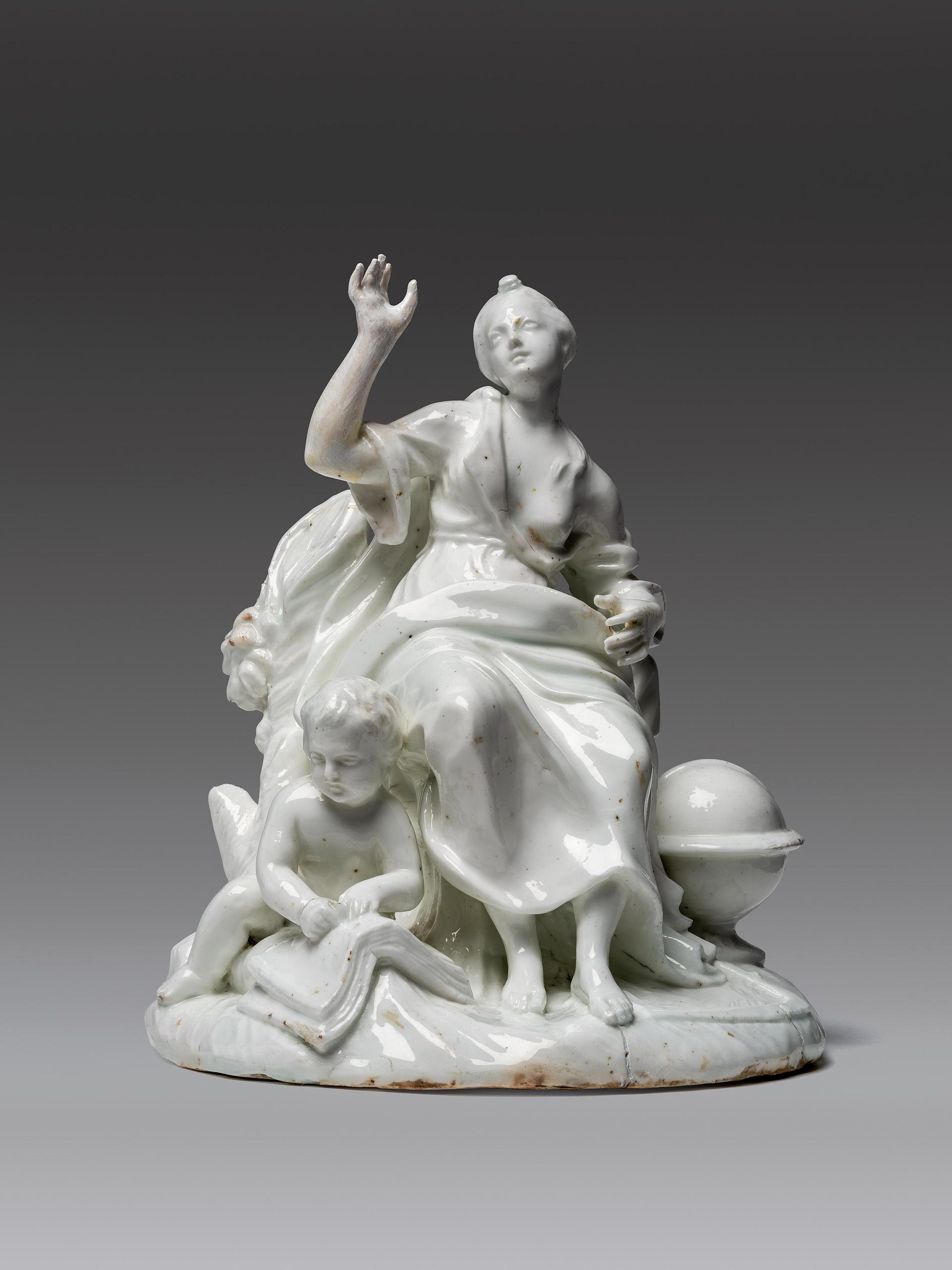
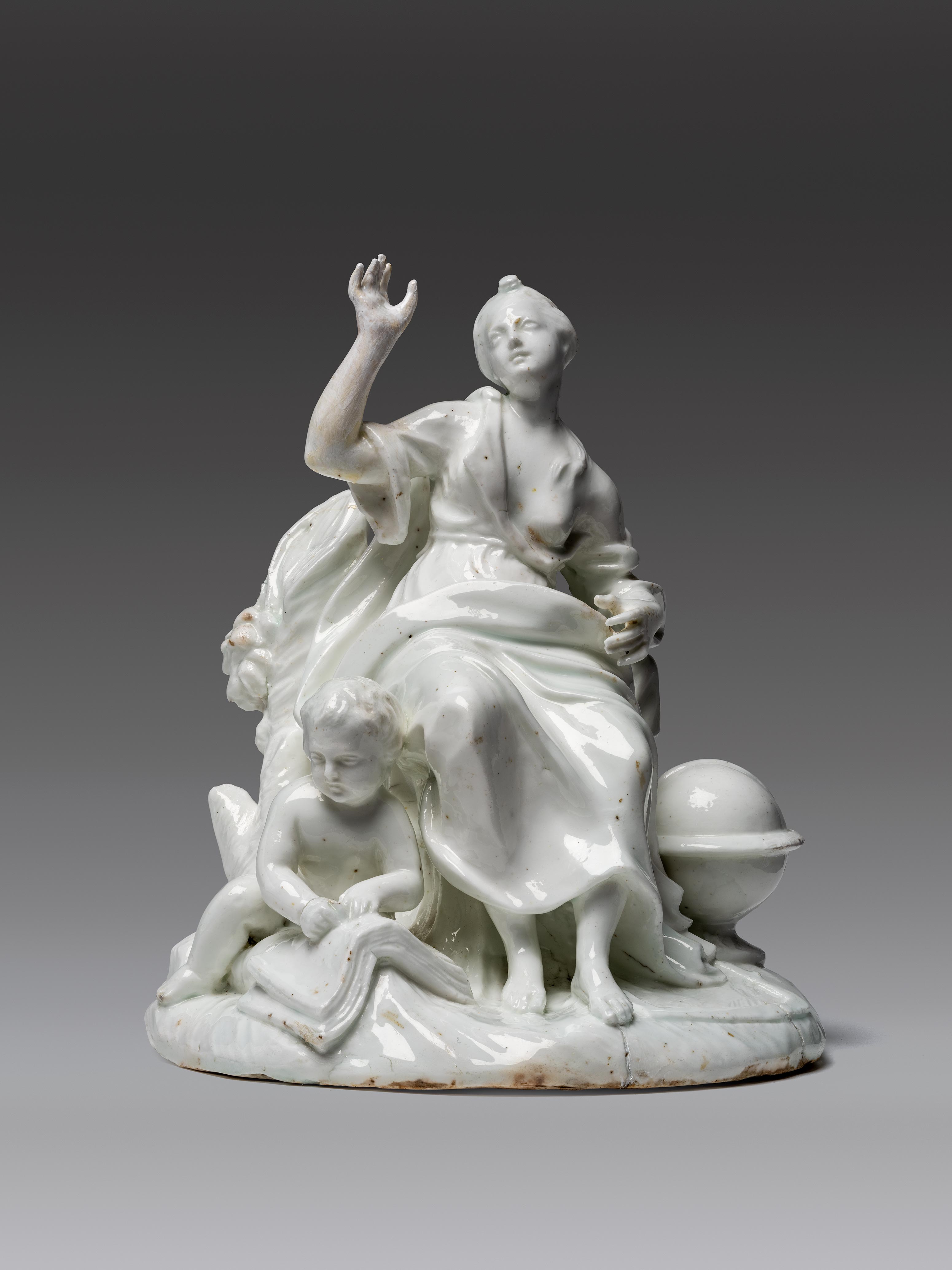
Astronomy (L’Astronomie), soft-paste porcelain
Vincennes, c. 1748
In the early years of the Vincennes manufactory, the production of figures was very limited, and the early models were typically glazed and left unpainted. Only after the move to larger production facilities at Sèvres in 1756 did the manufacture of figures and figure groups intensify. By this point, the production was predominantly in unglazed porcelain – so-called biscuit porcelain (52/1974).
This early figure group in soft-paste, glazed porcelain depicts an allegorical female figure with a child at her feet. The child is reading from a book, while the woman raises her hand and eyes towards the heavens. Beside her stands a celestial globe, which in eighteenth-century art served as a symbol of astronomical knowledge. The globe, the book, and the child are classic attributes of Urania, the Muse of Astronomy. An accompanying child – often depicted as a putto – frequently appears in this type of allegory as an assistant or companion. The entire figure group is a fine example of a type of subject popular at the manufactories of Vincennes and, later, Sèvres, where the scientific disciplines of the age were represented through allegories and personifications.
Several figures with the same allegorical theme are known from the manufactory.2
Publiceret i
Publiceret i
Svend Eriksen: Davids samling. Fransk porcelæn = The David Collection. French Porcelain, Copenhagen 1980, cat. 18a, ill. rear flyleaf;
Tamara Préaud (ed.): Porcelaines de Vincennes. Les origins de Sèvres. Grand Palais, Paris 1977, cat. 452;
Fodnoter
Fodnoter
The history of the Vincennes manufactory has been described by many scholars, including Svend Eriksen and Geoffrey de Bellaigue, who in their book emphasise that the precise circumstances surrounding the earliest attempts at porcelain production at Vincennes remain unclear and will probably never be fully established. However, the authors do point out that the main impetus came from the Dubois brothers, who had previously worked at the porcelain manufactory at Chantilly. See Svend Eriksen and Geoffrey de Bellaigue: Sèvres Porcelain. Vincennes and Sèvres 1740–1800, London 1987, pp. 25–39.
Several types of figure groups symbolising Astronomy are known. Svend Eriksen refers, among others, to an earlier figure group in the porcelain collection at the Zwinger in Dresden (Svend Eriksen: Davids Samling. Fransk porcelæn, Copenhagen 1980, p. 35). The British Museum also has a related version of the figure group found in The David Collection, although it differs in having a flowering tree behind the female figure (inv. no. 1938,0217.1.CR).