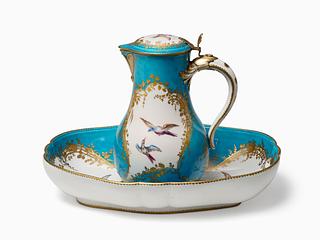
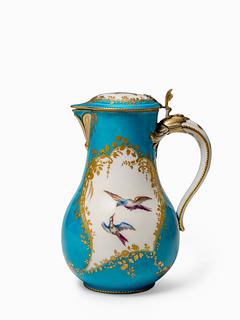
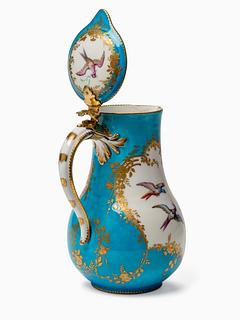
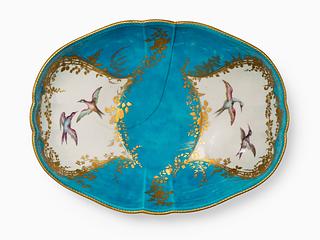
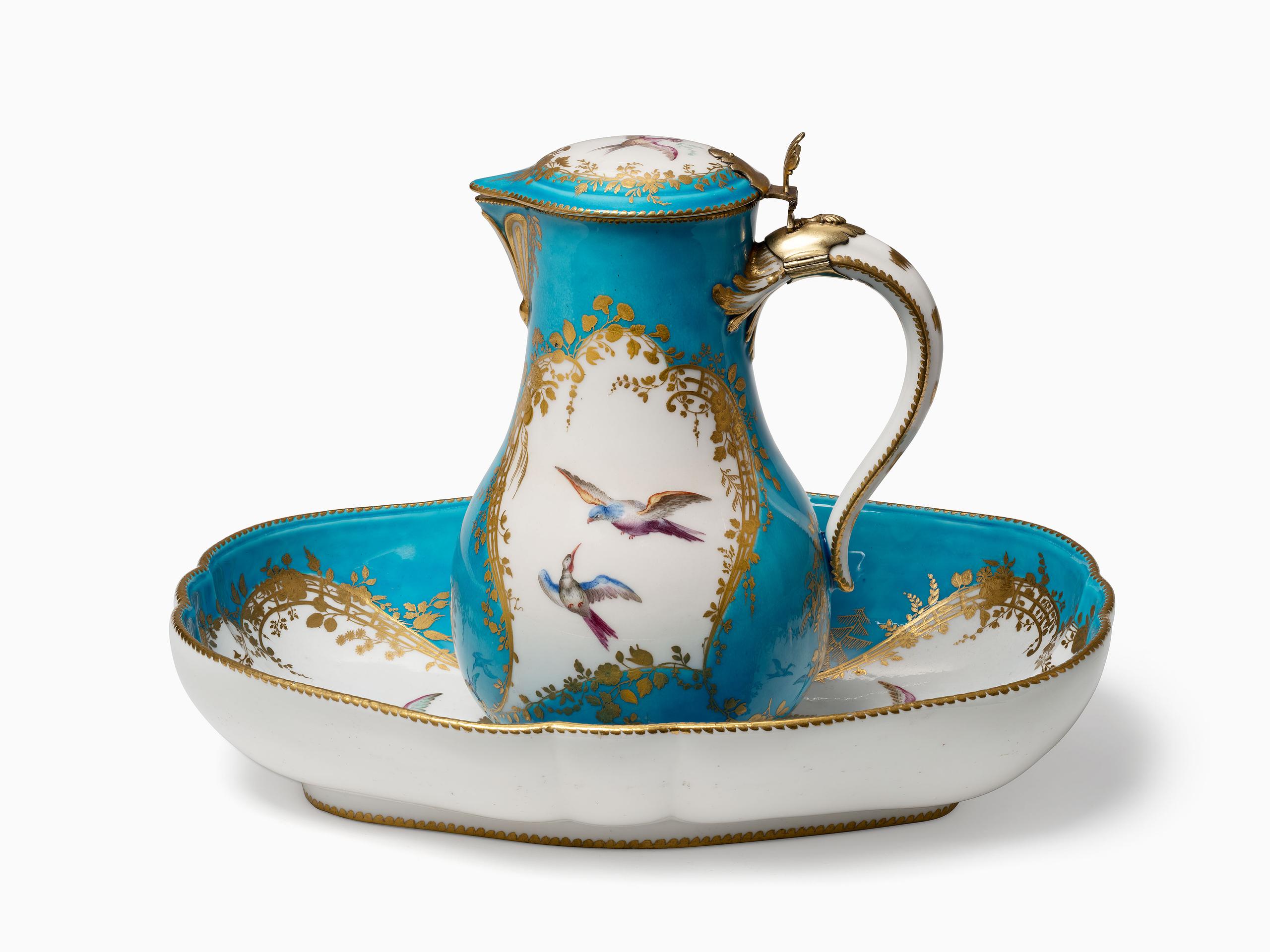
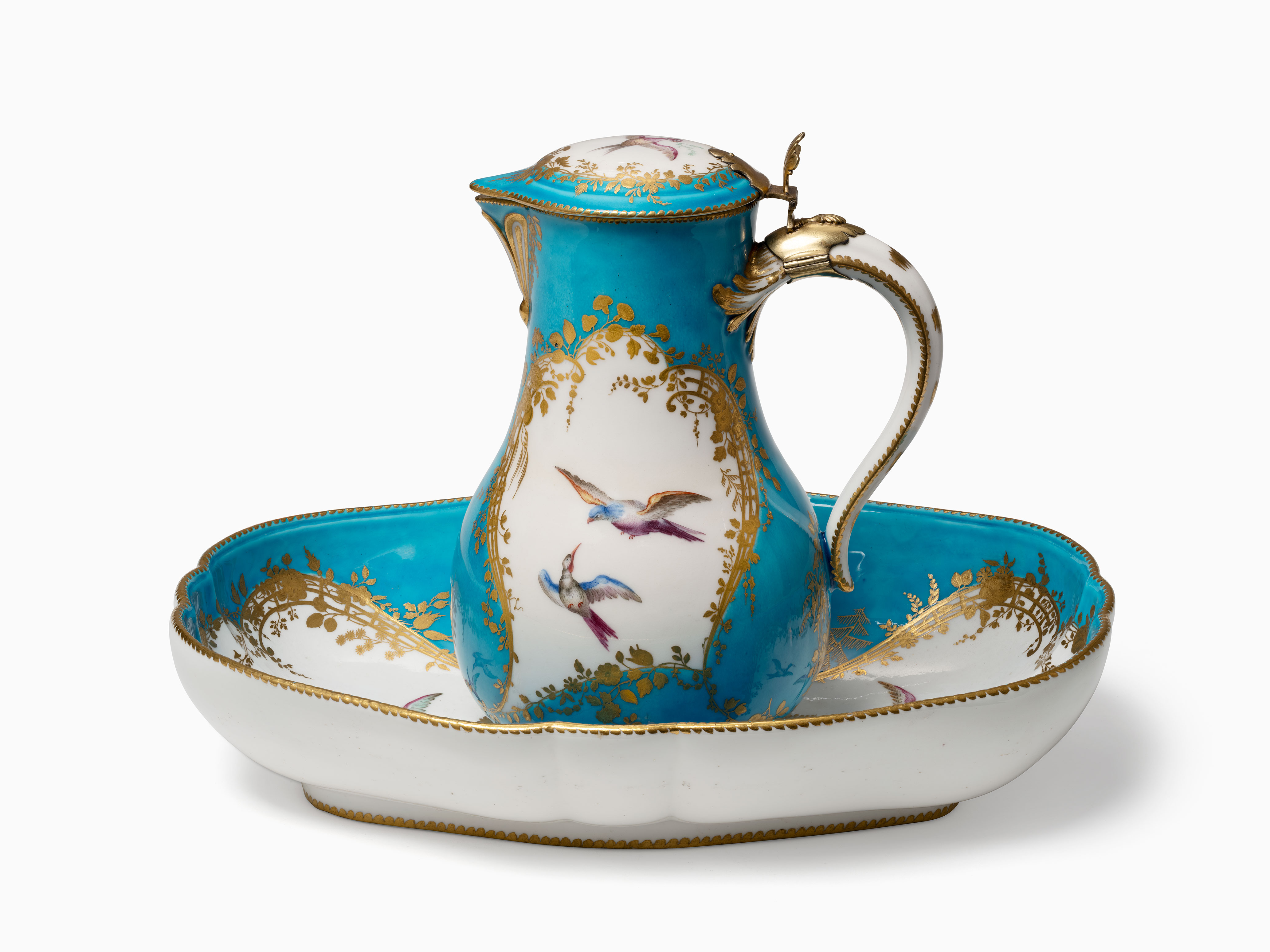
Ewer and basin; soft-paste porcelain with silver mounts
Vincennes, c. 1753–1754
The Vincennes manufactory began producing matching ewers and basins in the early 1750s, competing fiercely with Chinese and Japanese porcelain, Meissen and other French manufactories. This pear-shaped ewer (known as a pot à l’eau tourné) and its matching oval basin (jatte ovale de pot à l’eau) were made of soft-paste porcelain at Vincennes around 1753–54.2 Both have a turquoise ground known as bleu céleste, with white reserves painted with colourful birds in flight. Gilding accentuates the rims and the pronounced relief decoration on both the ewer and basin.
Bleu céleste is a distinctive and costly ground colour, initially known as bleu ancien. It is characterised by its subtly opalescent, velvety surface. Developed by Jean Hellot (1685–1766), chief chemist at the Sèvres manufactory, it was introduced for the extensive dinner and dessert service commissioned by Louis XV of France in 1753. Thereafter, bleu céleste was regarded as one of the manufactory’s most luxurious and prestigious ground colours, being both expensive to produce and technically demanding to use. Its exclusivity meant that it was reserved for commissions from the French court, the aristocracy and a select number of other European royal and princely houses.3
Publiceret i
Publiceret i
Svend Eriksen: Davids samling. Fransk porcelæn = The David Collection. French Porcelain, Copenhagen 1980, p. 24, cat. 40, ill. rear flyleaf;
Fodnoter
Fodnoter
Rosalind Savill surveys the many types of toilet wares and their owners, noting that, besides ewers and basins, these included shaving and washing basins, chamber pots, eye baths, spectacle trays and various containers for perfume and cosmetics. See Rosalind Savill: The Wallace Collection. Catalogue of Sèvres Porcelain, pp. 691–692.
These forms originated at the Vincennes manufactory: the ewer was developed in 1752 and the basin in 1753. See Rosalind Savill: The Wallace Collection. Catalogue of Sèvres Porcelain, pp. 692–695. The ewer was produced in four sizes; the example in the David Collection is of the first and largest size.
Svend Eriksen and Geoffrey de Bellaigue: Sèvres porcelain. Vincennes and Sèvres 1740–1800, London 1987, pp. 48–54.