Svend Hammershøi (1873–1948)
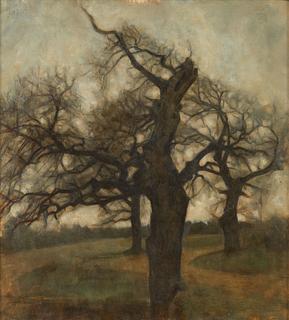
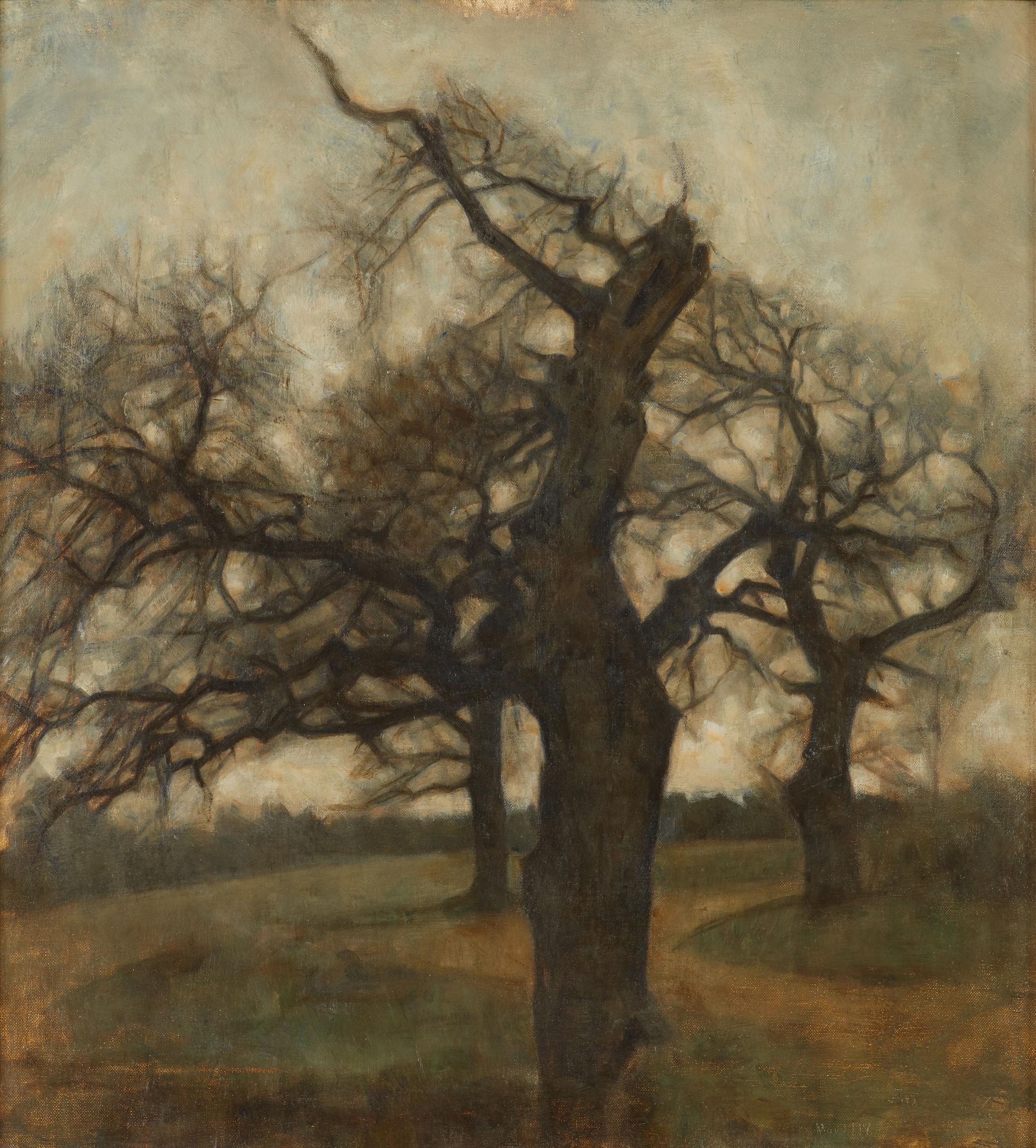
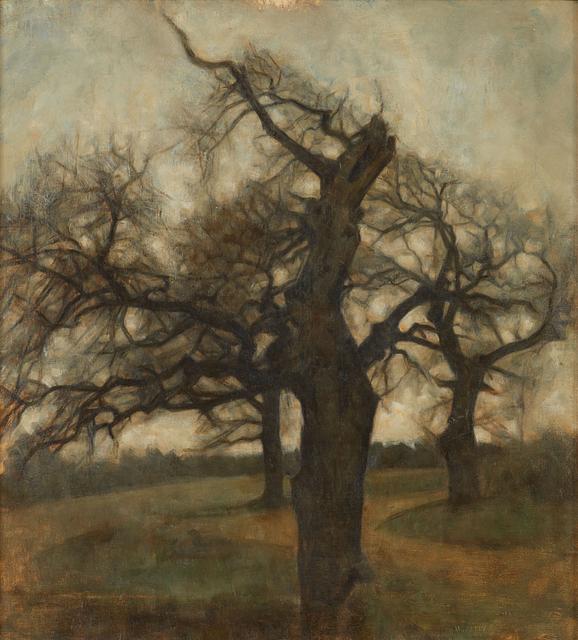
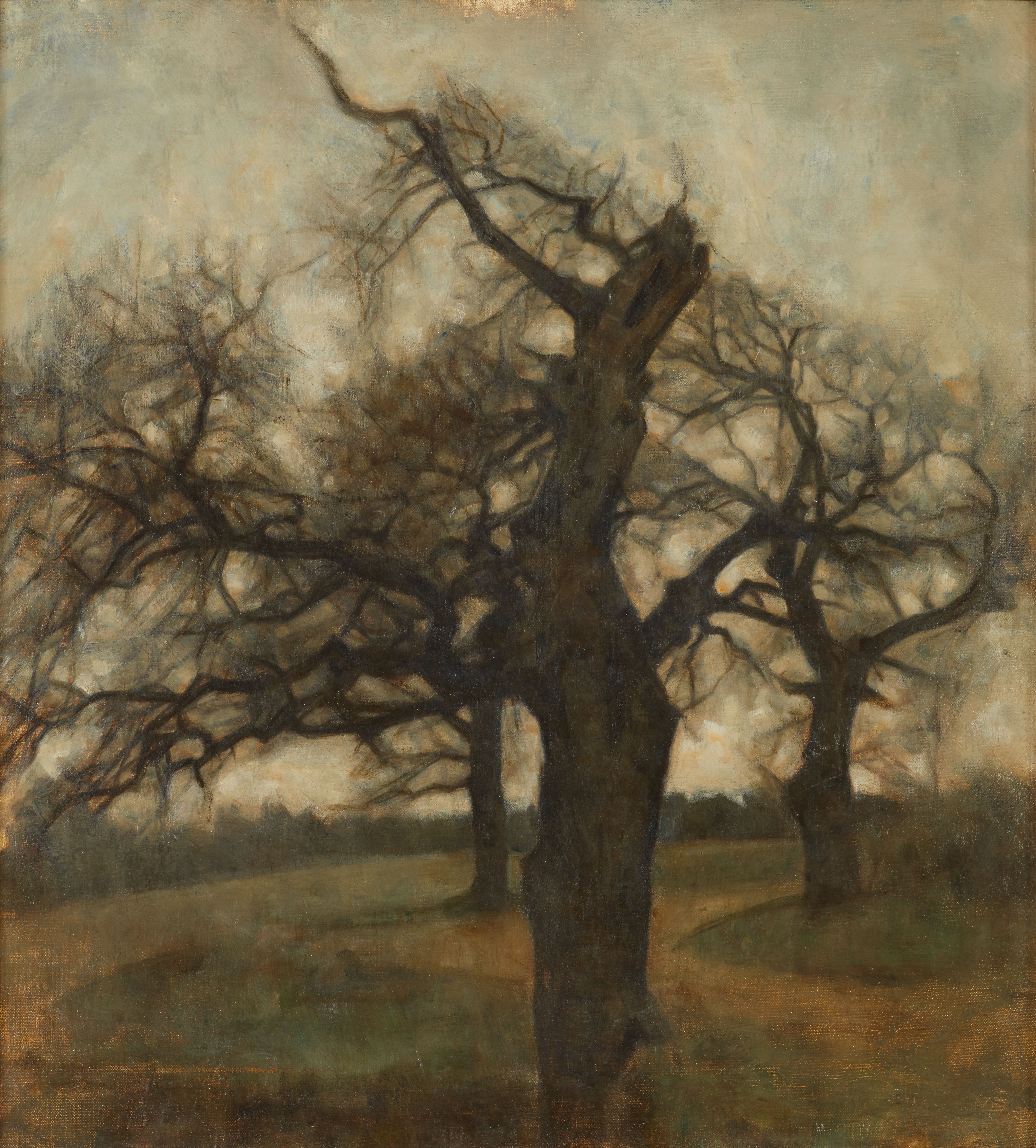
Oak Trees near Vordingborg, 1917
Oil on canvas
70 x 64 cm
Inventarnummer B 304
In Oak Trees near Vordingborg, three oak trees form dark silhouettes against a grey, hazy sky. One tree, pulled into the very foreground, blocks our view of the landscape behind where a road winds through the scene. The exact geographical location, in this case in the vicinity of Vordingborg, is immaterial. The true subject of the picture is the dark and sombre atmosphere evoked here. An atmosphere further accentuated by the crooked, leafless branches of the trees forming a dense pattern against the sky.
In Danish art created around the turn of the century, several artists, including Svend Hammershøi, applied a metaphysical atmosphere to the landscapes, and it was not unusual to include trees as a main theme, focal point or significant element.1 Hence, it is no surprise that trees became a recurring motif in Svend Hammershøi’s paintings. He often let one or more trees fill the entire composition or assigned them a dominant role in landscapes bearing no trace of human activity. Like his brother, Vilhelm Hammershøi (1864-1916), nine years his senior, Svend Hammershøi employed a subtle, subdued colour palette, carefully coordinated in dark, green and golden hues.
In contrast to Vilhelm, Svend Hammershøi was strongly interested in design and applied art throughout his life, and he had a particular fondness for ceramics and silver. Here, too, one senses a fascination with nature, for example in the foliar ornamentation that often adorns the many silver pieces created by Svend Hammershøi in collaboration with the goldsmith Holger Kyster (1872-1944) in the years 1906 to 1929. The artist’s ceramics also testify to an obvious interest in organic ornamentation, both the early works, where Svend Hammershøi was inspired by his friend and teacher Thorvald Bindesbøll (1846–1908), and the later efforts created in Kähler’s workshop in Næstved from 1893 to 1948.
In Danish art created around the turn of the century, several artists, including Svend Hammershøi, applied a metaphysical atmosphere to the landscapes, and it was not unusual to include trees as a main theme, focal point or significant element.1 Hence, it is no surprise that trees became a recurring motif in Svend Hammershøi’s paintings. He often let one or more trees fill the entire composition or assigned them a dominant role in landscapes bearing no trace of human activity. Like his brother, Vilhelm Hammershøi (1864-1916), nine years his senior, Svend Hammershøi employed a subtle, subdued colour palette, carefully coordinated in dark, green and golden hues.
In contrast to Vilhelm, Svend Hammershøi was strongly interested in design and applied art throughout his life, and he had a particular fondness for ceramics and silver. Here, too, one senses a fascination with nature, for example in the foliar ornamentation that often adorns the many silver pieces created by Svend Hammershøi in collaboration with the goldsmith Holger Kyster (1872-1944) in the years 1906 to 1929. The artist’s ceramics also testify to an obvious interest in organic ornamentation, both the early works, where Svend Hammershøi was inspired by his friend and teacher Thorvald Bindesbøll (1846–1908), and the later efforts created in Kähler’s workshop in Næstved from 1893 to 1948.
Publiceret i
Publiceret i
Arbejder af Svend Hammershøi fra tidsrummet 1914-25, Kunstforeningen 7.-26. februar 1926, København 1926, cat.no. 17;
Tove Jørgensen: Svend Hammershøi 1873-1948: maler og formgiver, Museet på Koldinghus, Kolding 1990, fig. 22, p. 33;
Iben Overgaard, Anne-Mette Villumsen and Sidsel Maria Søndergaard (eds.): Svend Hammershøi – en kunstner og hans tid, Skovgaard Museet, Viborg 2008, p. 121;
Tove Jørgensen: Svend Hammershøi 1873-1948: maler og formgiver, Museet på Koldinghus, Kolding 1990, fig. 22, p. 33;
Iben Overgaard, Anne-Mette Villumsen and Sidsel Maria Søndergaard (eds.): Svend Hammershøi – en kunstner og hans tid, Skovgaard Museet, Viborg 2008, p. 121;
Fodnoter
Fodnoter
1.
Peter Nørgaard Larsen et al.: Symbolism in Danish and European Painting 1870–1910, Statens Museum for Kunst, Copenhagen 2000, p. 85.