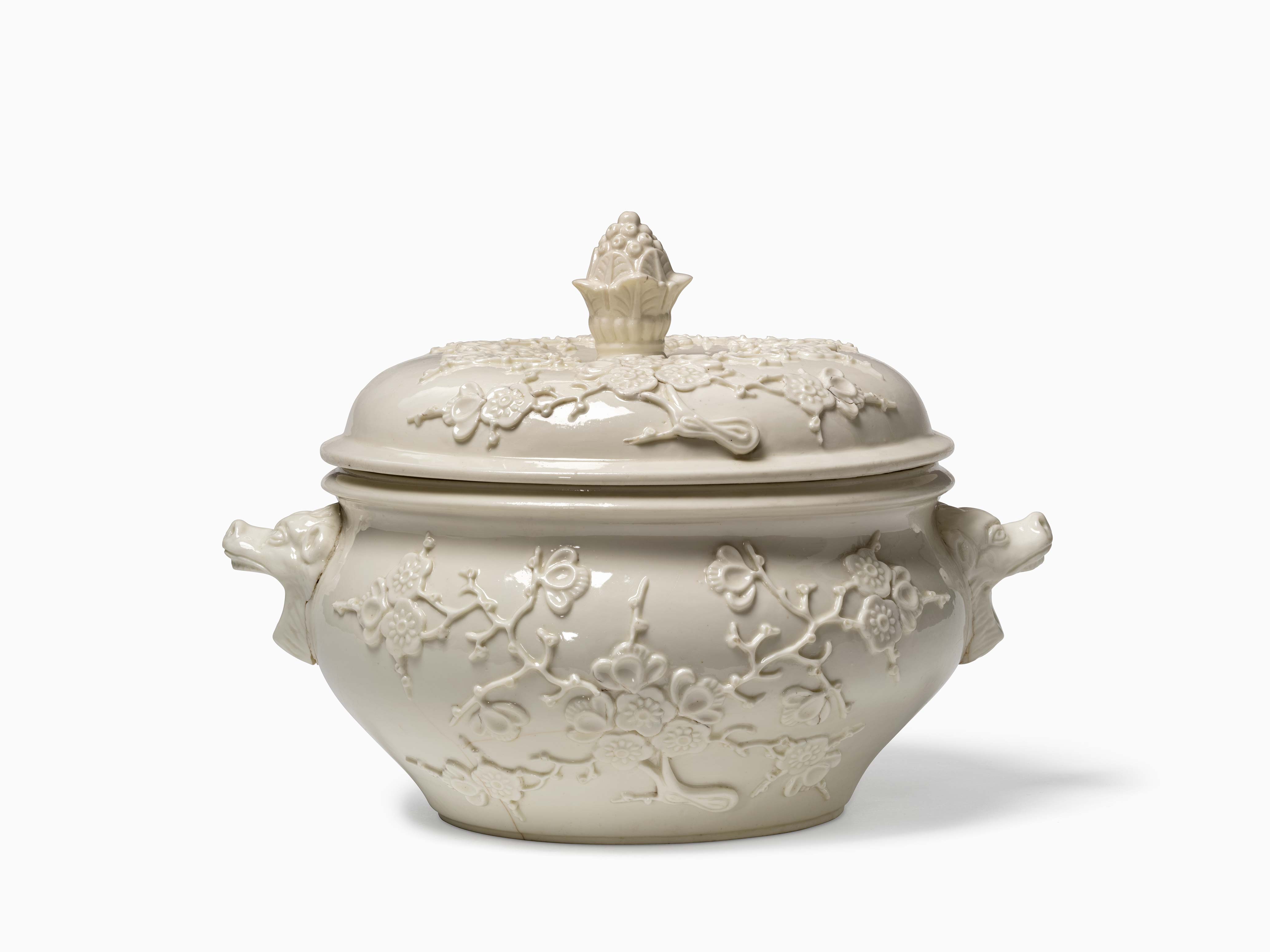
Tureen; soft-paste porcelain
Saint-Cloud Manufactory, c. 1730–40
In the production of white porcelain, the Saint-Cloud Manufactory enjoyed a particular advantage: its soft-paste formulation had a creamy, slightly ivory-coloured tone reminiscent of the renowned and highly prized blanc de Chine porcelain made at Dehua in Fujian province, southern China. During the Ming dynasty (1368–1644), Dehua produced exclusively white porcelain covered in a clear glaze, and at Saint-Cloud attempts were made to emulate these wares. The result was highly successful: white porcelain became not only a major triumph for the Saint-Cloud Manufactory in France, but also an inspiration to other porcelain factories across Europe. For a wealthy clientele, the appeal lay precisely in the absence of colour, which allowed the form, quality and beauty of the porcelain to be fully appreciated.
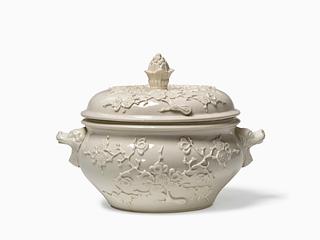
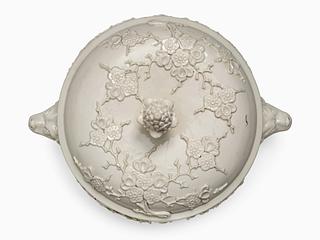
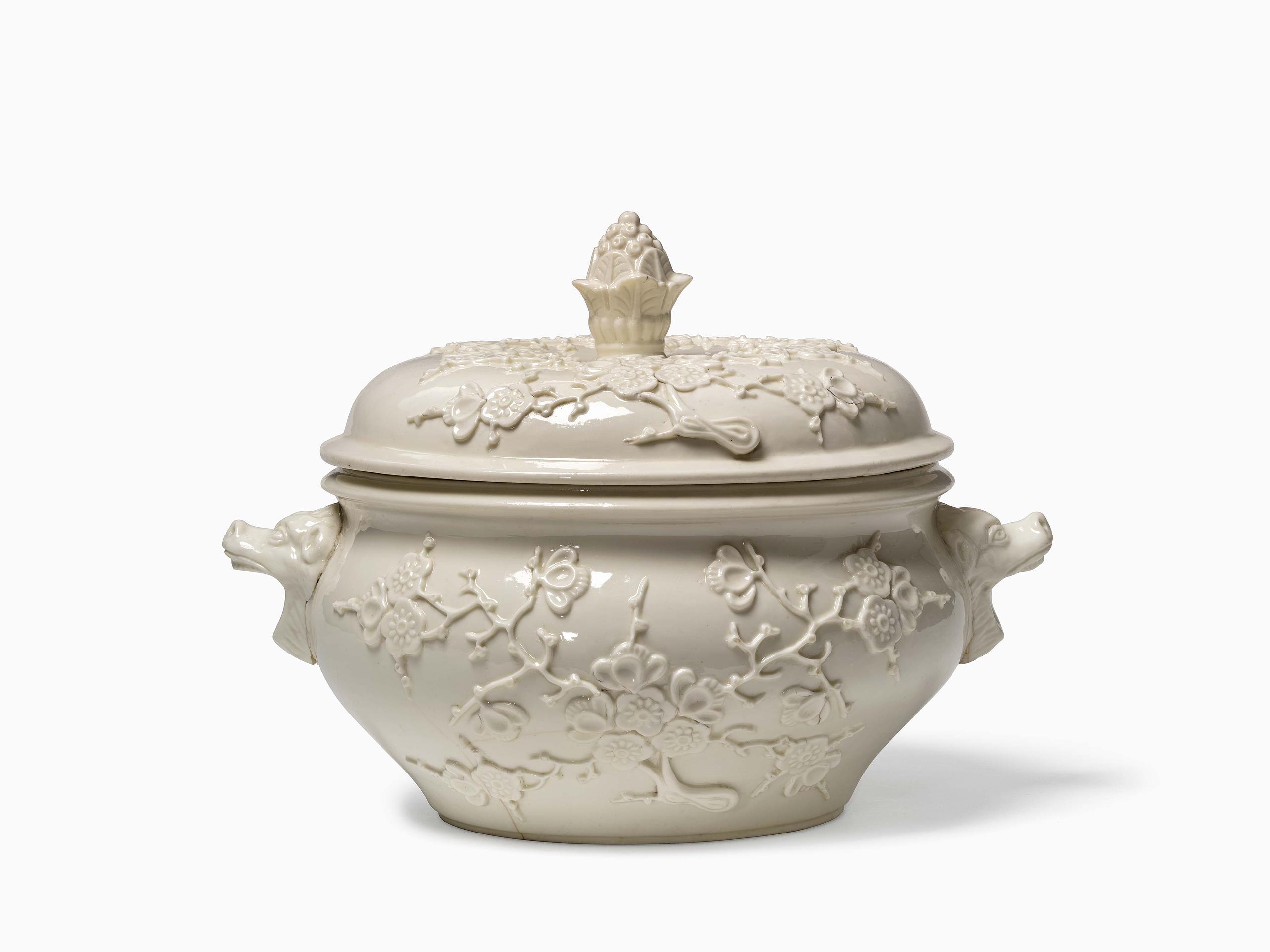
This round lidded tureen is a fine example of Saint-Cloud white porcelain. It is distinguished both by its impressive size and by its relief decoration of flowering plum-branches, a motif inspired by Chinese blanc de Chine porcelain. The design quickly became one of the factory’s most popular, closely following its Chinese prototypes while introducing variations in the size and shape of the flowers and in the quality of the formulation used.2
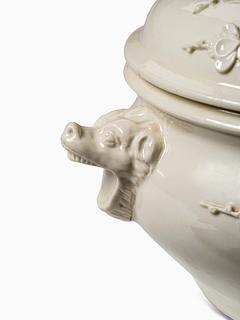
One further feature makes the tureen in The David Collection especially noteworthy: its two handles are freely modelled as animal heads with gaping maws, a motif seldom encountered on pieces from the Saint-Cloud Manufactory.3
Like so many objects made at the Saint-Cloud Manufactory, the tureen is unmarked. It is thought to have been made c. 1730–40.
Publiceret i
Publiceret i
C.L. David: ”Fransk blødt porcelæn,” in C.L. Davids Samling, vol. 2, Copenhagen 1953, pp. 73, 78-79;
C.L. David: C.L. Davids Samling, Copenhagen 1960, p. 74 (mentioned);
Svend Eriksen: Davids samling. Fransk porcelæn = The David Collection. French porcelain, Copenhagen 1980, cat. 3, p. 31 (ill., back endleaf);
Bertrand Rondot (ed.): Discovering the Secrets of Soft-Paste Porcelain at The Saint-Cloud Manufactory ca. 1609-1766, New York 1999, p. 272;
Fodnoter
Fodnoter
The first appearance of white porcelain at the Saint-Cloud Manufactory is difficult to date, but production presumably began in the early eighteenth century. See Bertrand Rondot (ed.): Discovering the Secrets of Soft-Paste Porcelain at the Saint-Cloud Manufactory ca. 1609–1766, New Haven 1999, p. 270.
The flowering plum-branch pattern was copied by most European porcelain factories, including Villeroy and Vincennes. Nevertheless, the design varied from one factory to another, which in many cases makes identifying the manufacturer relatively easy. See, for example, Bertrand Rondot (ed.): Discovering the Secrets of Soft-Paste Porcelain at the Saint-Cloud Manufactory ca. 1609–1766, New Haven 1999, p. 272.
This shape does not normally occur in the output of the Saint-Cloud Manufactory. By contrast, it is well known from the Chantilly factory, where it was used frequently. See Bertrand Rondot (ed.): Discovering the Secrets of Soft-Paste Porcelain at The Saint-Cloud Manufactory ca. 1609–1766, New York 1999, p. 272.