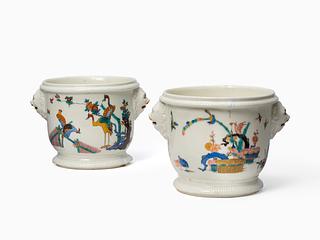
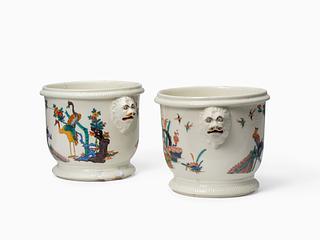
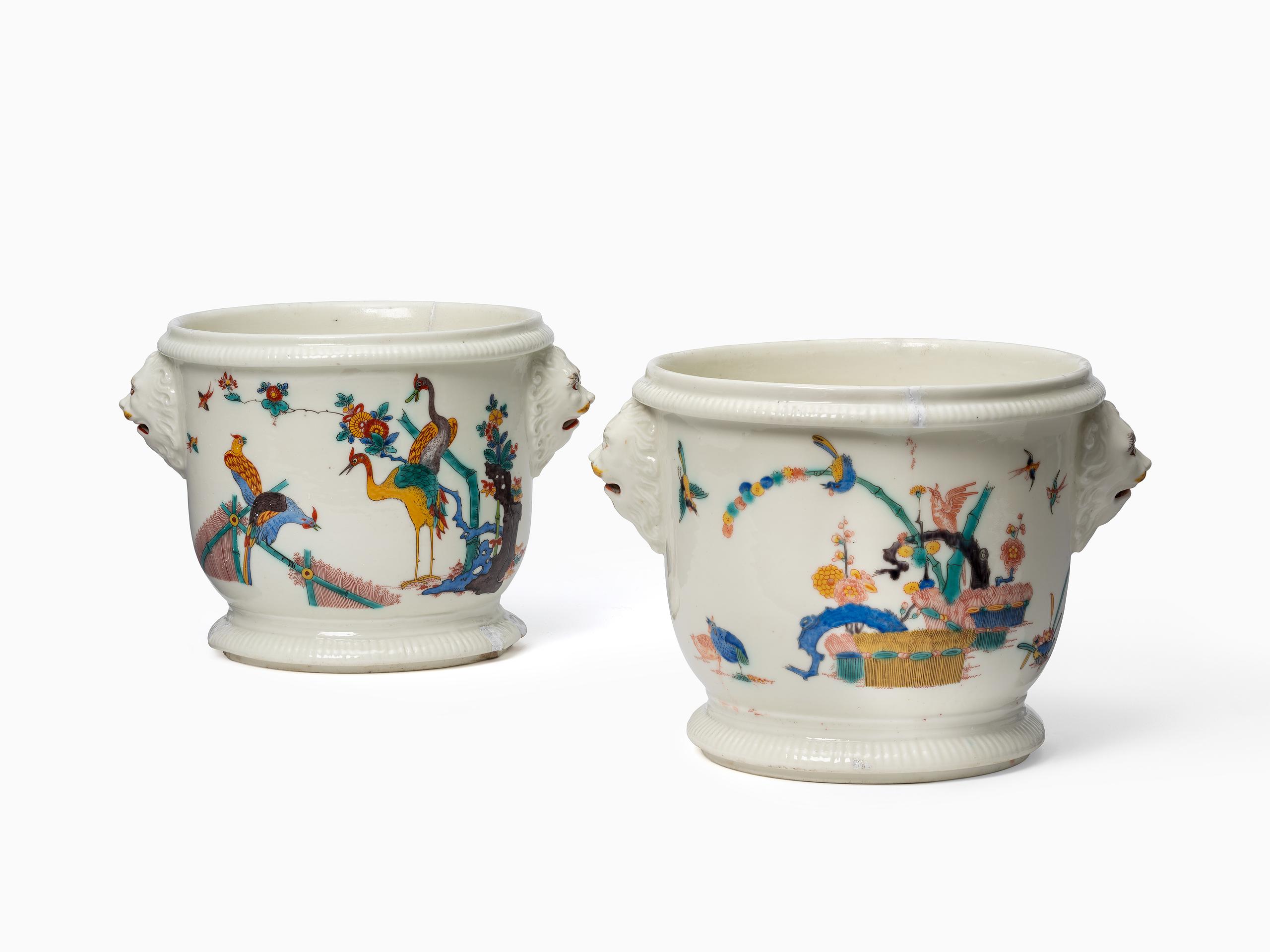
A pair of wine coolers (seaux à bouteille); soft-paste porcelain
Saint-Cloud Manufactory, c. 1735–50
H: 18 cm
Inventory number FK 33a & FK 33b
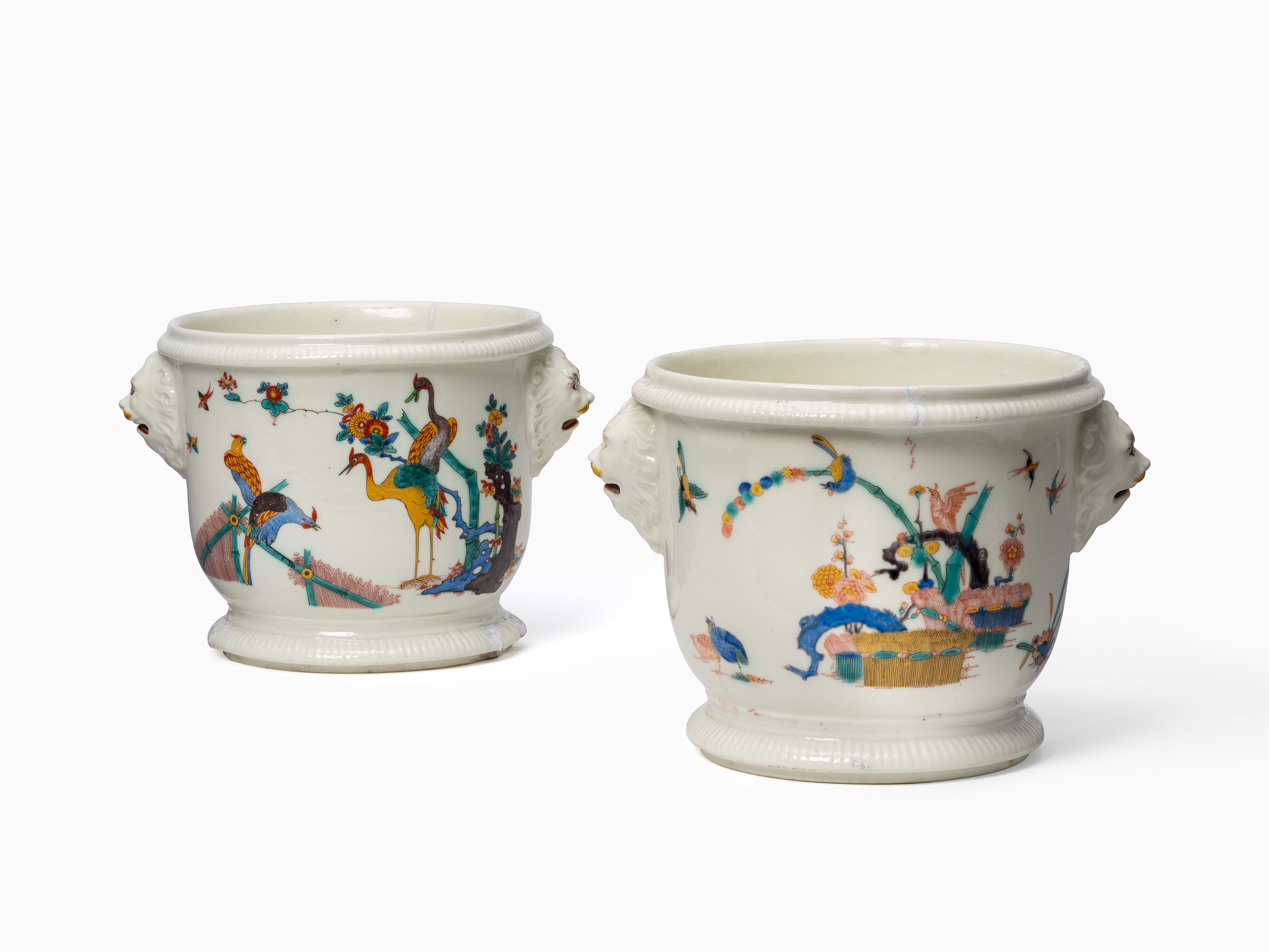
The David Collection holds a fine group of early French porcelain from the Saint-Cloud Manufactory, including these two soft-paste porcelain wine coolers. Their form – comprising a rounded body with profiled foot sections featuring radiating fluting, a corresponding rim above, and a smooth central zone with freely modelled lion-mask handles – is characteristic of the factory’s production. In the eighteenth century, wine coolers of this kind were used at formal dinners among the upper ranks of society, where wine bottles were chilled in crushed ice or iced water1
The most striking feature of the two wine coolers is their decoration, inspired by the Japanese porcelain that was fashionable in Europe in the early eighteenth century and much admired at the Saint-Cloud Manufactory.2 Both pieces are decorated on the sides with designs in the Kakiemon style: various birds set within naturalistic scenes of branches, flowers, sheaves of grain and a distinctive bamboo fence motif. The latter was a characteristic decorative element used at Saint-Cloud as well as at several other European porcelain factories, among them Meissen in Germany.3
The decoration is executed in transparent polychrome enamel colours, which at the time were difficult to fire successfully on soft-paste porcelain. The overglaze technique required lower temperatures and several firings, making the process technically demanding and costly. For this reason, objects with polychrome decoration were produced in far smaller numbers than those decorated in blue and white.
Exactly how many wine coolers were made at the Saint-Cloud Manufactory remains unknown, but the considerable variation in both form and decoration points to substantial demand. It is equally unclear how many pieces a typical ‘set’ comprised. It is, however, very likely that wine coolers such as these in The David Collection were made as pairs.
The two wine coolers are unmarked but are thought to date from c. 1735–50.
The most striking feature of the two wine coolers is their decoration, inspired by the Japanese porcelain that was fashionable in Europe in the early eighteenth century and much admired at the Saint-Cloud Manufactory.2 Both pieces are decorated on the sides with designs in the Kakiemon style: various birds set within naturalistic scenes of branches, flowers, sheaves of grain and a distinctive bamboo fence motif. The latter was a characteristic decorative element used at Saint-Cloud as well as at several other European porcelain factories, among them Meissen in Germany.3
The decoration is executed in transparent polychrome enamel colours, which at the time were difficult to fire successfully on soft-paste porcelain. The overglaze technique required lower temperatures and several firings, making the process technically demanding and costly. For this reason, objects with polychrome decoration were produced in far smaller numbers than those decorated in blue and white.
Exactly how many wine coolers were made at the Saint-Cloud Manufactory remains unknown, but the considerable variation in both form and decoration points to substantial demand. It is equally unclear how many pieces a typical ‘set’ comprised. It is, however, very likely that wine coolers such as these in The David Collection were made as pairs.
The two wine coolers are unmarked but are thought to date from c. 1735–50.
Published in
Published in
C.L. David: C.L. Davids Samling, Copenhagen 1960, p. 74 (mentioned);
C.L. David: “Fransk blødt porcelæn,” in C.L. Davids Samling, Second part, Copenhagen 1953, pp. 73, 82-83;
Erik Lassen: Keramik. En gennemgang af keramikkens historie i Europa fra middelalderen til vor tid, Copenhagen 1969, p. 132 and fig. 58, p. 133;
Svend Eriksen: Davids samling. Fransk porcelæn = The David Collection. French Porcelain, Copenhagen 1980, cat. 7, (ill., back endleaf);
Footnotes
Footnotes
1.
Bertrand Rondot (ed.): Discovering the Secrets of Soft-Paste Porcelain at The Saint-Cloud Manufactory ca. 1609–1766, New Haven 1999, p. 283.
2.
Japanese porcelain was a common source of inspiration for decoration at European porcelain factories. For that very reason, porcelain later played a central role in the nineteenth-century fascination with all things Japanese (cf. Japonism). See Bertrand Rondot (ed.): Discovering the Secrets of Soft-Paste Porcelain at The Saint-Cloud Manufactory ca. 1609–1766, New Haven 1999, p. 283.
3.
Wine coolers in a range of sizes (for standard wine bottles as well as half-sized liqueur bottles) were produced at many porcelain and faience factories across Europe. See Elizabeth Williams (ed.): Daily Pleasures. French Ceramics from the MaryLou Boone Collection, Los Angeles County Museum of Art, Los Angeles 2012, p. 43.