Jan Asselijn (c. 1610–1652)
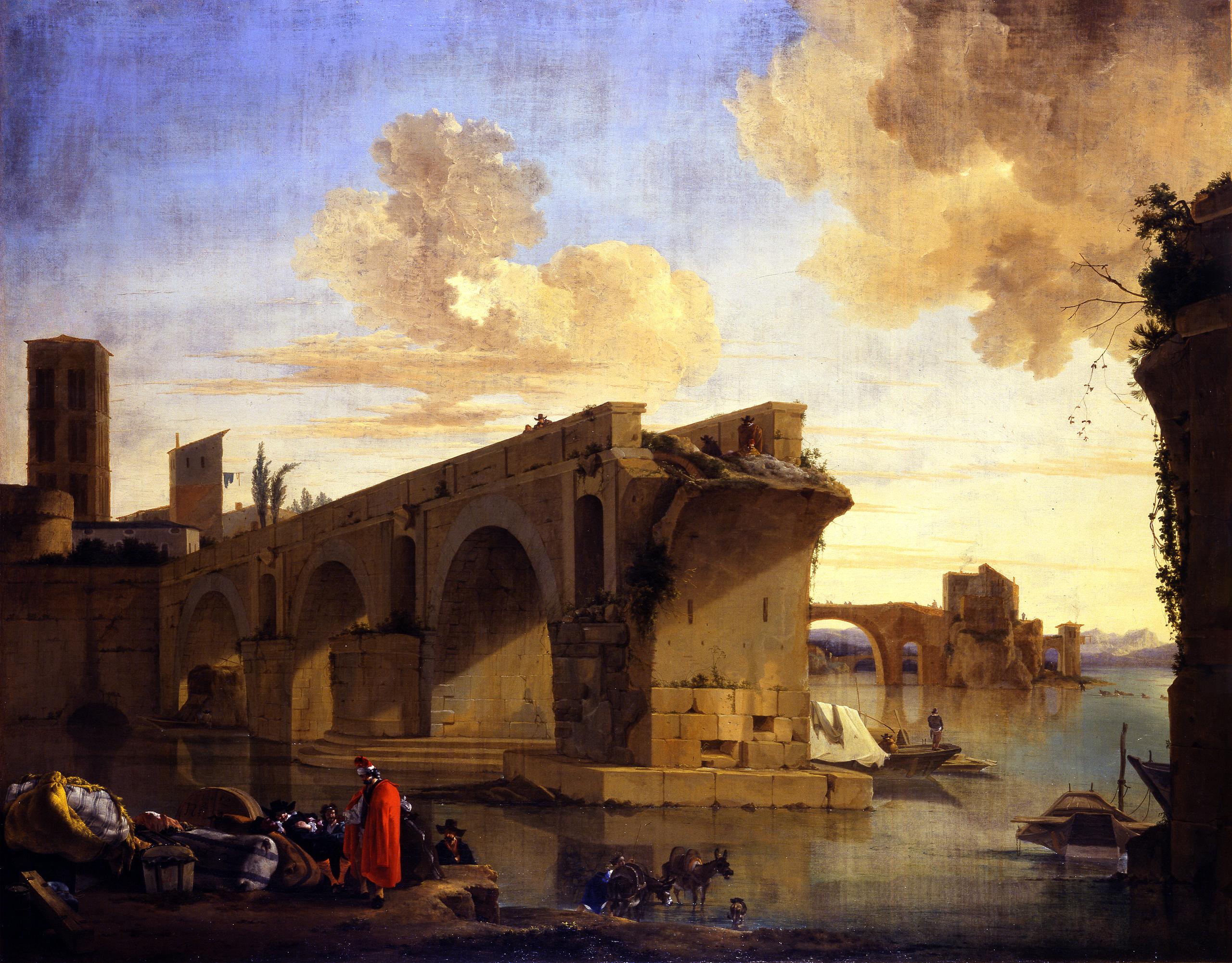
View of the Ponte Rotto, 1650
Oil on canvas
134.5 × 169.5 cm
Inventory number B 272
Jan Asselijn was a prominent Dutch painter who became particularly known for his landscape paintings in which merchants, peasants and animals are often depicted in landscapes with Roman ruins. The artist drew inspiration from Italy, which he visited early in life, in all likelihood at some point from the mid-1630s to the early 1640s. In Rome, he was a member of the so-called Bentvueghels, a society of mainly Dutch and Flemish painters who lived and worked there during the seventeenth century.
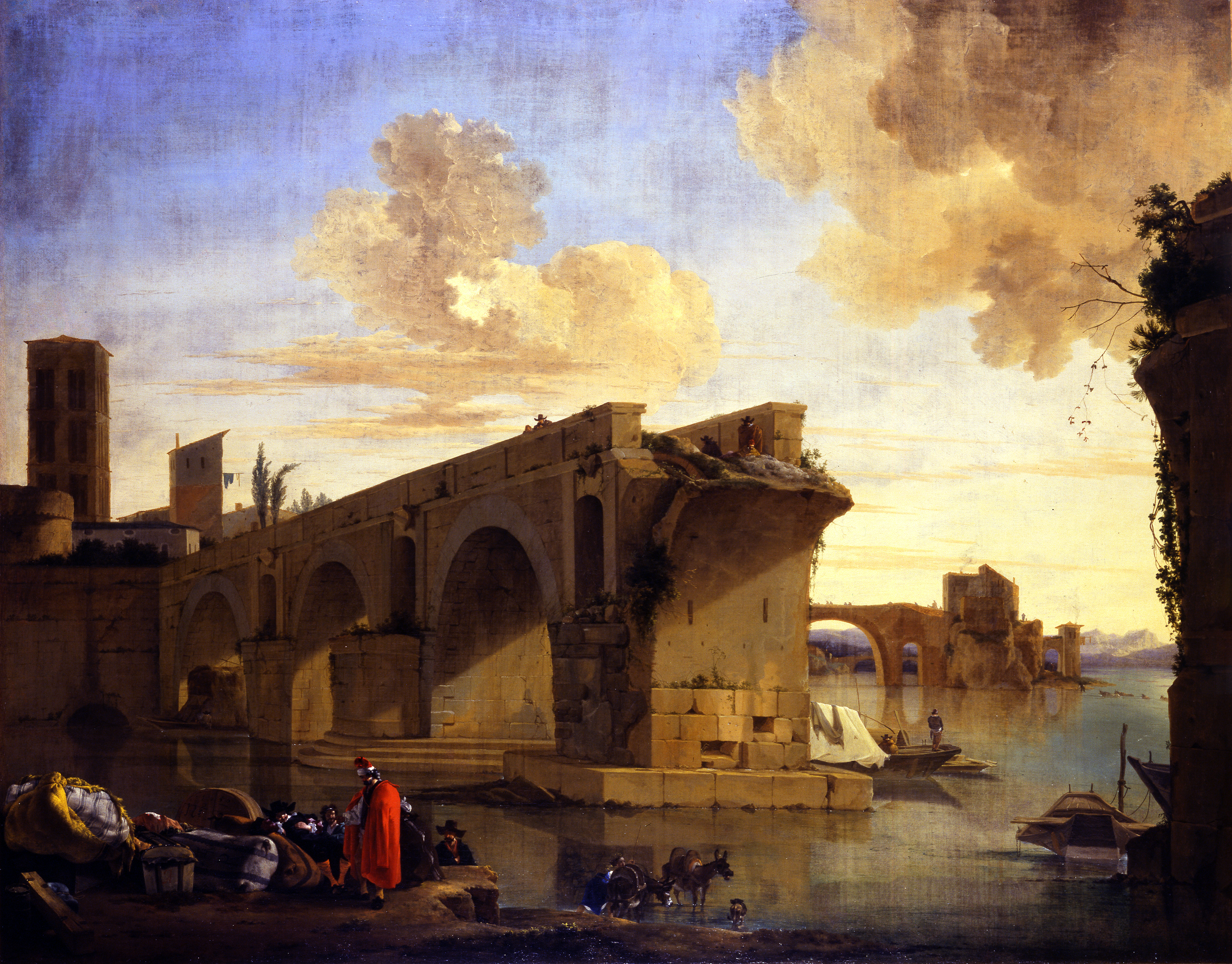
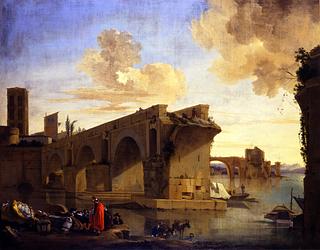
The large painting Ponte Rotto was completed just two years before Asselijn’s untimely death in 1652. The subject originates from Rome and is the ruined bridge Ponte Rotto.1 Extending diagonally into the painting, the monumental structure appears particularly impressive. This effect is achieved by Asselijn’s choice of a low vantage point from the banks of the Tiber River, whose calm, mirror-like surface strikes a dominant note in the painting, emphasised by the gentle light suffusing the scene from a blue sky with light clouds. While Asselijn depicts both the Ponte Rotto and the bridge behind it, Ponte Cestio, with great precision, this is not a topographically accurate representation. He has omitted other architectural elements of the landscape as well as most of the buildings in the Trastevere district on the left bank of the Tiber. Moreover, it was not possible to see mountains on the distant horizon.2
Other elements in the painting also emphasise Asselijn’s use of artistic license.3 For example, he used his imagination to add a lively everyday scene to the river landscape. In the foreground of the painting is a group of traders with their goods, among which a bundle wrapped partly in yellow and partly in striped, blue fabric attracts particular attention. Equally eye-catching is the standing man dressed in a red cloak and red headgear.
C.L. David acquired View of the Ponte Rotto in 1949. The David Collection owns one other work by the artist.
The large painting Ponte Rotto was completed just two years before Asselijn’s untimely death in 1652. The subject originates from Rome and is the ruined bridge Ponte Rotto.1 Extending diagonally into the painting, the monumental structure appears particularly impressive. This effect is achieved by Asselijn’s choice of a low vantage point from the banks of the Tiber River, whose calm, mirror-like surface strikes a dominant note in the painting, emphasised by the gentle light suffusing the scene from a blue sky with light clouds. While Asselijn depicts both the Ponte Rotto and the bridge behind it, Ponte Cestio, with great precision, this is not a topographically accurate representation. He has omitted other architectural elements of the landscape as well as most of the buildings in the Trastevere district on the left bank of the Tiber. Moreover, it was not possible to see mountains on the distant horizon.2
Other elements in the painting also emphasise Asselijn’s use of artistic license.3 For example, he used his imagination to add a lively everyday scene to the river landscape. In the foreground of the painting is a group of traders with their goods, among which a bundle wrapped partly in yellow and partly in striped, blue fabric attracts particular attention. Equally eye-catching is the standing man dressed in a red cloak and red headgear.
C.L. David acquired View of the Ponte Rotto in 1949. The David Collection owns one other work by the artist.
Published in
Published in
Katalog over ældre udenlandske Malerier fra Privateje udstillede i Statens Museum for Kunst, Oktober 1946, København 1946, cat. 3 (title: Afbrudte Broer i en italiensk Flod);
Erik Zahle: ”Malerisamlingens vækst” in C.L. Davids Samling, Tredie del, København 1958, pp. 114-118 and 132-133.;
Denys Sutton: Artists in 17th century Rome: a loan exhibition, 1 June-16 July 1955, 2. rev.ed., London [1966], cat. 4, p. 5-6. (mentioned);
Anne Charlotte Steland-Stief: Jan Asselijn nach 1610 bis 1652, Amsterdam 1971, p. 78, fig. LII and cat. 178, p. 153;
Albert Blankert: Nederlandse 17e eeuwse italianiserende landschapschilders = Dutch 17th century italianate landscape painters, Soest 1978, rev. ed., pp. 6, 26 and fig. 172;
Laurie B. Harwood: Inspired by Italy: Dutch landscape painting 1600-1700, Dulwich Picture Gallery, 2002, cat. 25, pp. 126-127;
Footnotes
Footnotes
1.
The Ponte Rotto (originally Pons Aemilius) is the oldest Roman stone bridge in Rome, likely constructed in the mid-second century BCE. It once spanned the Tiber, connecting the Forum Boarium with Trastevere. The Ponte Rotto has been damaged and rebuilt several times, but after floods in the late sixteenth century, it was decided to discontinue its use as a functioning bridge. A large portion of the bridge was demolished in 1886 to make room for its replacement, the Ponte Palatino. Today, only a single arch of the Ponte Rotto remains.
2.
As has been pointed out by, among others, Anne Charlotte Steland-Stief in the book Jan Asselijn nach 1610 bis 1652, Amsterdam 1971, pp. 78–79.
3.
A more accurate drawing is housed at the Rijksmuseum in Amsterdam; Jan Asselijn: View of the Ponte Rotto in Rome, Seen from the East, c. 1635–c. 1644. Inv.no. RP-T-1991-3.
Dutch and French Paintings