Two reverse glass painted mirrors in rosewood frames
China, c. 1740
83 x 54 cm
Gift from ”Haand i Haand”
Gift from ”Haand i Haand”
Inventory number 19a/1970 & 19b/1970
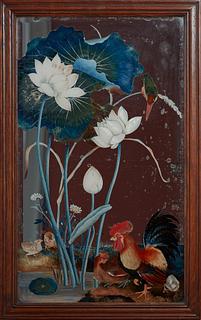
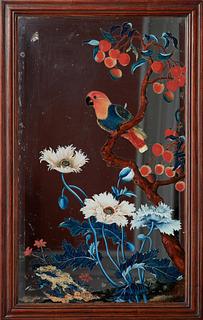
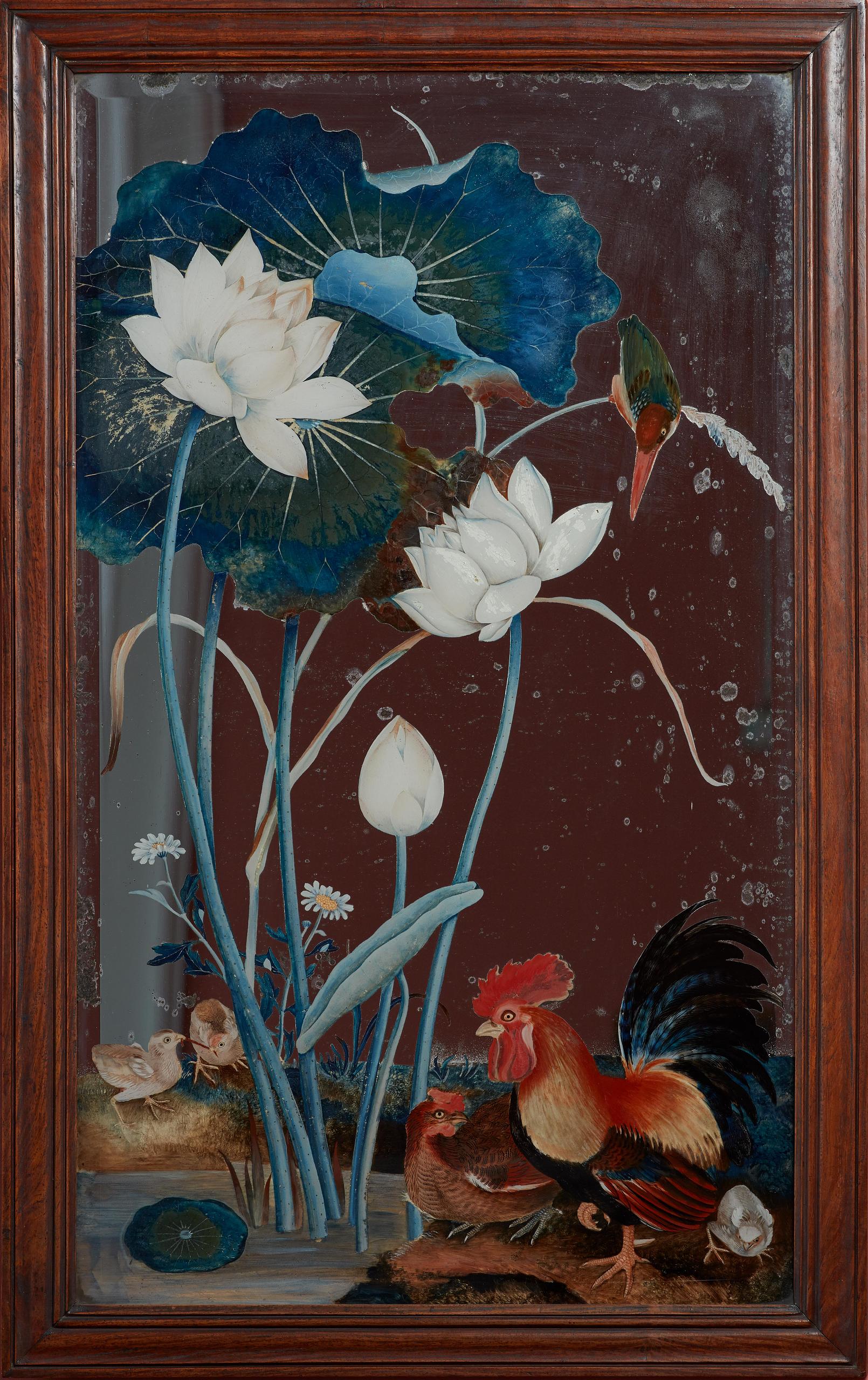
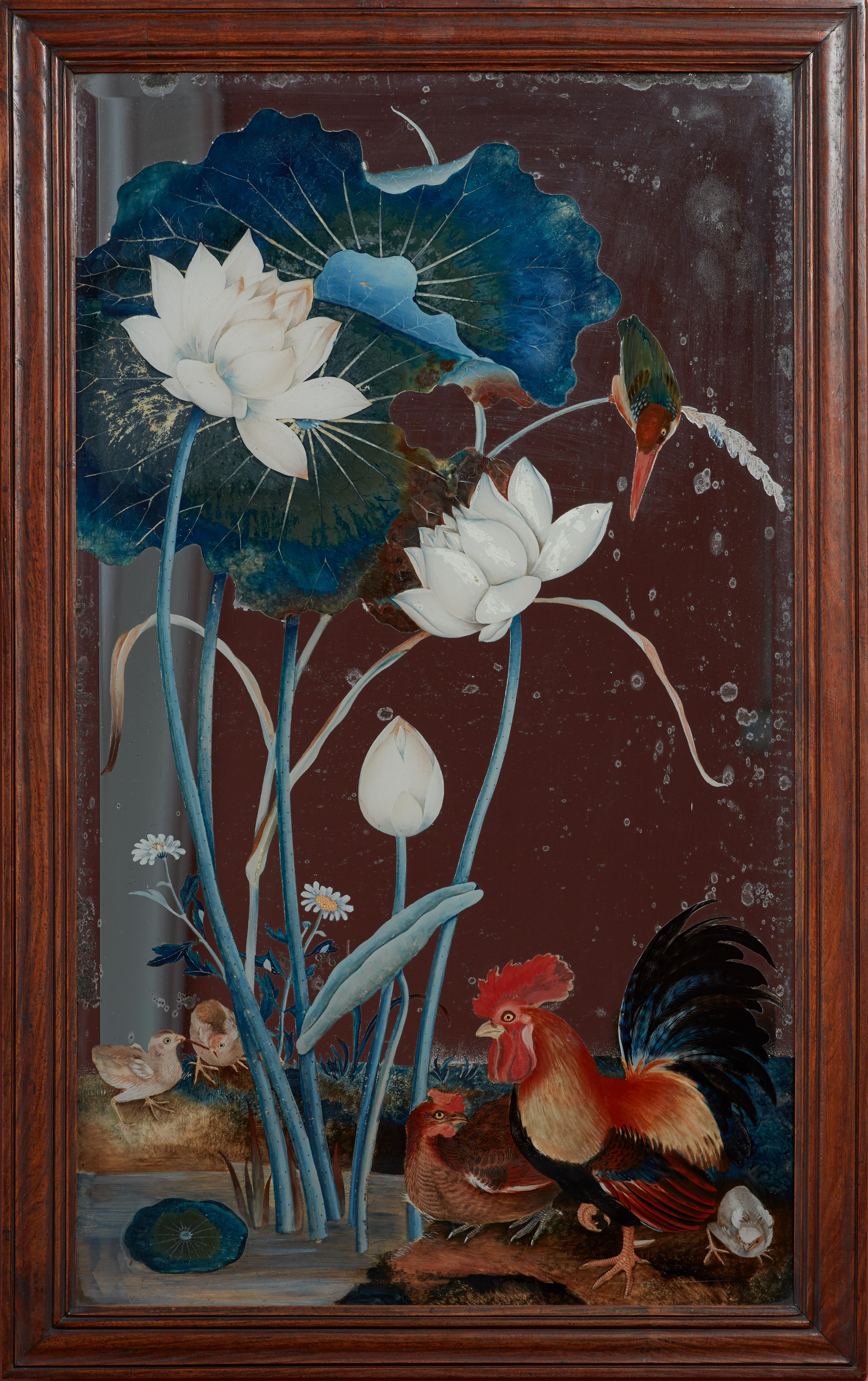
One of the painted mirrors depicts a long-stemmed lotus plant with two white, fully blooming flowers and a bud, as well as large blue-green leaves that provide good contrast to the white flowers. The plant rises from a small pool. On a stalk of grain sits a small bird with a long beak, its head facing downward. In the foreground on the bank is a cockerel, a hen and a small chick. In the background, behind the lotus plant, two additional chicks can be seen tugging at opposite ends of a worm. The other painted mirror shows a tree bearing heavy, ripe fruits, with a multi-coloured parrot perched on one of its branches. In the foreground, a white peony with large blossoms and buds grows. Both mirror paintings are set in profiled rosewood frames.
The technique used for these two paintings is called reverse glass painting. This means that the images were painted on the back of the mirror glass, imported from Europe. First, the artist would have removed the layers of tin and mercury amalgam from the back of the glass before the images were subsequently outlined, drawn and painted (in reverse). The remaining mirror glass thus forms the background of the paintings.1
Like item 51/1978, the two painted mirrors come from Canton (present-day Guangzhou) and belonged to supercargo Christen Lintrup (1703–1772), who brought them to Denmark aboard the ship “Dronningen af Danmark” in 1742.2
Christen Lintrup (1703–1772) began his career as second assistant on the first ship sent from Denmark to China. He then advanced to chief assistant, third supercargo, and finally chief supercargo. Lintrup travelled to China five times before ending his voyages in 1742, when he married Mette Holmsted, the daughter of Frederik Holmsted, co-founder and director of the Danish Asiatic Company. Lintrup purchased the estates of Gjorslev, Søholm, and Erikstrup and built a mansion at St. Annæ Plads — one of the first in Frederiksstaden, a new district in Copenhagen. In 1756, Lintrup was ennobled and adopted the surname (de) Lindencrone. The Danish artist Jens Juel painted his son in 1787 (B 354).
The technique used for these two paintings is called reverse glass painting. This means that the images were painted on the back of the mirror glass, imported from Europe. First, the artist would have removed the layers of tin and mercury amalgam from the back of the glass before the images were subsequently outlined, drawn and painted (in reverse). The remaining mirror glass thus forms the background of the paintings.1
Like item 51/1978, the two painted mirrors come from Canton (present-day Guangzhou) and belonged to supercargo Christen Lintrup (1703–1772), who brought them to Denmark aboard the ship “Dronningen af Danmark” in 1742.2
Christen Lintrup (1703–1772) began his career as second assistant on the first ship sent from Denmark to China. He then advanced to chief assistant, third supercargo, and finally chief supercargo. Lintrup travelled to China five times before ending his voyages in 1742, when he married Mette Holmsted, the daughter of Frederik Holmsted, co-founder and director of the Danish Asiatic Company. Lintrup purchased the estates of Gjorslev, Søholm, and Erikstrup and built a mansion at St. Annæ Plads — one of the first in Frederiksstaden, a new district in Copenhagen. In 1756, Lintrup was ennobled and adopted the surname (de) Lindencrone. The Danish artist Jens Juel painted his son in 1787 (B 354).
Published in
Published in
Tove Clemmensen and Mogens B. Mackeprang: Kina og Danmark 1600-1950: Kinafart og Kinamode, København 1980, pp. 155-157;
Ole Villumsen Krog (ed.): Skatte fra kejserens Kina: Den Forbudte By og det danske kongehus = Treasures from imperial China, København 2006, cat. 210, p. 625;
Ole Villumsen Krog (ed.): Skatte fra kejserens Kina: Den Forbudte By og det danske kongehus = Treasures from imperial China, København 2006, cat. 210, p. 625;
Footnotes
Footnotes
1.
In an inventory of his own goods shipped from Canton to Denmark aboard the ship “Dronningen af Danmark”, Lintrup mentions two decorated mirrors with rosewood frames. See Tove Clemmensen and Mogens B. Mackeprang: Kina og Danmark 1600-1950; Kinafart og Kinamode, Copenhagen 1980, p. 155.
2.
For more information on reverse glass painting, see Tove Clemmensen and Mogens B. Mackeprang: Kina og Danmark 1600-1950; Kinafart og Kinamode, Copenhagen 1980, pp. 155–156.