Theodor Philipsen (1840–1920)
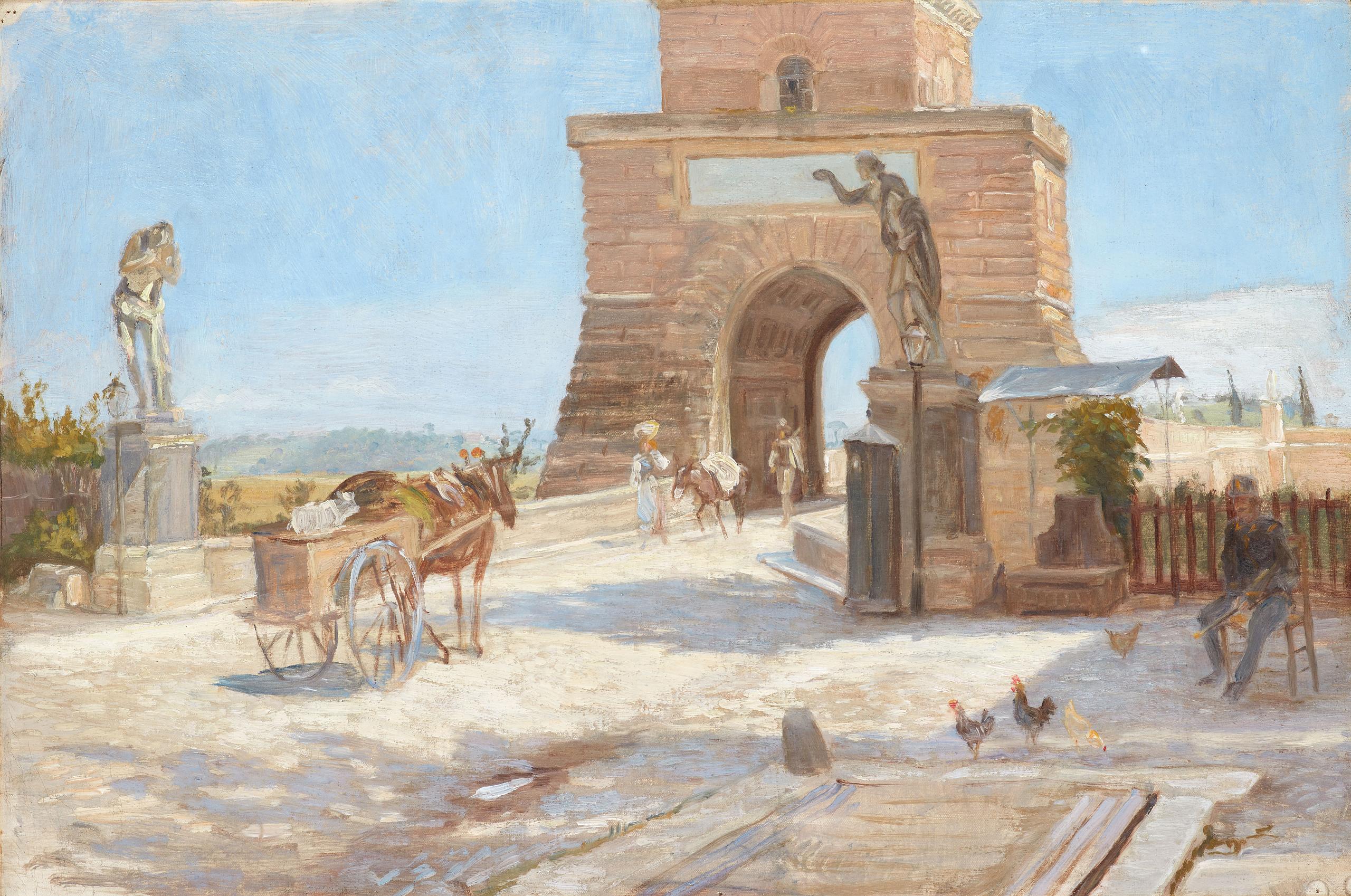
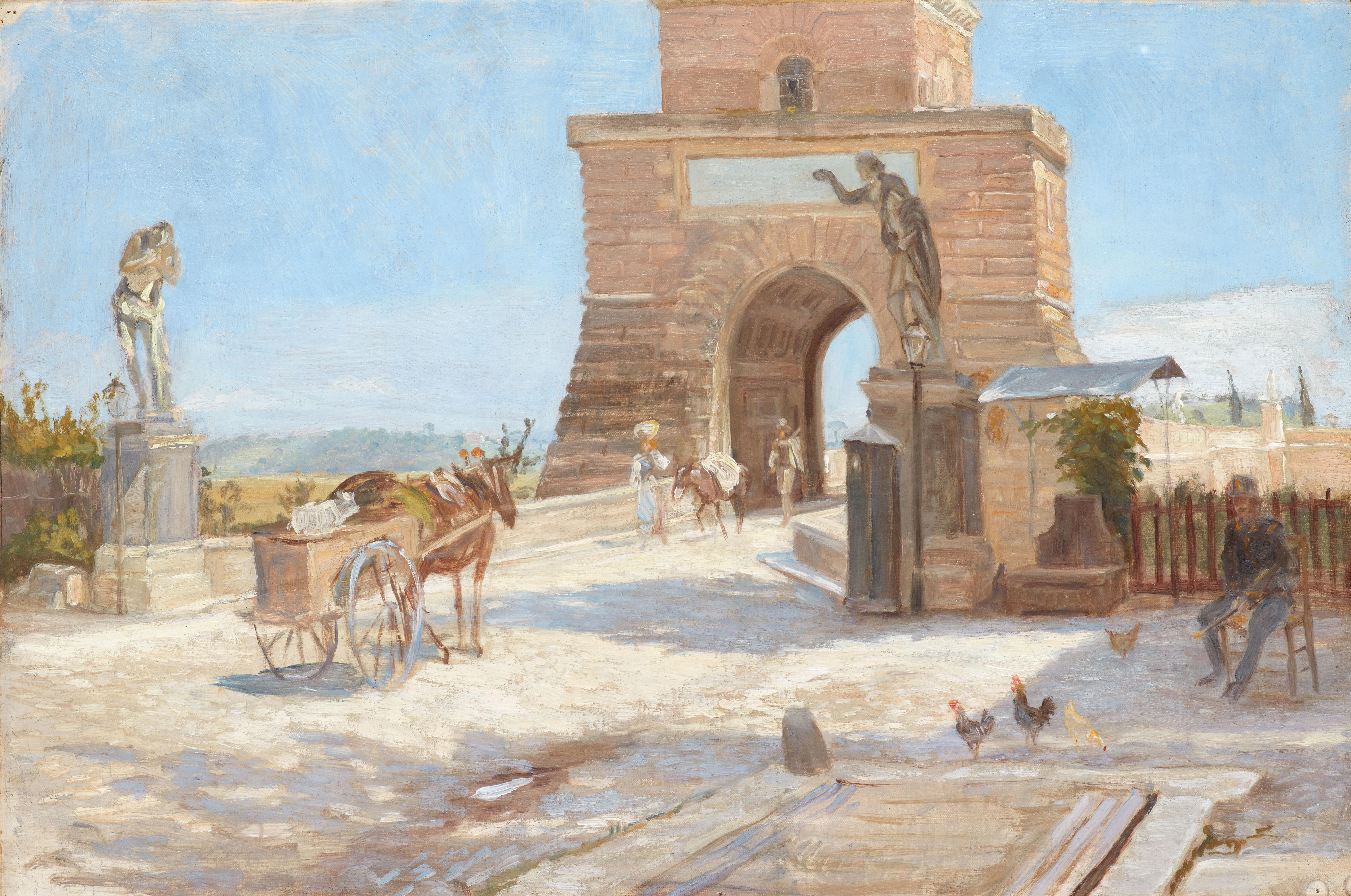
At the Milvian Bridge outside Rome, 1902
Oil on canvas
35 x 52 cm
Inventory number B 398
Theodor Philipsen was a plein-air painter who celebrated light, so the mild climate and dazzling sunlight of Southern Europe quite naturally held great appeal for him. While no firm routine was ever established, Philipsen tended to head south during the winter, while his Danish imagery was often explored and unfolded during the summer.1
Philipsen’s scenes from Italy are associated with a very different view of light and colour than the one seen in the works he created in Denmark. This is especially evident in At the Milvian Bridge outside Rome, where Philipsen has painted in strong, direct daylight, thereby achieving a lighter and richer colour scheme than the one seen in his Danish scenes. In the foreground of the picture, he has worked with blue-violet shading, and the almost dust-white road across the bridge demonstrates how Philipsen strove for a vivid, lifelike representation of nature.
The David Collection is home to another painting showing a scene from the Milvian Bridge (B 401).
Philipsen’s scenes from Italy are associated with a very different view of light and colour than the one seen in the works he created in Denmark. This is especially evident in At the Milvian Bridge outside Rome, where Philipsen has painted in strong, direct daylight, thereby achieving a lighter and richer colour scheme than the one seen in his Danish scenes. In the foreground of the picture, he has worked with blue-violet shading, and the almost dust-white road across the bridge demonstrates how Philipsen strove for a vivid, lifelike representation of nature.
The David Collection is home to another painting showing a scene from the Milvian Bridge (B 401).
Published in
Published in
Th. Philipsen Udstilling: Kunstforeningen februar-marts 1911, Kunstforeningen, København 1911, cat.no. 256, p. 24;
Erik Zahle: ”Malerisamlingens vækst” in C.L. Davids Samling, Tredie del, København 1958, pp. 125-126;
Vibeke Skov's List og Works in Finn Terman Frederiksen: Med solen i øjnene: en Theodor Philipsen-studie, Randers 1992, cat.no. 490, p. 181;
Finn Terman Frederiksen: Theodor Philipsen. En traditionsbevidst nyskaber, Randers Kunstmuseum, Randers 2016, BFL 688, p. 471;
Erik Zahle: ”Malerisamlingens vækst” in C.L. Davids Samling, Tredie del, København 1958, pp. 125-126;
Vibeke Skov's List og Works in Finn Terman Frederiksen: Med solen i øjnene: en Theodor Philipsen-studie, Randers 1992, cat.no. 490, p. 181;
Finn Terman Frederiksen: Theodor Philipsen. En traditionsbevidst nyskaber, Randers Kunstmuseum, Randers 2016, BFL 688, p. 471;
Footnotes
Footnotes
1.
Finn Terman Frederiksen: Theodor Philipsen. En traditionsbevidst nyskaber, Randers Kunstmuseum, Randers 2016, p. 359.