Albert Gottschalk (1866-1906)
From Sct. Jørgensbjerg near Roskilde. Grey Winter’s Day, 1894
Oil on canvas
41.5 x 63 cm
Inventory number B 297
Being a keen plein air painter, Albert Gottschalk was fond of travelling around Denmark to explore the countryside with his own eyes. His way of working was described in the following terms by his friend and fellow artist Johan Rohde: ‘He sought out his subject matter with great care; roaming his hunting grounds for miles with his long strides, scouting with wide-open eyes and craning neck for those nooks and crannies he so loved on the outskirts of the big city or in the old streets and alleys of the small Danish market towns’.1
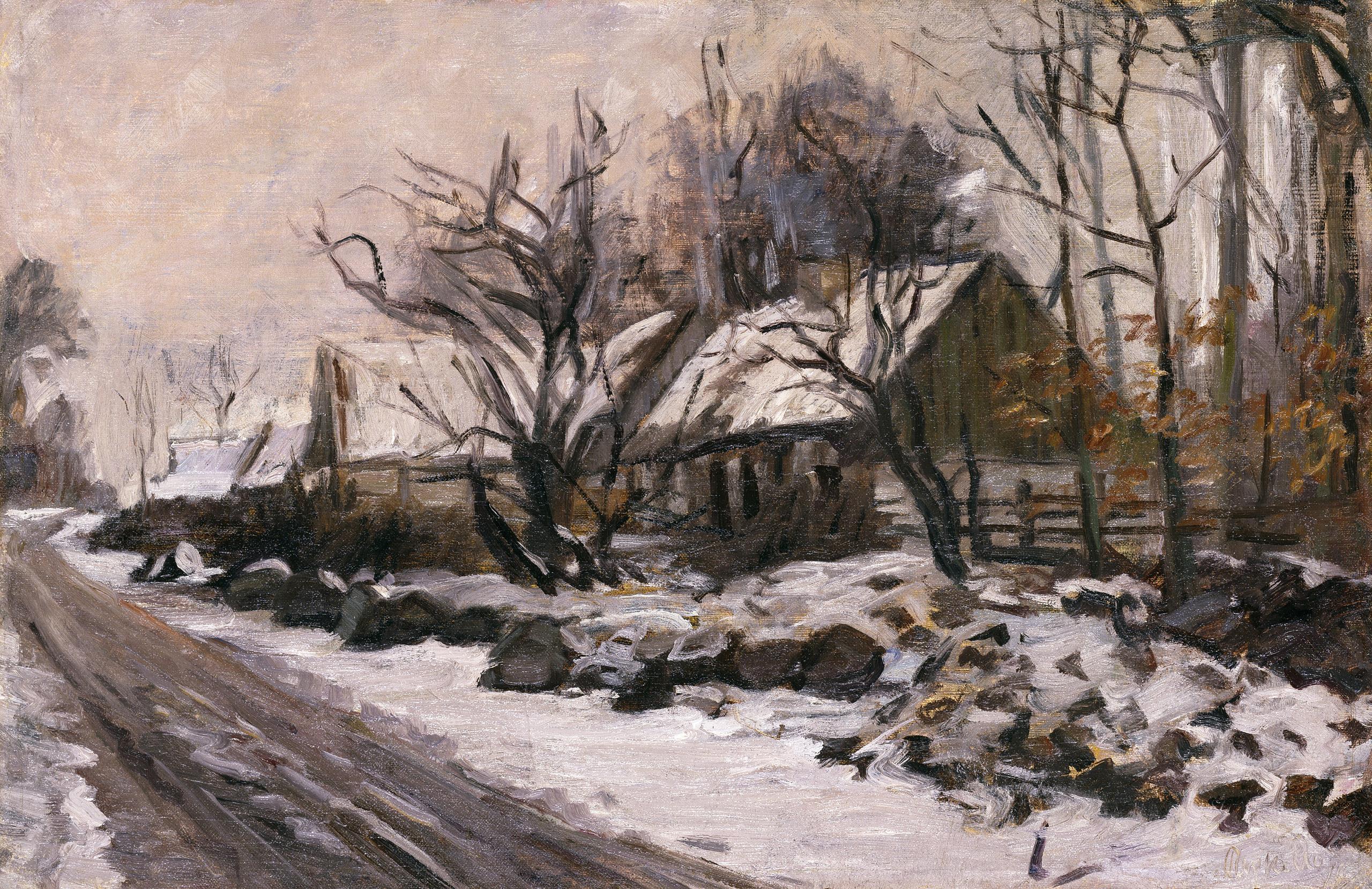
In the winter of 1894, Gottschalk visited Roskilde. Here he created this painting, whose muted winter scene with houses along a muddy road is typical of Gottschalk, who at this time worked mainly with naturalistic motifs rich in atmosphere. He preferred to depict landscapes devoid of people, often painted in overcast conditions and with a road progressing from the foreground of the picture into the pictorial space as in this painting.
The dynamic composition is particularly striking. In the foreground and middle ground are some slender trees, their bare, dark branches constituting restless elements in the snowy landscape against the hazy sky. The houses are positioned so that they move into the pictorial space. So does the road, its oblique, winding movement completing the composition, which may at first glance seem almost colourless. However, closer inspection reveals that the pared-back palette is interspersed with brushstrokes in strong colours – ochre, yellow, green and light blue.
In the winter of 1894, Gottschalk visited Roskilde. Here he created this painting, whose muted winter scene with houses along a muddy road is typical of Gottschalk, who at this time worked mainly with naturalistic motifs rich in atmosphere. He preferred to depict landscapes devoid of people, often painted in overcast conditions and with a road progressing from the foreground of the picture into the pictorial space as in this painting.
The dynamic composition is particularly striking. In the foreground and middle ground are some slender trees, their bare, dark branches constituting restless elements in the snowy landscape against the hazy sky. The houses are positioned so that they move into the pictorial space. So does the road, its oblique, winding movement completing the composition, which may at first glance seem almost colourless. However, closer inspection reveals that the pared-back palette is interspersed with brushstrokes in strong colours – ochre, yellow, green and light blue.
Published in
Published in
Fortegnelse over Albert Gottschalks arbejder: udstillede i Kunstforeningen i København, November-December 1906, København 1906, cat.no. 107, p. 9;
Albert Gottschalk, født i Stege 3. Juli 1866, død i København 13. Februar 1906, Den Frie Udstilling, Oktober 1930, København 1930, cat.no. 128, p 24;
Erik Zahle: ”Malerisamlingens vækst” in C.L. Davids Samling, Tredie del, København 1958, pp. 128, 164-165;
C.L. David: C.L. Davids Samling, København 1960, p. 24;
Troels Andersen and Helle Behrndt: Albert Gottschalk: 1866-1906, Sophienholm, Lyngby 1988, p. 13;
Troels Andersen: Albert Gottschalk: 1866-1906, 2. rev. ed., Valby 2013, cat.no. 198, pp. 52, 30, 157;
Troels Andersen in Kjeld von Folsach and Nana Lund (eds.): Dansk kunst i Davids Samling – fra Philipsen til Saxbo, København 1995, cat.no. 60, pp. 148-149;
Gertrud Oelsner (ed.): I maleriets udkant - Albert Gottschalk (1866-1906) = Men denna eftermiddag = But this afternoon, Storstrøms Kunstmuseum and Faaborg Museum, Maribo 2002, p. 43, cat.no. 28, pl. 16, p. 95;
Albert Gottschalk, født i Stege 3. Juli 1866, død i København 13. Februar 1906, Den Frie Udstilling, Oktober 1930, København 1930, cat.no. 128, p 24;
Erik Zahle: ”Malerisamlingens vækst” in C.L. Davids Samling, Tredie del, København 1958, pp. 128, 164-165;
C.L. David: C.L. Davids Samling, København 1960, p. 24;
Troels Andersen and Helle Behrndt: Albert Gottschalk: 1866-1906, Sophienholm, Lyngby 1988, p. 13;
Troels Andersen: Albert Gottschalk: 1866-1906, 2. rev. ed., Valby 2013, cat.no. 198, pp. 52, 30, 157;
Troels Andersen in Kjeld von Folsach and Nana Lund (eds.): Dansk kunst i Davids Samling – fra Philipsen til Saxbo, København 1995, cat.no. 60, pp. 148-149;
Gertrud Oelsner (ed.): I maleriets udkant - Albert Gottschalk (1866-1906) = Men denna eftermiddag = But this afternoon, Storstrøms Kunstmuseum and Faaborg Museum, Maribo 2002, p. 43, cat.no. 28, pl. 16, p. 95;
Footnotes
Footnotes
1.
Quote from Johan Rohde’s eulogy for Albert Gottschalk, Den Frie Udstilling 1906. See Troels Andersen: Albert Gottschalk, Sophienholm, Kgs. Lyngby, Viborg 1988, p. 26.