Vilhelm Hammershøi (1864–1916)
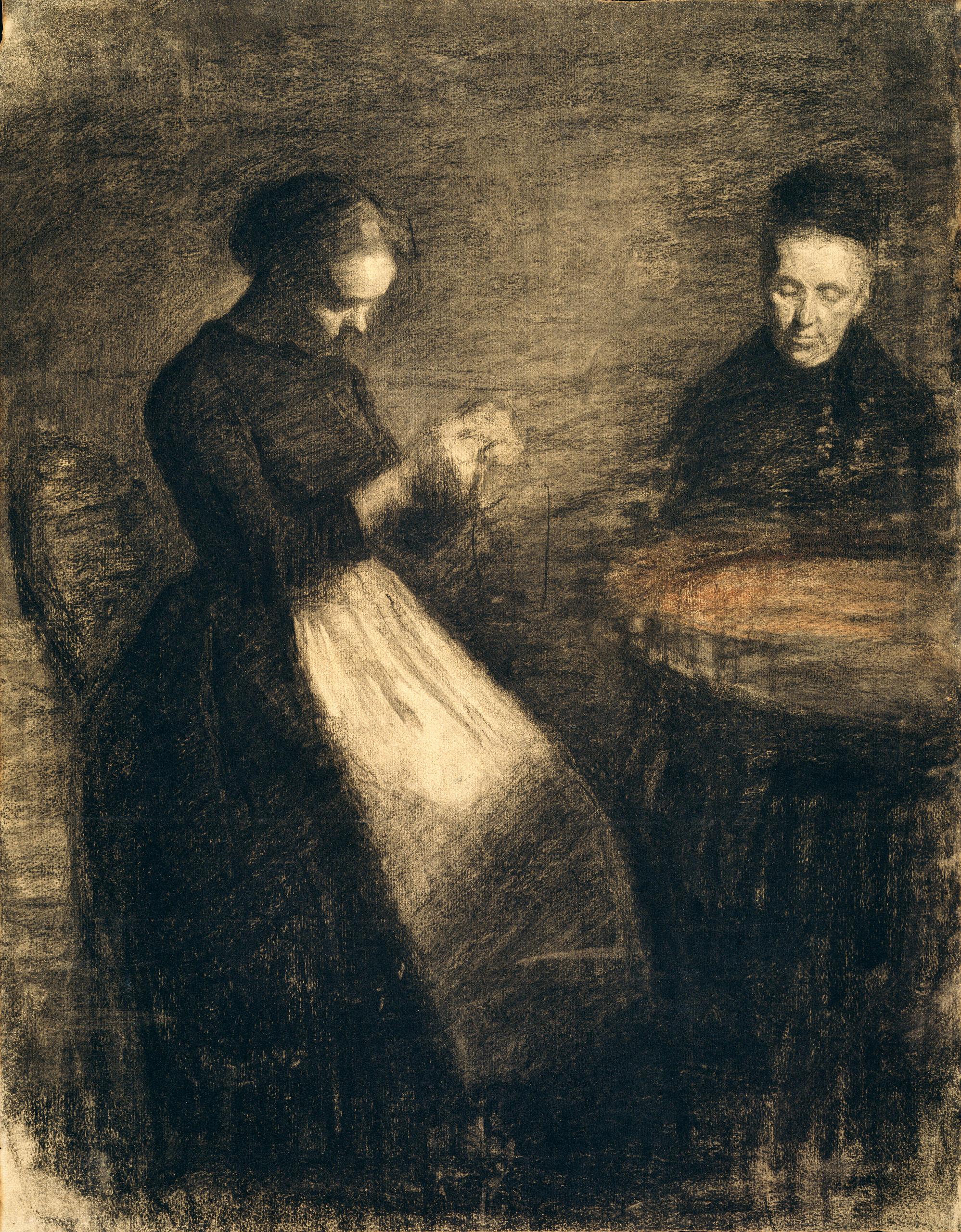
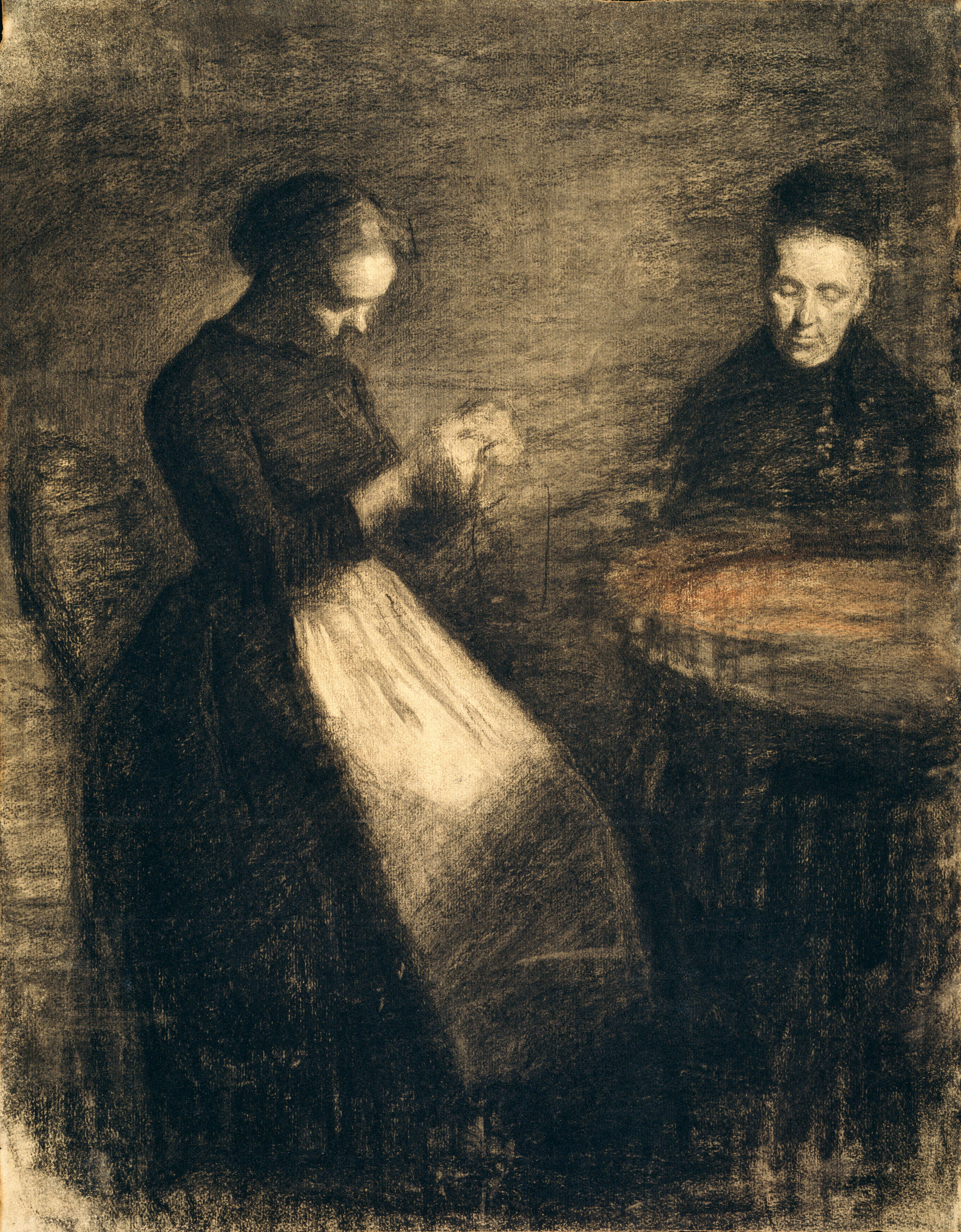
Evening in the Drawing Room. Two Women at a Round Table, 1891
Lead and chalk on paper
This drawing is one of the few works in Vilhelm Hammershøi’s oeuvre that depicts, in one and the same image, two of the women closest to him: his mother, Frederikke Hammershøi (1838–1914) and his wife, Ida Hammershøi (1869–1949). The latter is a familiar figure in Hammershøi’s work as she eventually became his favourite model. The drawing was done in the year the couple married.
However, the women are not the main focus in Hammershøi’s work, meaning that this is not a portrait or a family picture in the usual sense. Rather, it is an arrangement of two women, each entirely caught up in their respective activities even though we cannot exactly see what those activities are. What is more, all elements and layers of meaning that might potentially describe the relationship between the two women or place them in a social context have been peeled away. This pared-back approach is an essential trait of Hammershøi’s art: he consistently omitted all narrative elements in his works, which is why they are at one and the same time so difficult and so easy to decipher.
The drawing shows to Hammershøi’s remarkable talent. He was a very skilled draughtsman, partly because he received regular and professional drawing lessons from the tender age of eight. The lessons made him well prepared for his training at the Royal Danish Academy of Fine Arts in Copenhagen from 1879 to 1884, as well as at the newly established art school The Artist’s Independent Study Schools in the years 1883 to 1885. In addition, the drawing also emphasises Hammershøi’s mastery of nuance and his keen understanding of the balance between light and dark areas. The use of chiaroscuro is very conspicuous in this work. The same holds true for the way he uses the light to create a distinctive atmosphere in the room, with the two almost contourless women blending into the setting.
Evening in the Drawing Room. Two Women at a Round Table is presumably a preliminary study for the oil painting Evening in the Drawing Room. The Artist’s Mother and Wife.[1]
Published in
Published in
Alfred Bramsen: Vilhelm Hammershøis Arbejder. Fortegnelse, Copenhagen 1900, cat. 45;
Sophus Michaëlis and Alfred Bramsen: Vilhelm Hammershøi. Kunstneren og hans Værk, Copenhagen 1918, p. 89, cat.103;
Hanne Finsen and Inge Vibeke Raaschou-Nielsen: Vilhelm Hammershøi. En retrospektiv udstilling, Ordrupgaard, Charlottenlund 1981, p. 68, cat. 36;
Hanne Finsen and Inge Vibeke Raaschou-Nielsen: Vilhelm Hammershøi. Painter of Stillness and Light, Wildenstein, New York and Phillips Collection, Washington, Copenhagen 1983, p. 38, cat. 22;
Poul Vad: Vilhelm Hammershøi and Danish Art at the Turn of the Century, New Haven 1992, fig. 56, p. 103;
Poul Vad: “Vilhelm Hammershøi,” in Kjeld von Folsach and Nana Lund (ed.): Dansk kunst i Davids Samling. Fra Philipsen til Saxbo, Copenhagen 1995, pp. 90-91, cat. 30;
Lena Boëthius and Görel Cavalli-Björkman (ed.): Vilhelm Hammershøi, Göteborg Konstmuseum and Stockholm Nationalmuseum, Gothenburg 1999, pp. 66-67, cat. 12;
Poul Vad: Hammershøi. Værk og liv, 5th ed., Copenhagen 2003, p. 85;
Kasper Monrad et al.: Hammershøi og Europa, Statens Museum for Kunst, Copenhagen 2012, p. 57, cat. 35;
Henrik Wivel: Hammershøi in The David Collection, Copenhagen 2017, pp. 60-61;
Annette Rosenvold Hvidt and Gertrud Oelsner: Vilhelm Hammershøi. På sporet af det åbne billede, Copenhagen 2018, p. 87;
Henrik Wivel: Vilhelm Hammershøi. Maleri som poesi, Copenhagen 2026, p. 31 and fig. 14, p. 33;
Footnotes
Footnotes
Vilhelm Hammershøi, Evening in the Drawing Room. The Artist’s Mother and Wife, 1891, SMK, inv.no. KMS1808.