The Kings of Awadh (Oudh), 1133-1273 H/1721-1856 AD
Legend & Design
Legend & Design
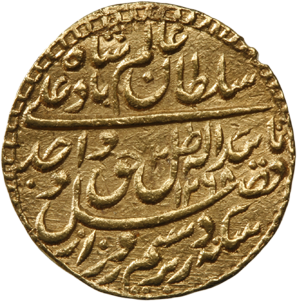
Obverse
Field
reading upwards sikka zad bar sim wa zar az / fazl-i 1268 / ta’yid-i ilah zill-i haqq wajid / ‘ali / sultan-i ‘alam padshah
“He struck coin on silver and gold, 1268, through the grace of God, the Shadow of Truth (God) Wajid ‘Ali, the Sultan of the World, Monarch“
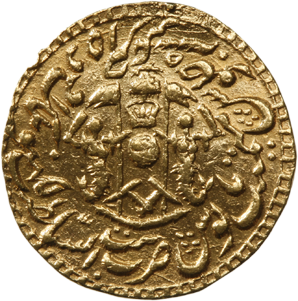
Reverse
Field
The arms of Wajid ‘Ali Shah, a crowned globe surmounted by a chatr, a royal parasol, flanked by two mermen holding pennants
Margin
clockwise from 12:00 sana 5 julus-i maymanat-i manus darb bayt al-saltanat lakhnaw mulk-i awadh akhtarnagar
“Year 5 of the accession of auspicious fortune, struck at the House of the Sultanate Lucknow, the Kingdom of Awadh, the Auspicious City”
Historical Note
Historical Note
In 1216 H (1801 AD) Lord Wellesley, The Earl of Mornington, forced Sa‘adat ‘Ali Khan to cede many of the principal towns in Awadh to the British East India Company, because he did not consider that Awadh was any longer effective as a buffer state. Now, apart from its boundary with Nepal, Awadh was entirely surrounded by British territory.
As part of the treaty it was agreed that Wajid ‘Ali Shah, the last ruler of Awadh, was to introduce a new system of administration to his state which, it was hoped, would bring about the general prosperity and security of his subjects.
Repeated warnings by the British, however, accomplished little or nothing in the way of improvements, misgovernment continued, and the Company finally lost patience with Wajid ‘Ali.
In an act which outraged public opinion both in Awadh and elsewhere in India, the British annexed Awadh in 1272 (1856) and dispatched Wajid ‘Ali Shah into exile in Calcutta where he lived on for thirty years, having been reduced to the status of a pensioner of the British Raj.
The annexation of Awadh caused a good deal of hardship, for the great families of the province were treated with little respect, and were ousted from the greater parts of their estates. In fact this was one of the principal causes behind the Indian Mutiny against the British which broke out in 1273 (1857), and much of the fiercest fighting took place in Lucknow.
Like the coins of his predecessor ‘Amjad ‘Ali, this coin of Wajid ‘Ali bears a crown, but in this case a much smaller one, surmounted by the chatr (royal parasol). Instead of the fish favoured by ‘Amjad ‘Ali, two mermen, with fish tails, stand on either side of the crown.