The Sultans of Delhi – Khalji Line, 689-720 H/1290-1320 AD
Legend & Design
Legend & Design
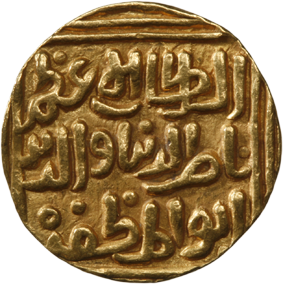
Obverse
Field
in a square, within double lines al-sultan al-a‘zam / nasir al-dunya wa’l-din / abu’l-muzaffar
“the Supreme Sultan, Defender of the World and the Faith, Father of Victory”
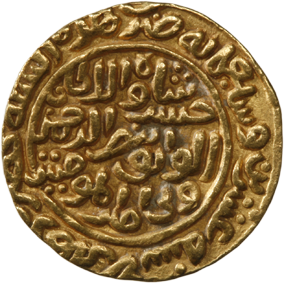
Reverse
Field
within a circle khusraw shah al-sultan / al-wathiq / bi-nasr al-rahman / wali amir al-mu’minin
“Khusraw Shah, the Sultan who trusts in the help of the Merciful (God), Trustee of the Commander of the Faithful”
Margin
duriba hadhihi’l-sikka bi-hadrat dihli sana ’ashrin wa sab’mi’a
“this coin was struck in the town of Delhi the year twenty and seven hundred”
Historical Note
Historical Note
Khusraw Shah began his life as a low-caste Hindu from Gujarat, who became a slave of Qutb al-Din Mubarak Shah and converted to Islam.
During Mubarak’s reign Khusraw Shah led an army to Warangal, in the rich region of Telingana province, where he was able to seize large quantities of booty. As he marched on he considered setting himself as an independent ruler, but Mubarak heard about this and recalled him to Delhi.
Instead of receiving a punishment, however, Khusraw became Mubarak’s right hand man and made himself the supreme figure in the state. Khusraw repaid Mubarak for his indulgence by raising an army which overthrew and murdered the sultan in 720 H (1320 AD). The very next day he acceded to the throne himself as Nasir al-Din Khusraw Shah.
Although he was able to placate many of the nobles, there were some who saw Khusraw as an inveterate Hindu infidel, and feared that he posed a threat to Islam. The leader of this group was Ghazi Tughluq who had risen from humble origins to a high position in the army. Tughluq appealed to various governors for assistance in overthrowing Khusraw, but received little support. He mounted a campaign against Khusraw, who sent an army led by his brother to check Tughluq’s advance. Khusraw’s brother was defeated, and Tughluq’s army continued to advance towards Delhi.
When Tughluq reached the city Khusraw rode out to meet him and confronted him in battle, but Tughluq, won, captured Khusraw and had him executed. As there were no surviving princes of the Khalji family, the nobles agreed that the obvious choice for their new ruler was Tughluq, who acceded to the throne in 720 (1320) as Ghiyath al-Din Tughluq Shah.
Because of the brevity of his reign, Khusraw’s coins, particularly gold, are extremely rare. He probably was all too well aware of his precarious position and his need for “the help of the Merciful God”. Unusually he calls himself wali amir al-mu’minin (Trustee of the Commander of the Faithful).