Shard of colourless glass decorated with coloured enamel and gilding
Syria; 1st half of the 13th century
H: 4.5; W: 5.7 cm
Inventory number 17/2019
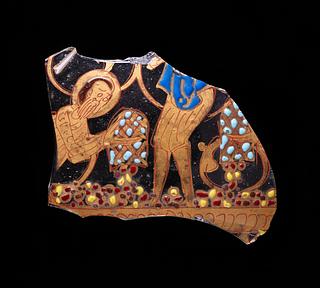
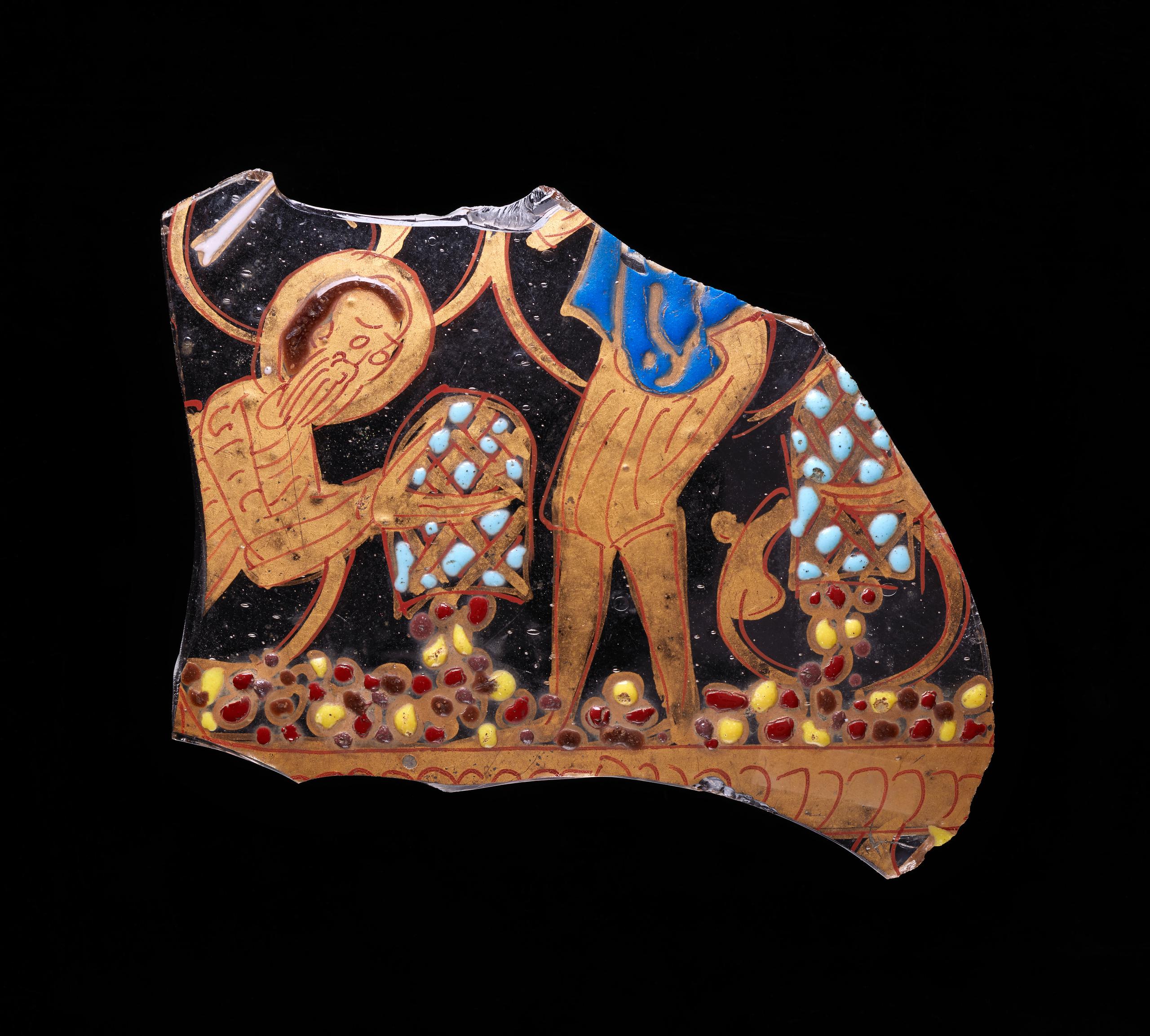
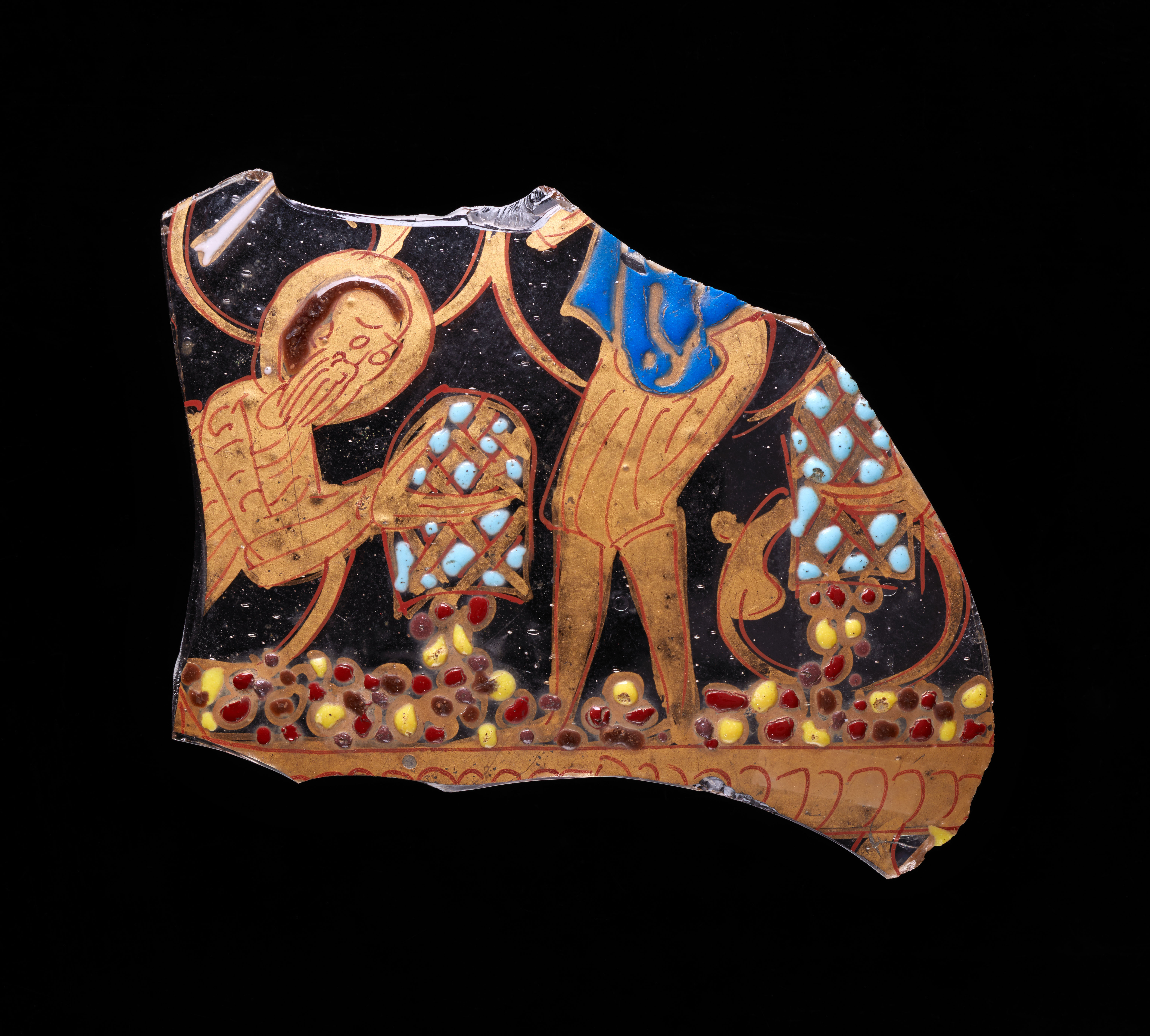
This shard of glass has a curved shape indicating that it once formed part of a flask or some other rounded vessel. The convex side bears a painted figurative decoration executed in gold as well as blue, red, yellow, turquoise, brown and white enamel.
To the left is the torso and head of a bearded man pouring small ‘beads’ out of a wicker basket, and to the right is a similar basket held by a single hand. Between the containers are the legs of a third figure who appears to be wearing a loose-fitting, blue garment on their upper body. The image is presumably a depiction of wine production, the red and yellow ‘beads’ representing grapes crushed under the central figure’s feet.
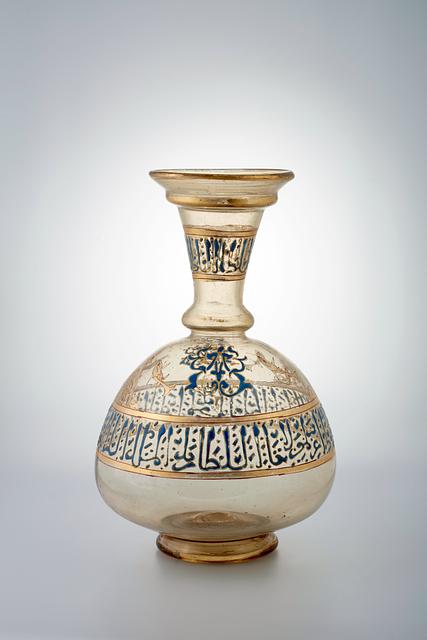
Related scenes with various types of agricultural production are seen on a fully preserved, Syrian bottle from around 1250.1 Furthermore, depictions of workers crushing grapes with their feet are included in several manuscripts of al-Hariri’s Maqamat, including one made in Syria between 1225 and 1235.2
As regards the portrayals of the figures, the halo surrounding the bearded man’s head and the remnants of the central figure’s blue, loose-fitting clothes clearly show a kinship with contemporary book illustration. For example, similar halos and richly folded costumes appear in a depiction of the Crucifixion in a Syriac Orthodox manuscript from the early thirteenth century (19/2019) as well as in a representation of a medical consultation from a work on medicinal plants dated 1224 (4/1997).
Although the halos were presumably inspired by Christian painting, the Islamic art of the period did not use them as a sign of holiness but instead as a means of highlighting the faces of the figures, whether religious or secular.
To the left is the torso and head of a bearded man pouring small ‘beads’ out of a wicker basket, and to the right is a similar basket held by a single hand. Between the containers are the legs of a third figure who appears to be wearing a loose-fitting, blue garment on their upper body. The image is presumably a depiction of wine production, the red and yellow ‘beads’ representing grapes crushed under the central figure’s feet.
Related scenes with various types of agricultural production are seen on a fully preserved, Syrian bottle from around 1250.1 Furthermore, depictions of workers crushing grapes with their feet are included in several manuscripts of al-Hariri’s Maqamat, including one made in Syria between 1225 and 1235.2
As regards the portrayals of the figures, the halo surrounding the bearded man’s head and the remnants of the central figure’s blue, loose-fitting clothes clearly show a kinship with contemporary book illustration. For example, similar halos and richly folded costumes appear in a depiction of the Crucifixion in a Syriac Orthodox manuscript from the early thirteenth century (19/2019) as well as in a representation of a medical consultation from a work on medicinal plants dated 1224 (4/1997).
Although the halos were presumably inspired by Christian painting, the Islamic art of the period did not use them as a sign of holiness but instead as a means of highlighting the faces of the figures, whether religious or secular.
Published in
Published in
Christie's, London, 2/5-2019, p. 11, lot 3;
Footnotes
Footnotes
1.
Stefano Carboni and David Whitehouse: Glass of the Sultans, New York 2001, cat. 121.
2.
See e.g. David James: A Masterpiece of Arab Painting: The ’Schefer’ Mâqâmat Manuscript in Context, London 2013, p. 178, fig. 2.9.