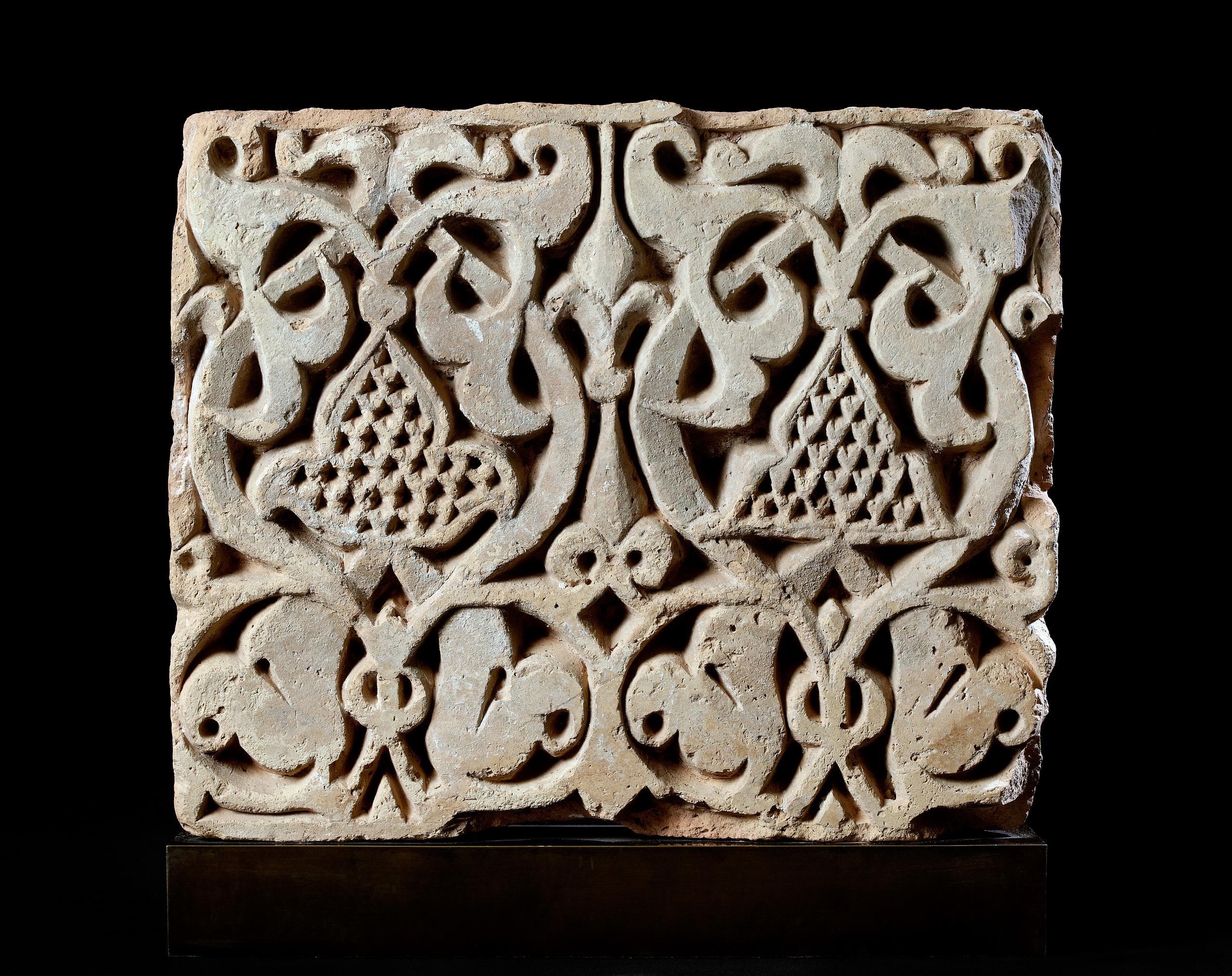
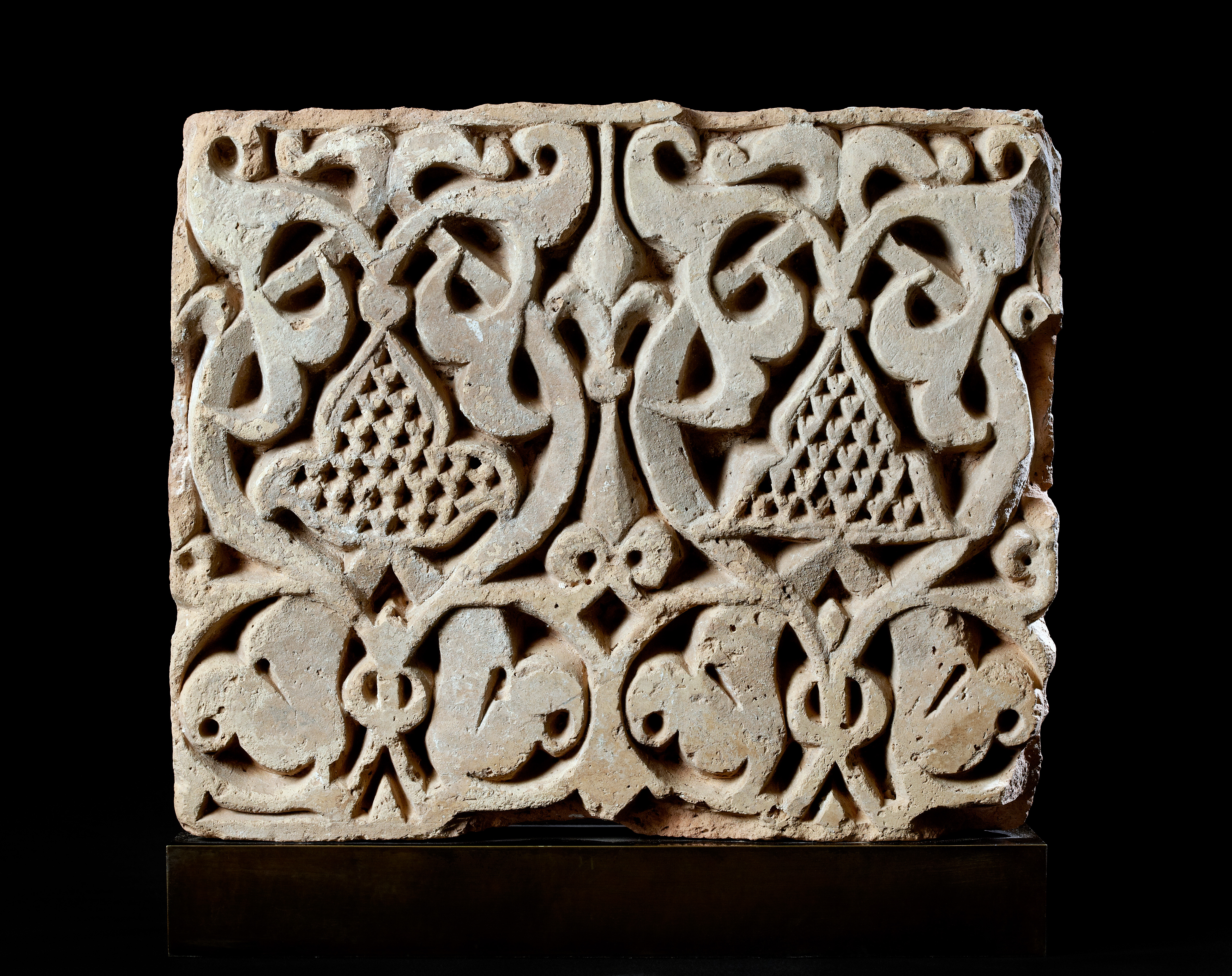
Architectural relief, carved, unglazed earthenware
Eastern Iran or Afghanistan; c. 1200
H: 34.4; W: 41.2 cm
Inventory number 24/2012
The beveled style had its heyday in 9th-century Iraq, but its tendency to stylize nature lived on in the following centuries. Abstractions of the plant world continued to be a strong element in Islamic art right to modern times.
The pattern on this terracotta relief, which could have embellished either religious or secular architecture in 13th-century eastern Iran or Afghanistan, consists primarily of split palmettes. They are more distinctive and more clearly delimited than the ones found in Samarra, but are not as cohesive as in a typical arabesque. It is impossible to say whether the central tripartite ornament should be seen as a leaf or as a stylized flower related to the fleur-de-lis.
The pattern on this terracotta relief, which could have embellished either religious or secular architecture in 13th-century eastern Iran or Afghanistan, consists primarily of split palmettes. They are more distinctive and more clearly delimited than the ones found in Samarra, but are not as cohesive as in a typical arabesque. It is impossible to say whether the central tripartite ornament should be seen as a leaf or as a stylized flower related to the fleur-de-lis.
Published in
Published in
Christie’s, London, 4/10-2012, lot 66;
Kjeld von Folsach: Flora islamica: plantemotiver i islamisk kunst, Davids Samling, København 2013, cat.no. 23;
Kjeld von Folsach: Flora islamica: plantemotiver i islamisk kunst, Davids Samling, København 2013, cat.no. 23;