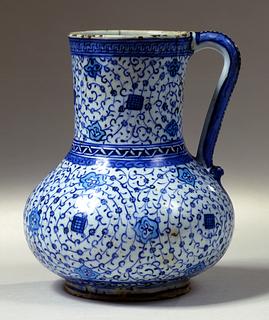
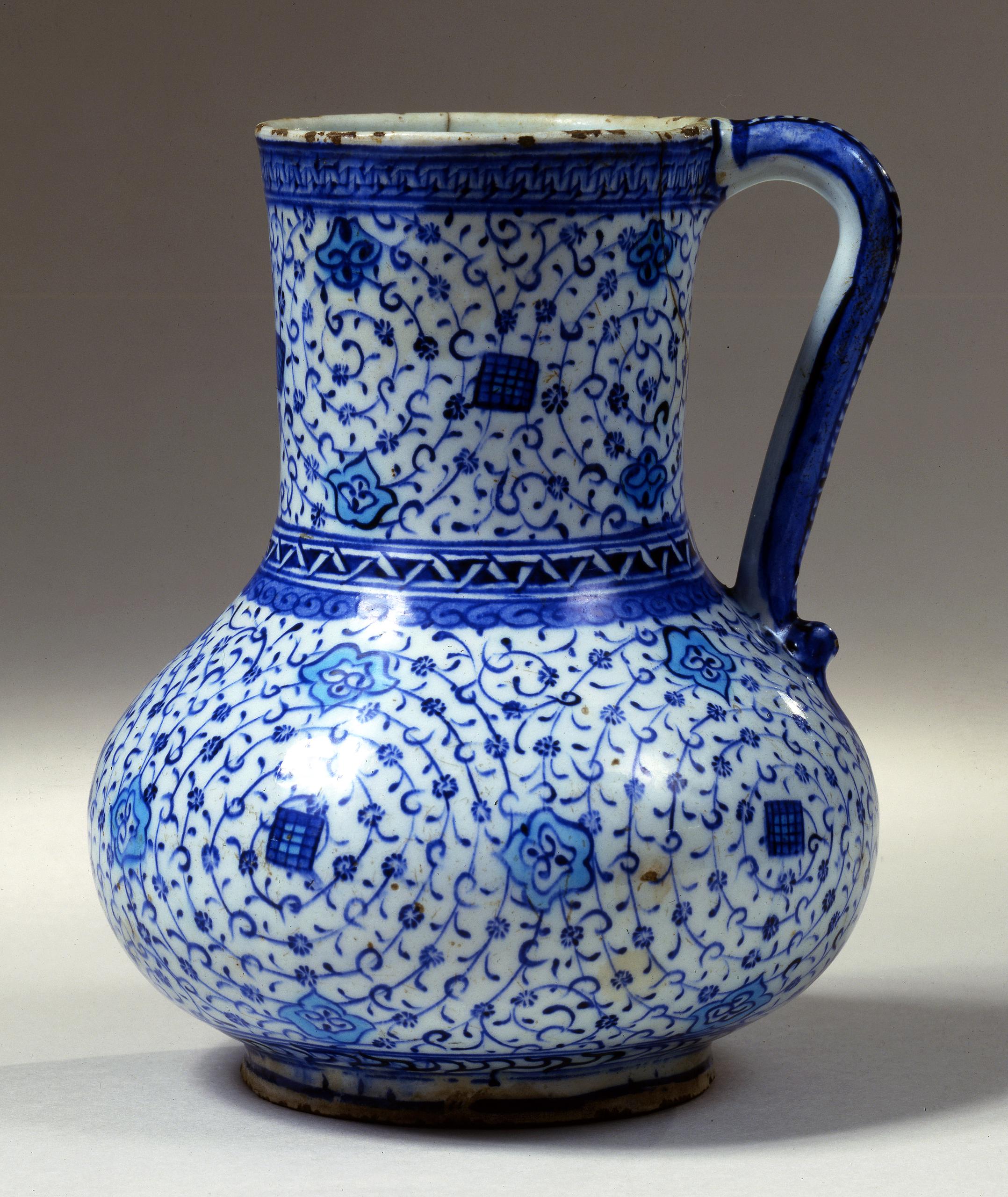
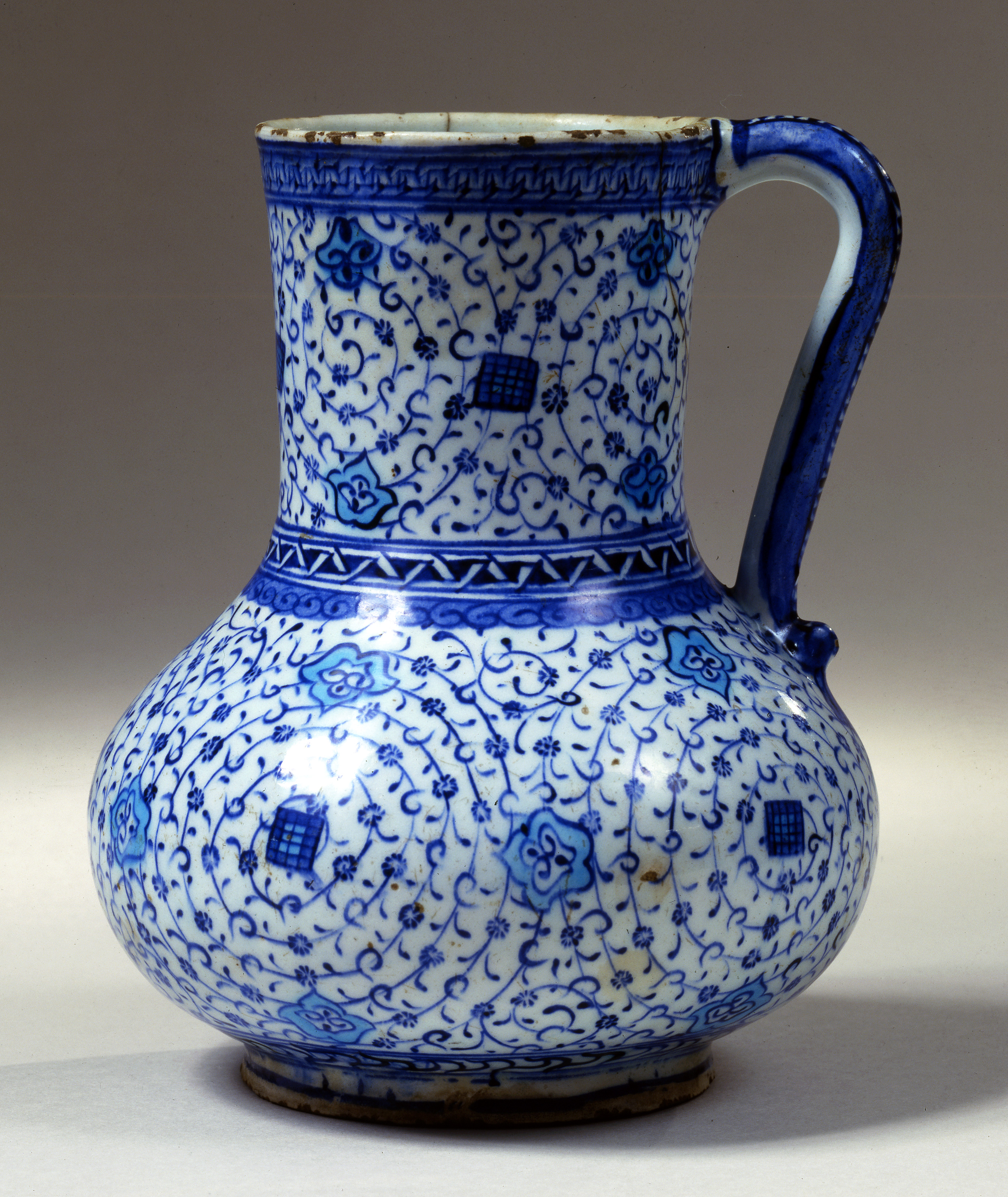
Fritware jug, painted in blue and turquoise under a transparent glaze
Iznik, Turkey; c. 1540
H: 18 cm
Inventory number 11/1970
Both the shape, in a simplified version, and the decoration of this jug were copied from contemporary jugs of silver (see 15/1986). The decoration was used in the period from 1520 to 1550 and was previously designated as Golden Horn, because it was erroneously believed that this is where it was produced in Istanbul. The dense spirals with little leaves are also highly reminiscent of the ones found on the ornamental sultan’s monograms (tughras) on imperial decrees (firmans) in the 16th century (see 51/2002). For this reason, this fairly short-lived spiral style is also called the tughrakes style.
The palette is nearly always blue and white, sometimes supplemented with turquoise, as here.
The palette is nearly always blue and white, sometimes supplemented with turquoise, as here.
Published in
Published in
Sotheby’s, London, 9/6-1970, lot 58;
André Leth: Davids Samling. Islamisk kunst = The David Collection. Islamic Art, København 1975, p. 97;
Art from the World of Islam. 8th-18th century, Louisiana, Humlebæk 1987, cat.no. 195;
Jean Soustiel: La céramique islamique: le guide du connoisseur, Paris 1985, fig. 351;
Nurhan Atasoy and Julian Raby: Iznik: the pottery of Ottoman Turkey, London 1989, fig. 330;
Soliman le Magnifique:15 fevrier au 14 mai 1990, Galeries Nationales du Grand Palais, Paris 1990, cat.no. 162;
Kjeld von Folsach: Islamic art. The David Collection, Copenhagen 1990, cat.no.184;
Kjeld von Folsach, Torben Lundbæk and Peder Mortensen (eds.): Sultan, Shah and Great Mughal: the history and culture of the Islamic world, The National Museum, Copenhagen 1996, cat.no. 394;
Kjeld von Folsach: Art from the World of Islam in The David Collection, Copenhagen 2001, cat.no. 255;
Sheila S. Blair and Jonathan M. Bloom (eds.): Cosmophilia. Islamic Art from the David Collection, Copenhagen, McMullen Museum of Art, Boston College, Boston 2006. cat.no. 68;
Loredana Pessa: ”La produzione locale e le suggestioni dell’arte ottoman le ceramiche” in Loredana Pessa (ed.): Turcherie: suggestioni dell'arte ottomana a Genova, Genova 2014, fig. 1, p. 31;
Asja Gimborg: Velikolepnyj vek osmanskogo iskusstva: dvorcy, meceti, garemy i nocnoj Bosfor, Moskva 2023, p. 126;
André Leth: Davids Samling. Islamisk kunst = The David Collection. Islamic Art, København 1975, p. 97;
Art from the World of Islam. 8th-18th century, Louisiana, Humlebæk 1987, cat.no. 195;
Jean Soustiel: La céramique islamique: le guide du connoisseur, Paris 1985, fig. 351;
Nurhan Atasoy and Julian Raby: Iznik: the pottery of Ottoman Turkey, London 1989, fig. 330;
Soliman le Magnifique:15 fevrier au 14 mai 1990, Galeries Nationales du Grand Palais, Paris 1990, cat.no. 162;
Kjeld von Folsach: Islamic art. The David Collection, Copenhagen 1990, cat.no.184;
Kjeld von Folsach, Torben Lundbæk and Peder Mortensen (eds.): Sultan, Shah and Great Mughal: the history and culture of the Islamic world, The National Museum, Copenhagen 1996, cat.no. 394;
Kjeld von Folsach: Art from the World of Islam in The David Collection, Copenhagen 2001, cat.no. 255;
Sheila S. Blair and Jonathan M. Bloom (eds.): Cosmophilia. Islamic Art from the David Collection, Copenhagen, McMullen Museum of Art, Boston College, Boston 2006. cat.no. 68;
Loredana Pessa: ”La produzione locale e le suggestioni dell’arte ottoman le ceramiche” in Loredana Pessa (ed.): Turcherie: suggestioni dell'arte ottomana a Genova, Genova 2014, fig. 1, p. 31;
Asja Gimborg: Velikolepnyj vek osmanskogo iskusstva: dvorcy, meceti, garemy i nocnoj Bosfor, Moskva 2023, p. 126;
Ceramics
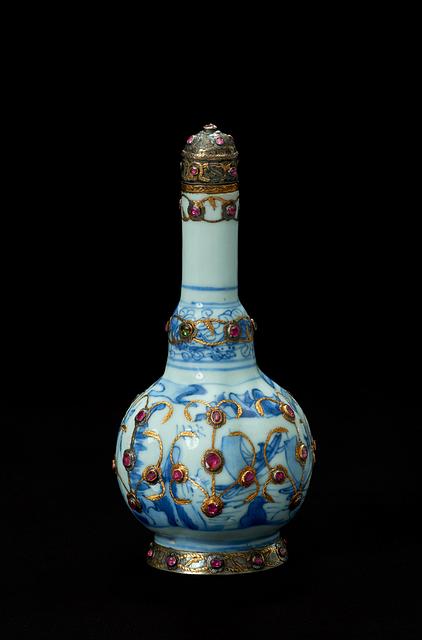
Porcelain bottle, mounted with silver, gold, and gemstones
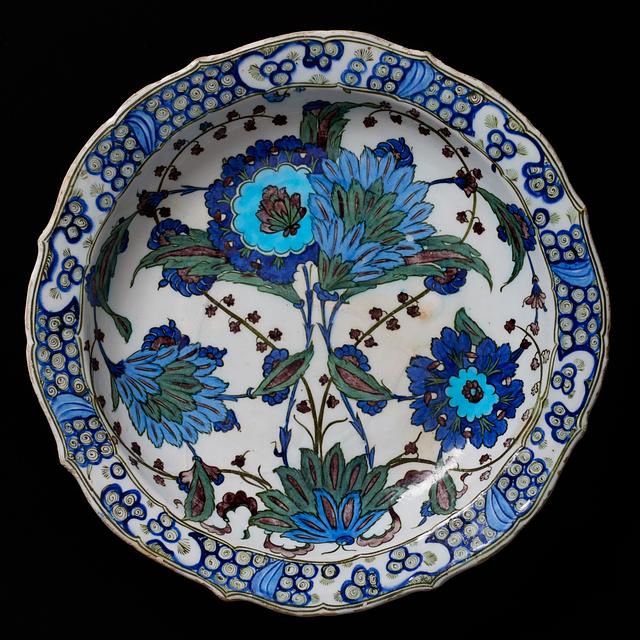
Fritware dish, painted in black, blue, light blue, turquoise, moss green, and manganese under a transparent glaze
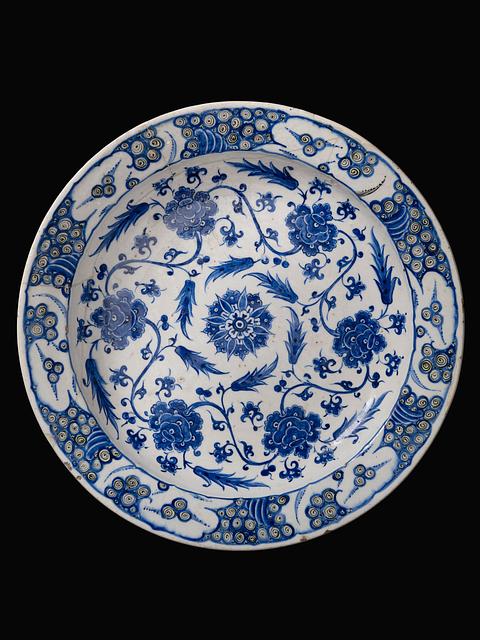
Fritware dish, painted in blue and black under a transparent glaze
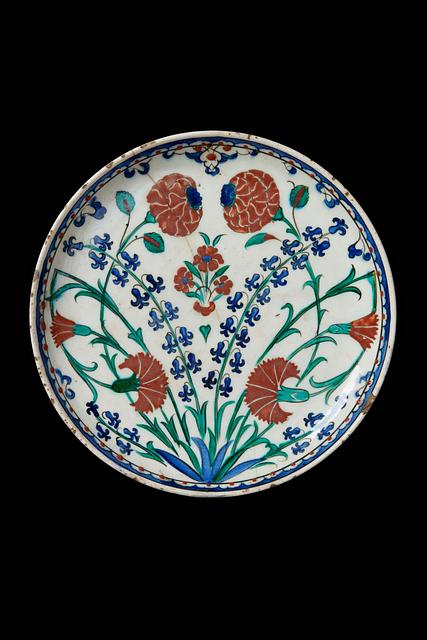
Fritware dish, painted in blue, green, and black and with a red slip under a transparent glaze