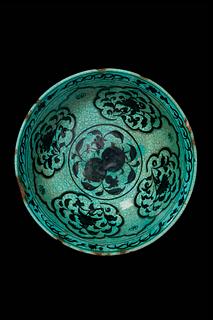
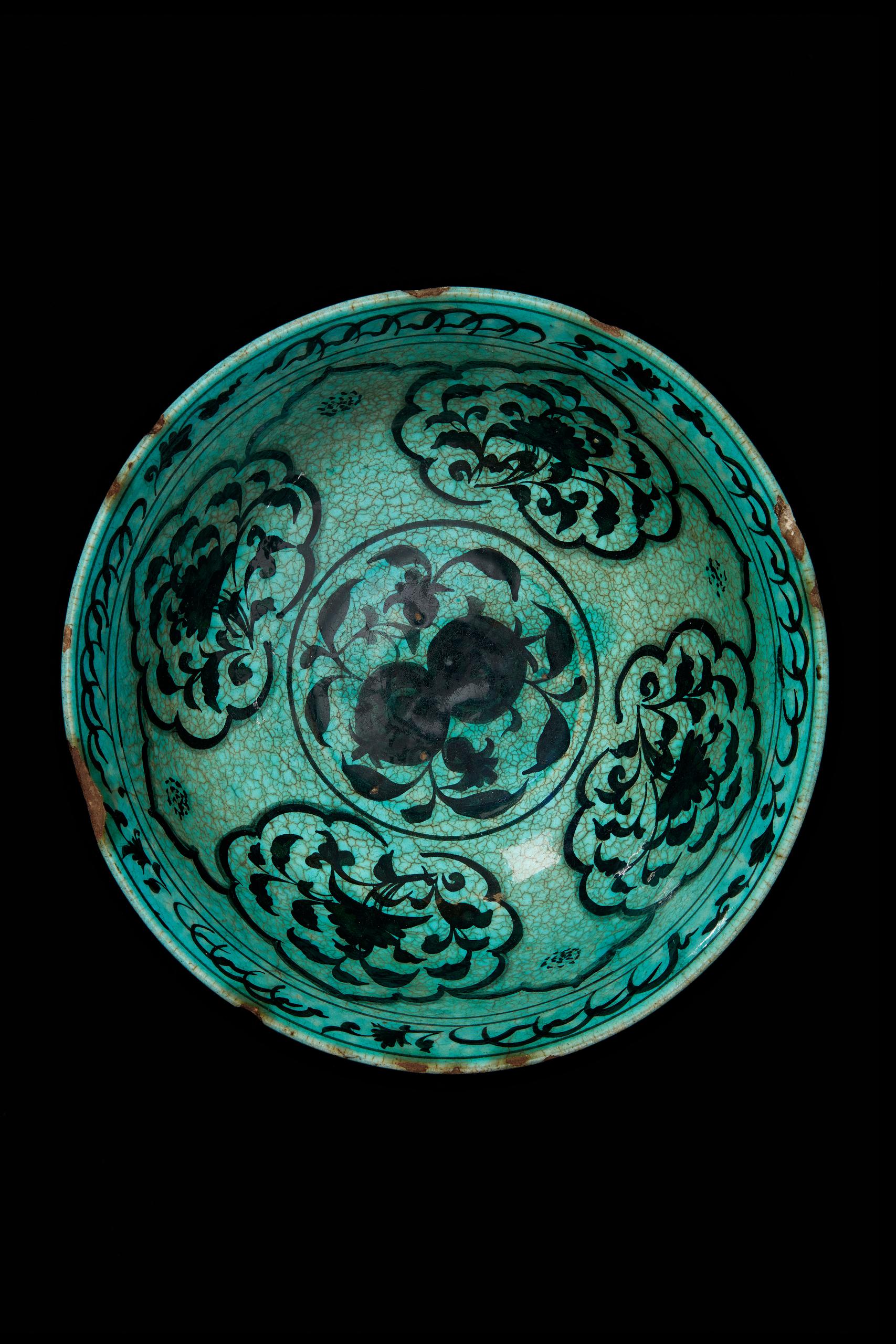
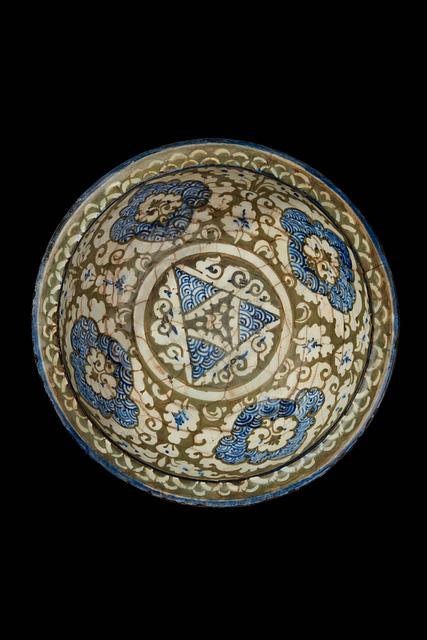
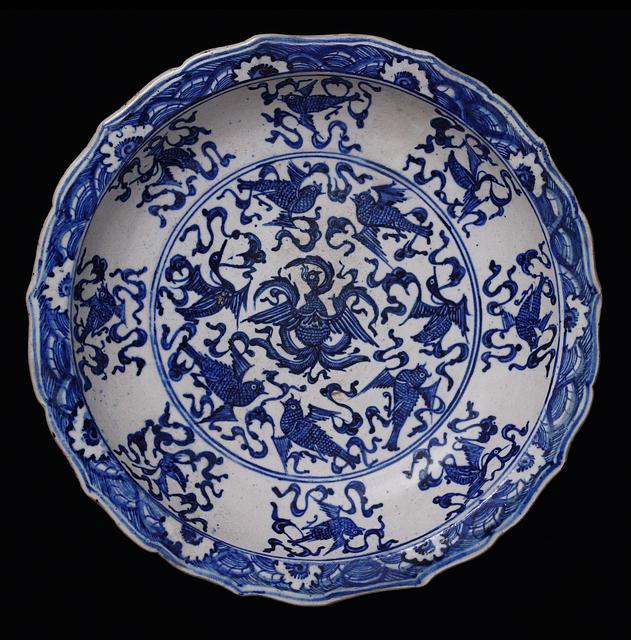
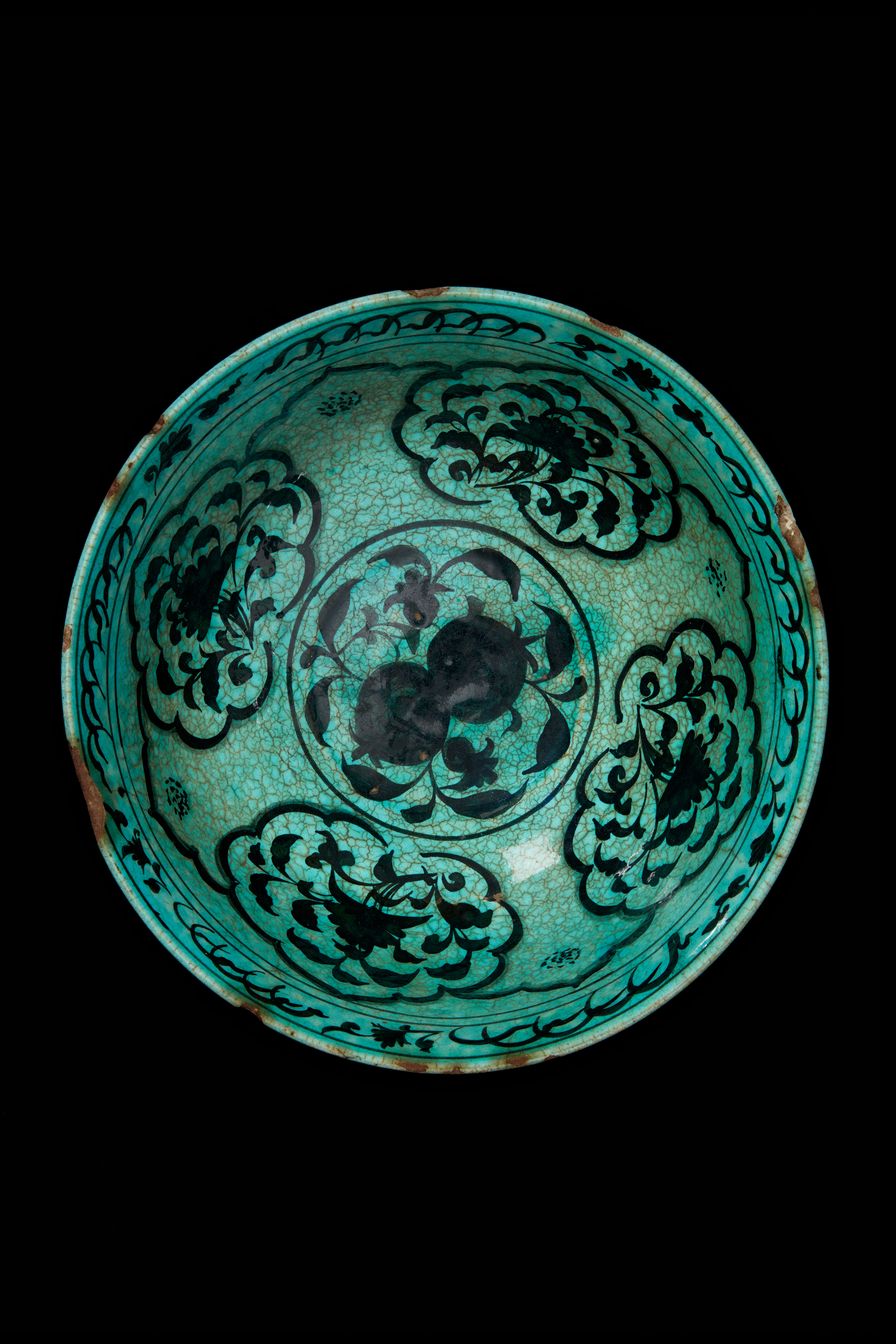
Fritware bowl, painted in black under a transparent, turquoise glaze
Iran, Nishapur?; 2nd half of 15th century
H: 13; Diam: 26 cm
Inventory number Isl 13
There are four dated pieces of pottery of this type, made between 1469 and 1495. Together with other later Persian ceramics, they were found in the outlying Caucasian city of Kubachi, which was famous for its knives. Nearly all of the bowls have holes so that they could be hung as decorations, but they were not, as previously believed, made in Kubachi. They only survived there by chance.
While the elegant decoration comprising two pomegranates surrounded by cartouches with peonies was inspired by that found on Chinese porcelain with blue decoration, the palette, with black painted under turquoise, is Islamic and dates back to the 12th century.
While the elegant decoration comprising two pomegranates surrounded by cartouches with peonies was inspired by that found on Chinese porcelain with blue decoration, the palette, with black painted under turquoise, is Islamic and dates back to the 12th century.
Published in
Published in
C.L. Davids Samling : Nogle Studier, København 1948, pp. 104-105;
Mentioned in Arthur Lane: Later Islamic pottery: Persia, Syria, Egypt, Turkey, London 1957, p. 36, note 2;
Art from the World of Islam. 8th-18th century, Louisiana, Humlebæk 1987, cat.no. 183;
Kjeld von Folsach: Islamic art. The David Collection, Copenhagen 1990, cat.no.164;
Kjeld von Folsach: Art from the World of Islam in The David Collection, Copenhagen 2001, cat.no. 234;
Mentioned in Arthur Lane: Later Islamic pottery: Persia, Syria, Egypt, Turkey, London 1957, p. 36, note 2;
Art from the World of Islam. 8th-18th century, Louisiana, Humlebæk 1987, cat.no. 183;
Kjeld von Folsach: Islamic art. The David Collection, Copenhagen 1990, cat.no.164;
Kjeld von Folsach: Art from the World of Islam in The David Collection, Copenhagen 2001, cat.no. 234;