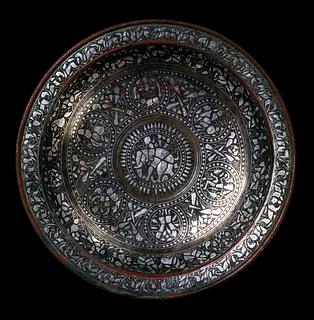
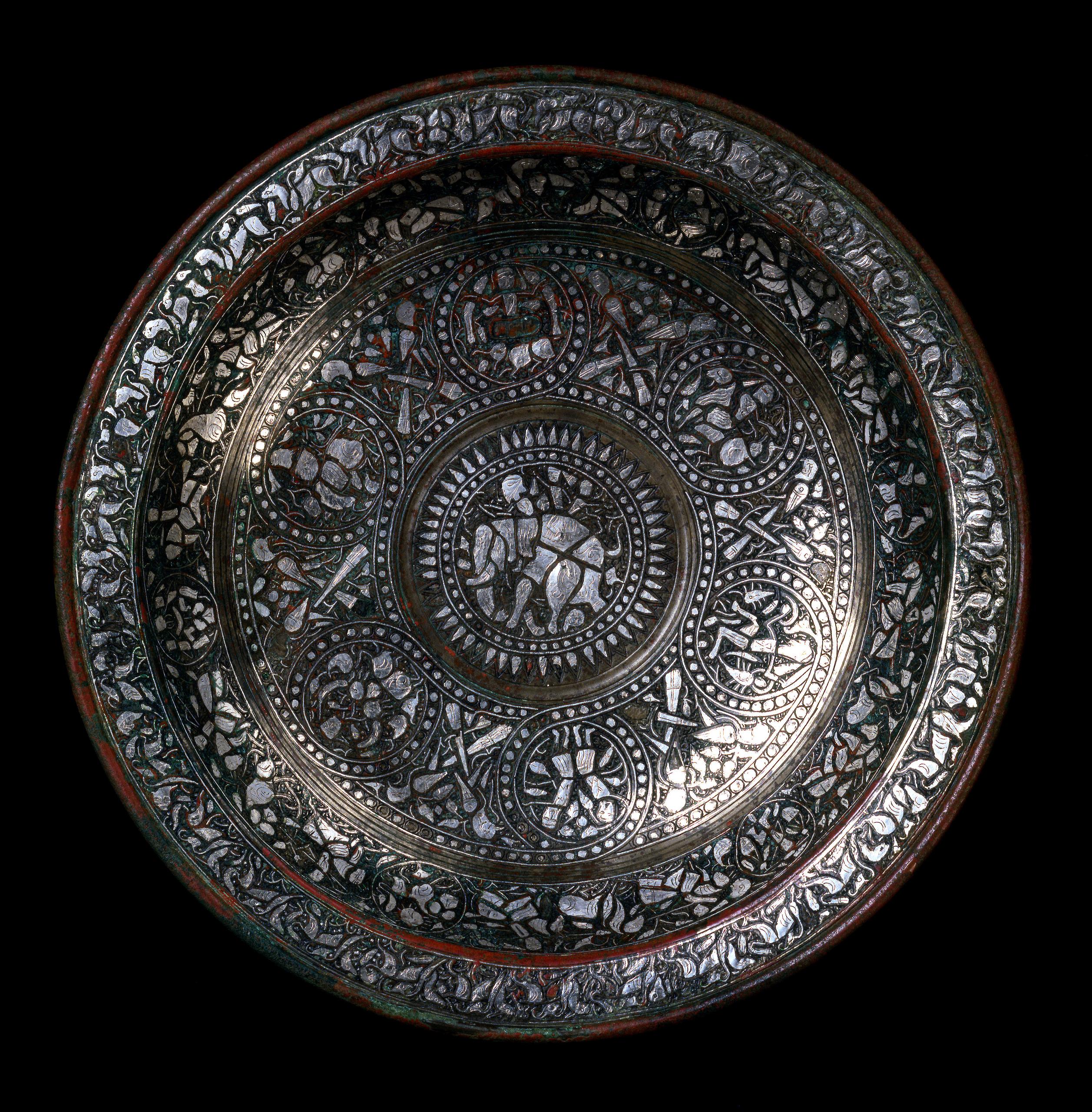
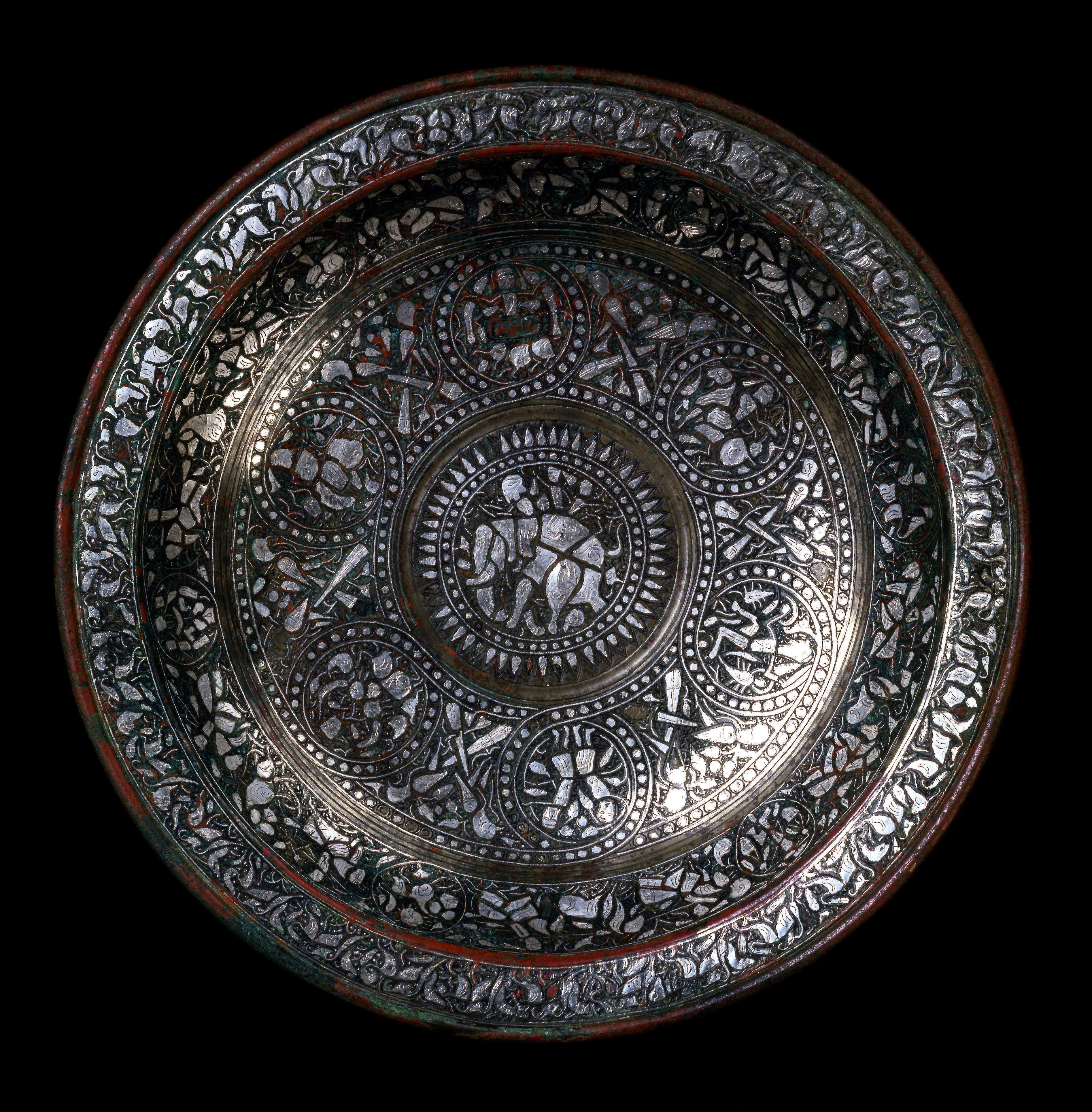
Footed bronze dish, engraved and inlaid with silver and a niello-like substance
Eastern Iran or Afghanistan; end of 12th-13th century
H: 9.8; Diam: 31.8 cm
Inventory number 43/1998
The dish has quite an unusual design in an Islamic context since it stands on a tall foot.
The inlaying in silver is related to the metalwork that was made under the Seljuks in Khorasan, but in this case the decoration is even more sumptuous and the details are perhaps a bit coarser. These features, combined with the depiction of an elephant in the central medallion, make it probable that the dish was made under the Ghurids, whose art shows the influence of Indian models.
The 12 medallions in the dish’s wide and narrow bands contain signs of the zodiac.
The inlaying in silver is related to the metalwork that was made under the Seljuks in Khorasan, but in this case the decoration is even more sumptuous and the details are perhaps a bit coarser. These features, combined with the depiction of an elephant in the central medallion, make it probable that the dish was made under the Ghurids, whose art shows the influence of Indian models.
The 12 medallions in the dish’s wide and narrow bands contain signs of the zodiac.
Published in
Published in
Kjeld von Folsach: Art from the World of Islam in the David Collection, Copenhagen 2001, cat. 487
Kjeld von Folsach and Joachim Meyer: The Human Figure in Islamic Art. Holy Men, Princes and Commoners, The David Collection, Copenhagen 2017, cat. 14;
Mark Kerr-Smiley: Mamluks, Conquest and Culture. The Ghurid Empire and Early Delhi Sultanate c. 1150-1236, London 2025, fig. 7;
Ayben Kayin: “Selçuklu Sanatında Gezegen ve Burç Tasvirlerinde Müzik ve Dans,” Selçuk Üniversitesi Türkiyat Araştırmaları Dergisi, 49, 2020, fig. 12-13, s. 504-505;
Kjeld von Folsach and Joachim Meyer: The Human Figure in Islamic Art. Holy Men, Princes and Commoners, The David Collection, Copenhagen 2017, cat. 14;
Mark Kerr-Smiley: Mamluks, Conquest and Culture. The Ghurid Empire and Early Delhi Sultanate c. 1150-1236, London 2025, fig. 7;
Ayben Kayin: “Selçuklu Sanatında Gezegen ve Burç Tasvirlerinde Müzik ve Dans,” Selçuk Üniversitesi Türkiyat Araştırmaları Dergisi, 49, 2020, fig. 12-13, s. 504-505;