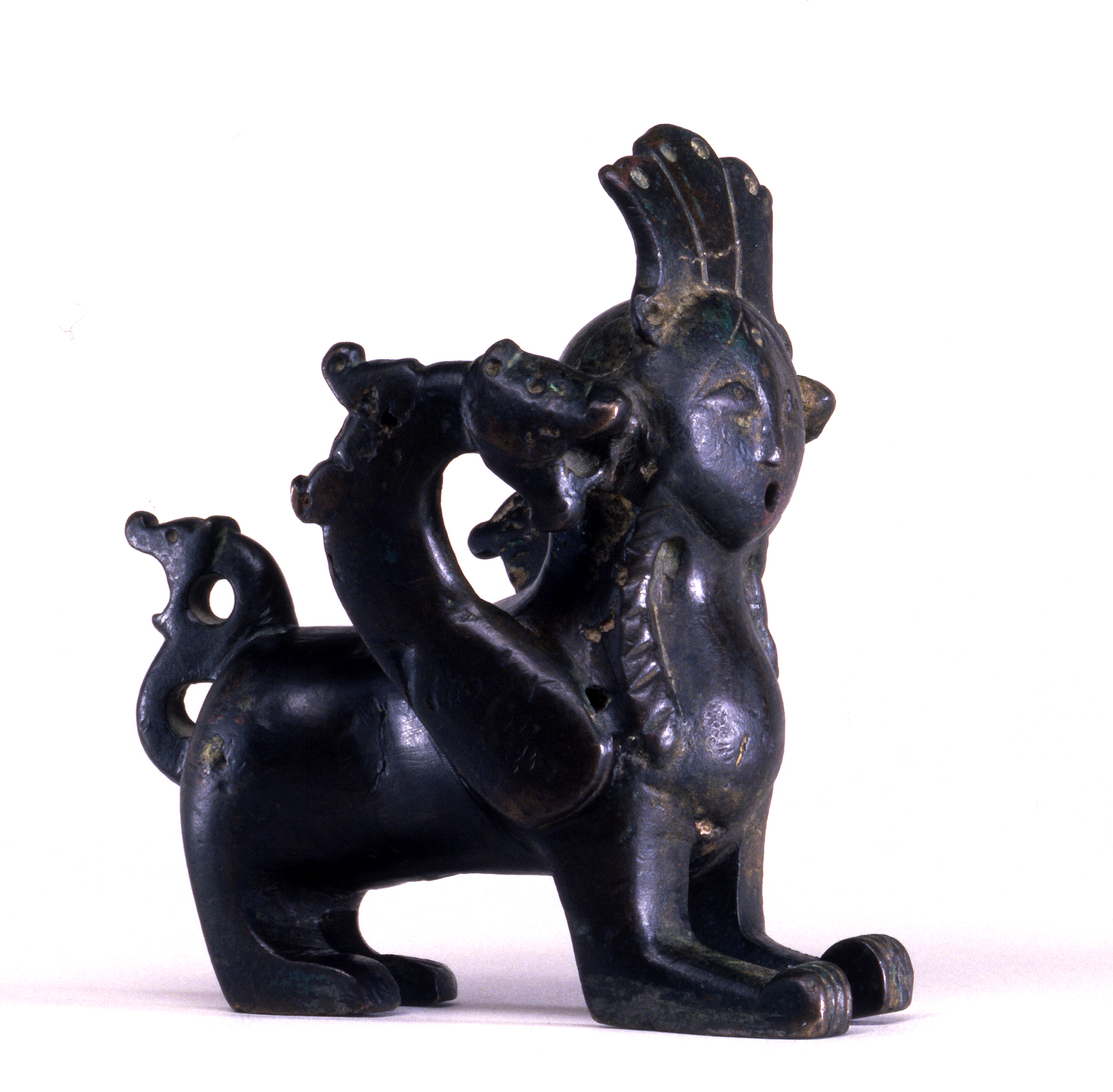
Sphinx, cast bronze
Eastern Turkey; 12th-13th century
H: 12; L: 10.8 cm
Inventory number 5/1978
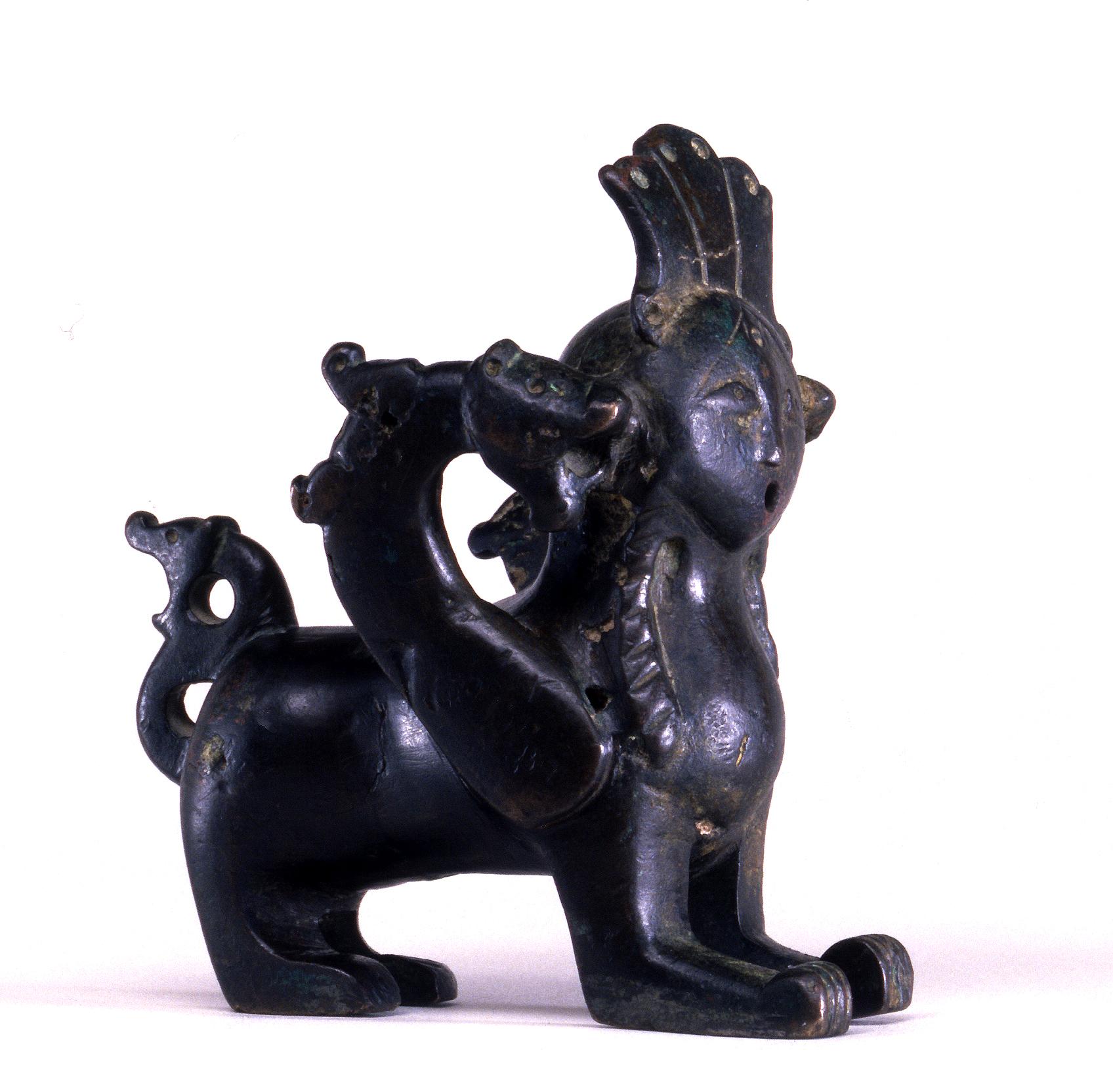
The little sphinx was probably a fountain figure from which water emerged in three jets: through the sphinx’s mouth and the mouths of the two dragon heads at the end of the sphinx’s wings.
Sphinxes (lions with human heads and also often wings) are mythological creatures whose history dates back to ancient times. They were among the most popular motifs in the Islamic Middle Ages, where they were often crowned with a diadem. It is difficult to determine a sphinx’s sex, although in some cases it seems to be mostly female.
The sphinx does not seem to have any specific symbolic significance. Its popularity as an artistic motif is probably due to its decorative qualities. Art from Jazira, in particular, often exhibits a close link with pre-Islamic imagery.
Sphinxes (lions with human heads and also often wings) are mythological creatures whose history dates back to ancient times. They were among the most popular motifs in the Islamic Middle Ages, where they were often crowned with a diadem. It is difficult to determine a sphinx’s sex, although in some cases it seems to be mostly female.
The sphinx does not seem to have any specific symbolic significance. Its popularity as an artistic motif is probably due to its decorative qualities. Art from Jazira, in particular, often exhibits a close link with pre-Islamic imagery.
Published in
Published in
Art from the World of Islam. 8th-18th century, Louisiana Museum of Modern Art, Humlebæk 1987, cat. 92;
Kjeld von Folsach: Islamic Art. The David Collection, Copenhagen1990, cat. 326;
Kjeld von Folsach: Fabelvæsner fra Islams Verden, Davids Samling, København 1991, cat. 4;
Joachim Gierlichs: Mittelalterliche Tierreliefs in Anatolien und Nordmesopotamien. Untersuchungen zur figürlichen Baudekoration der Seldschuken, Artuqiden und ihrer Nachfolger bis ins 15. Jahrhundert, Tübingen 1996, p. 49 og note 404;
Kjeld von Folsach: Art from the World of Islam in the David Collection, Copenhagen 2001, cat. 499;
Yusuf Cetin: Türk Sanatında Ejder Ikonografisi, Ankara 2025, fig. 171, p. 211;
Kjeld von Folsach: Islamic Art. The David Collection, Copenhagen1990, cat. 326;
Kjeld von Folsach: Fabelvæsner fra Islams Verden, Davids Samling, København 1991, cat. 4;
Joachim Gierlichs: Mittelalterliche Tierreliefs in Anatolien und Nordmesopotamien. Untersuchungen zur figürlichen Baudekoration der Seldschuken, Artuqiden und ihrer Nachfolger bis ins 15. Jahrhundert, Tübingen 1996, p. 49 og note 404;
Kjeld von Folsach: Art from the World of Islam in the David Collection, Copenhagen 2001, cat. 499;
Yusuf Cetin: Türk Sanatında Ejder Ikonografisi, Ankara 2025, fig. 171, p. 211;
.-The-David-Collection_Copenhagen_Photo-Pernille-Klemp.jpg)