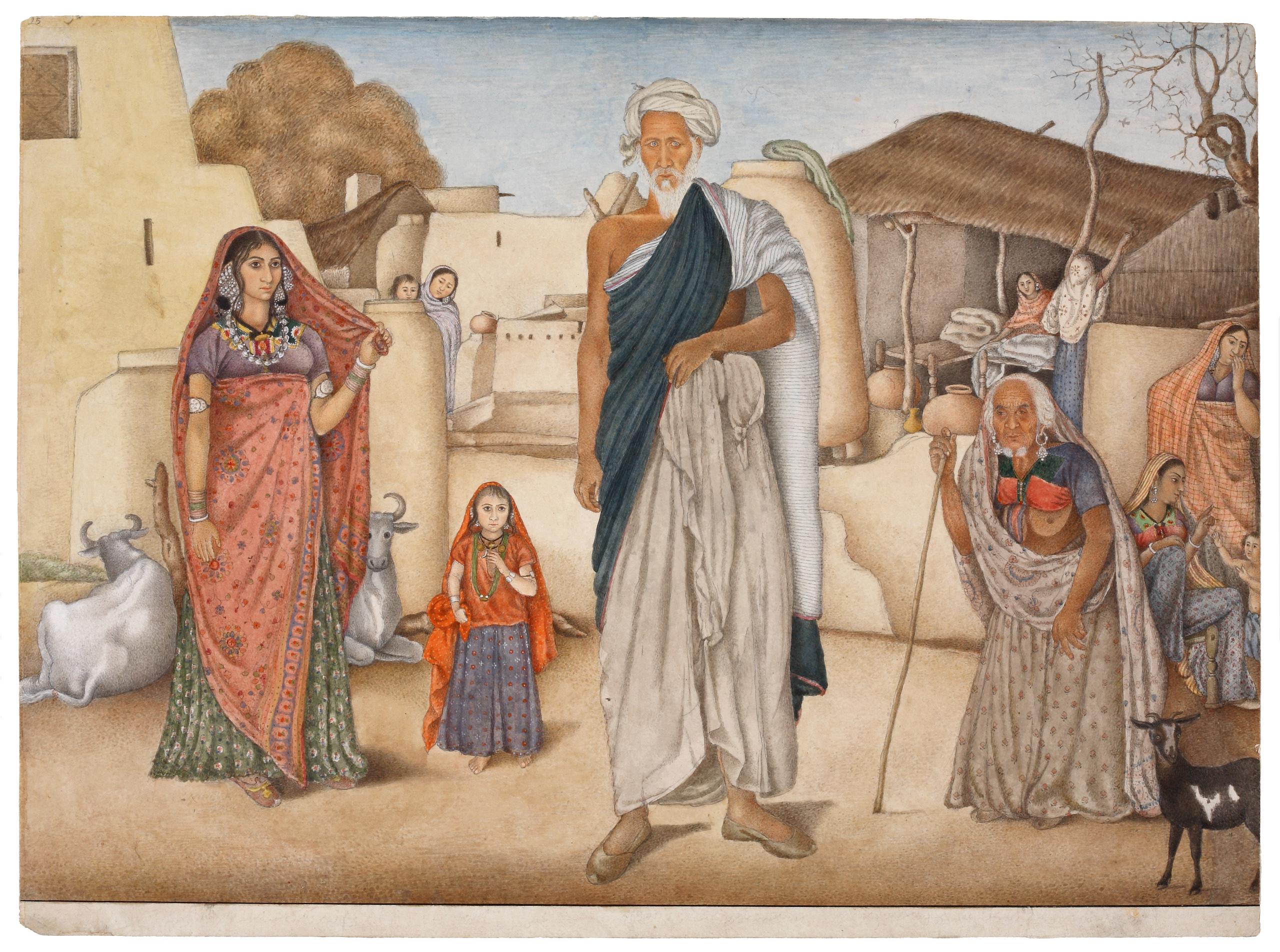
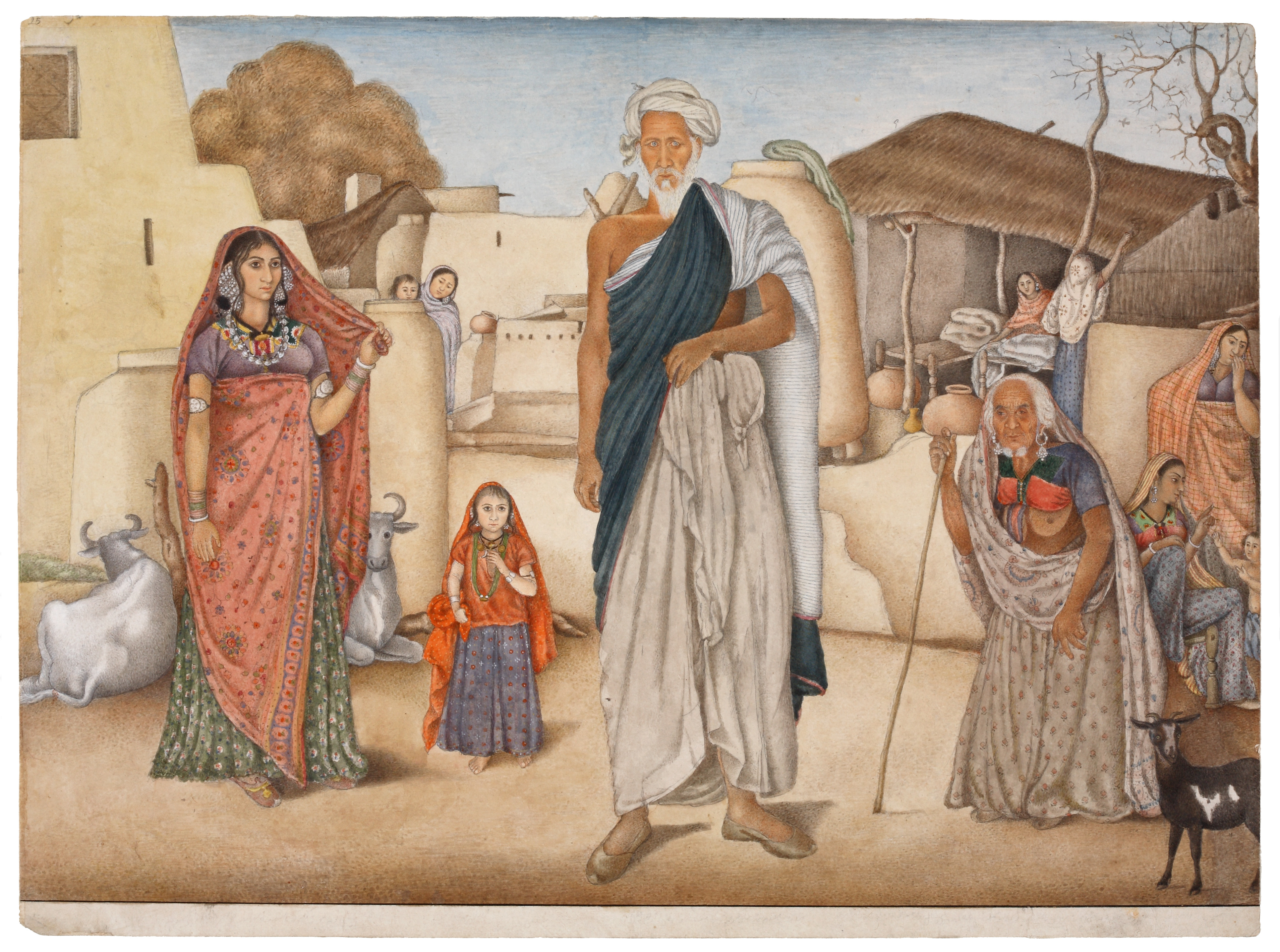
Miniature. ‘Inhabitants from the Village of Rania’
India, Delhi; 1815-1816
Leaf: 31.4 × 43 cm
Inventory number 61/2007
Like four other paintings in the David Collection, this one also comes from the so-called Fraser albums. It shows a number of persons from the village of Rania whose names are also given. The village had a special significance for William Fraser, since Amiban, the lovely young woman on the left, was his Indian “wife.”
Fraser was described in his day as a man who had a very close relationship with the native population and spoke their various languages – characteristics that were useful, but also were offensive to some of his countrymen.
As on most of the Fraser paintings, the synthesis of European and Indian painting traditions seems appealing, but also curiously alienating. In this miniature, the four central figures are, however, supplemented by a village setting that makes them slightly less statuesque.
Fraser was described in his day as a man who had a very close relationship with the native population and spoke their various languages – characteristics that were useful, but also were offensive to some of his countrymen.
As on most of the Fraser paintings, the synthesis of European and Indian painting traditions seems appealing, but also curiously alienating. In this miniature, the four central figures are, however, supplemented by a village setting that makes them slightly less statuesque.
Published in
Published in
Mildred Archer and Toby Falk: India revealed: the art and adventures of James and William Fraser, 1801-35, London 1989, pl. 75, p. 101;
B.N. Goswamy: “Masters of the “Company” portraits” in Milo C. Beach, Eberhard Fischer, B. N. Goswamy (eds.): Masters of Indian painting, vol. 2, 1650-1900, Zûrich 2011, p. 776, fig. 3;
Kjeld von Folsach, Joachim Meyer: The Human Figure in Islamic Art – Holy Men, Princes, and Commoners, The David Collection, Copenhagen 2017, cat.no. 69;
William Dalrymple (ed.): Forgotten masters: Indian painting for the East India Company, Wallace Collection, London 2019, cat.no. 103, p. 166;
B.N. Goswamy: “Masters of the “Company” portraits” in Milo C. Beach, Eberhard Fischer, B. N. Goswamy (eds.): Masters of Indian painting, vol. 2, 1650-1900, Zûrich 2011, p. 776, fig. 3;
Kjeld von Folsach, Joachim Meyer: The Human Figure in Islamic Art – Holy Men, Princes, and Commoners, The David Collection, Copenhagen 2017, cat.no. 69;
William Dalrymple (ed.): Forgotten masters: Indian painting for the East India Company, Wallace Collection, London 2019, cat.no. 103, p. 166;