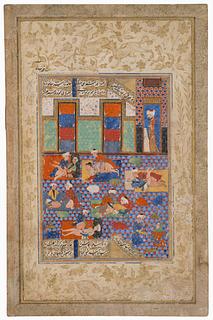
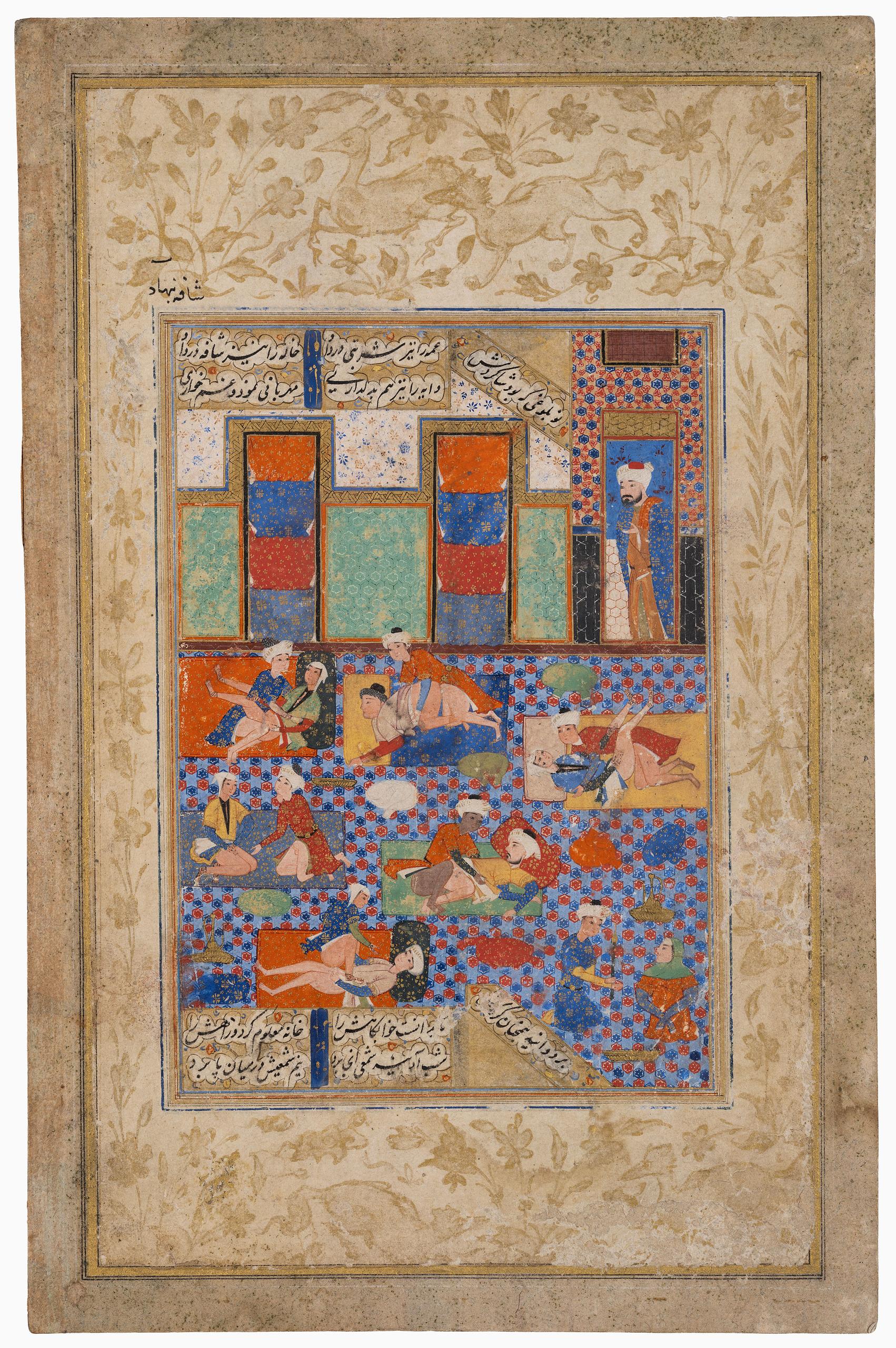
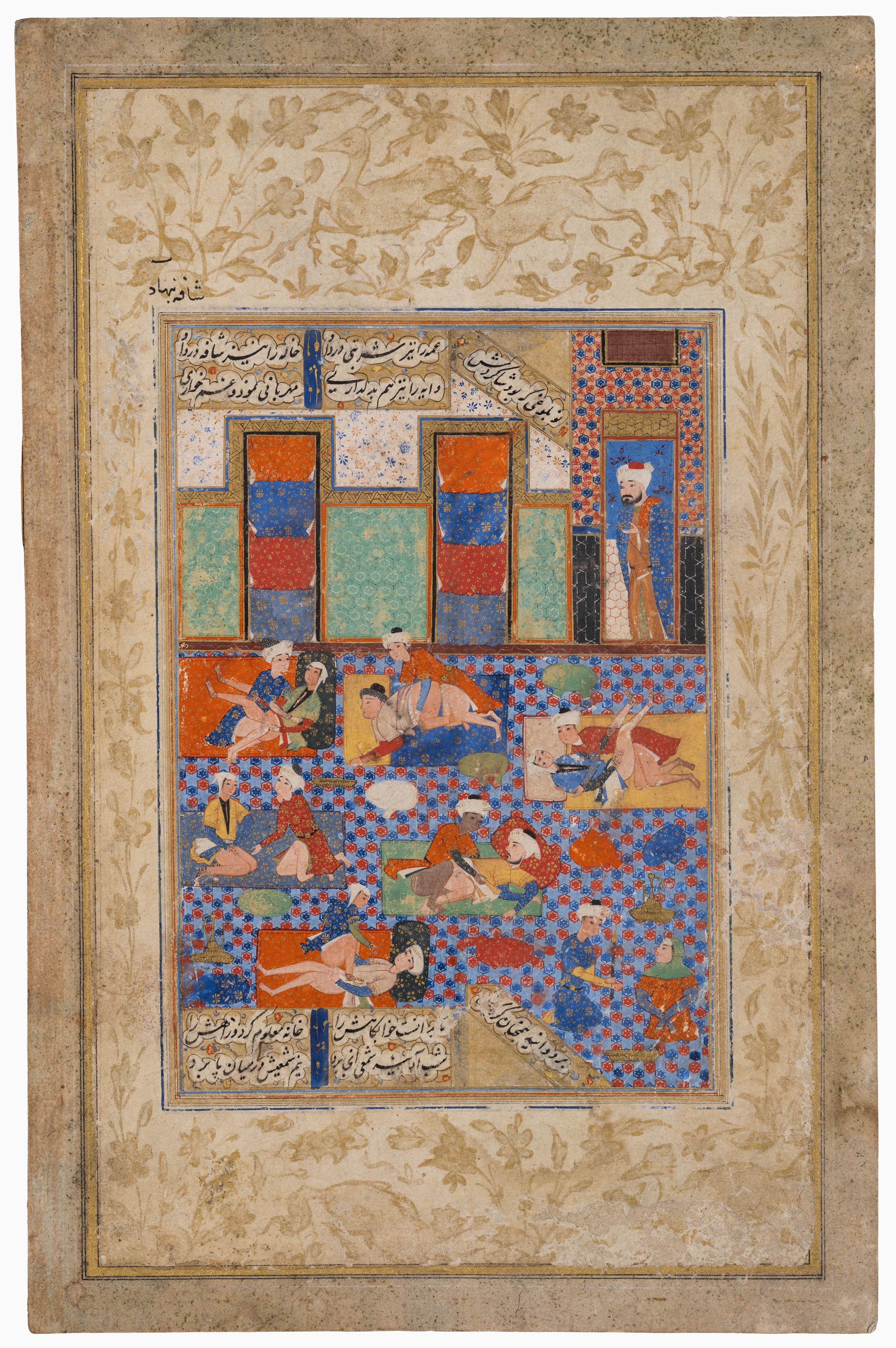
Miniature from a copy of Sadi’s Kulliyat (Collected Works). ‘A Disappointed Groom’s Revolt’
Iran, Shiraz; second half of the 16th century
Leaf: 26.3 x 17.2 cm
Inventory number 9/2024
Explicit sex scenes are rare in the Islamic miniature tradition, but they are not an unknown phenomenon (see 8/2018). Particularly in illustrated manuscripts from sixteenth-century Shiraz, there appears to have been a certain openness toward erotic subjects (see also 94/2006), which may be linked to the broader interest in colourful depictions of daily life in the city’s bazaars and bathhouses that characterized Shiraz paintings from this period.1
This miniature illustrates a poem by the poet Sadi (d. 1292), which tells the story of a young groom who, on his wedding night, finds his bride repulsive. When he requests a divorce from his father-in-law, he is refused, and in frustration, the young groom engages in a series of erotic affairs with everyone in the household, from the bride’s sister and brother to the family’s elderly nursemaid. The ensuing scandal ultimately forces the father-in-law to annul the marriage and return the bride price.
The poem is one of Sadi’s obscene poems, known as khabisat (obscenities, ribaldries). In modern editions of Sadi’s collected works, these poems are often omitted, but in older manuscripts they appear alongside his more modest love poetry.2
The poem consists of 70 double verses, but rather than illustrating a single couplet, the artist has depicted all of the groom’s transgressions as a series of parallel scenes of intercourse, all observed by the father-in-law.3 In the lower right corner, the young man’s nocturnal visit to the household’s nursemaid is portrayed. At first glance, this scene appears more innocent than the others, but the slender candle he holds before him can be interpreted as a phallic metaphor, a symbolism made explicit in the text: ‘On Friday night, he took a candle there / He placed half of his candle in the candle holder.’
This miniature illustrates a poem by the poet Sadi (d. 1292), which tells the story of a young groom who, on his wedding night, finds his bride repulsive. When he requests a divorce from his father-in-law, he is refused, and in frustration, the young groom engages in a series of erotic affairs with everyone in the household, from the bride’s sister and brother to the family’s elderly nursemaid. The ensuing scandal ultimately forces the father-in-law to annul the marriage and return the bride price.
The poem is one of Sadi’s obscene poems, known as khabisat (obscenities, ribaldries). In modern editions of Sadi’s collected works, these poems are often omitted, but in older manuscripts they appear alongside his more modest love poetry.2
The poem consists of 70 double verses, but rather than illustrating a single couplet, the artist has depicted all of the groom’s transgressions as a series of parallel scenes of intercourse, all observed by the father-in-law.3 In the lower right corner, the young man’s nocturnal visit to the household’s nursemaid is portrayed. At first glance, this scene appears more innocent than the others, but the slender candle he holds before him can be interpreted as a phallic metaphor, a symbolism made explicit in the text: ‘On Friday night, he took a candle there / He placed half of his candle in the candle holder.’
Published in
Published in
Bora Keskiner: Hidden Treasures: geometry and nature between past and present, Kent Antiques, London 2024, p. 62;
Footnotes
Footnotes
1.
Lale Uluç: Turkman Governors, Shiraz Artisans and Ottoman Collectors: Sixteenth Century Shiraz Manuscripts, Istanbul 2006, pp. 198–223.
2.
See Chapter 3 in Domenico Ingenito: Beholding Beauty: Sa’di of Shiraz and the Aesthetics of Desire in Medieval Persian Poetry, Leiden 2020.
3.
Similar depictions of the same poem can be found in two contemporary Kulliyat manuscripts from Shiraz, reproduced in: Lale Uluç: Turkman Governors, Shiraz Artisans and Ottoman Collectors: Sixteenth Century Shiraz Manuscripts, Istanbul 2006, pp. 218–219, and Joseph Allen Boone: The Homoerotics of Orientalism, New York 2014, p. 397 and plate 21.
Miniature Paintings
Double frontispiece painting from a copy of Jami’s Yusuf wa Zulaykha. ‘Picnic in a Tree House’
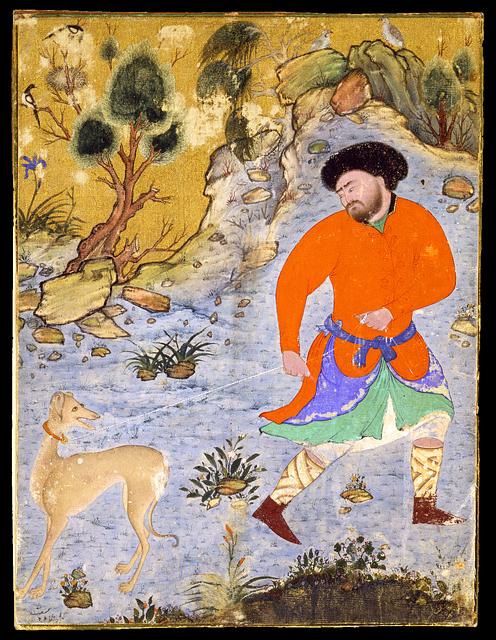
Miniature painted on cotton fabric. ‘Man with a Saluki’
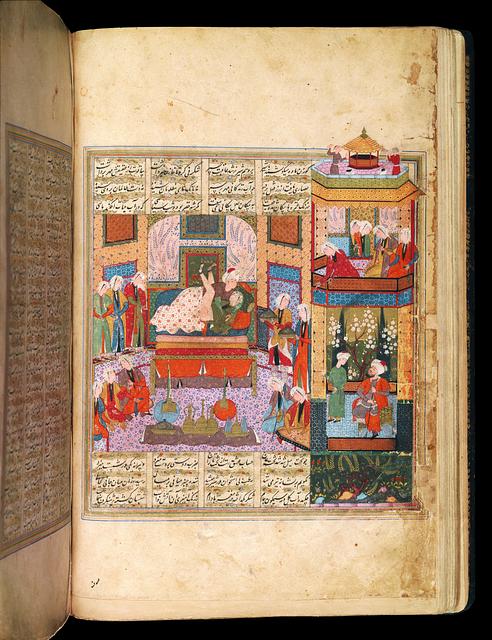
A copy of Nizami’s Khamsa. The first miniature (fol. 107v): ‘The Consummation of the Marriage Between Khusraw and Shirin’
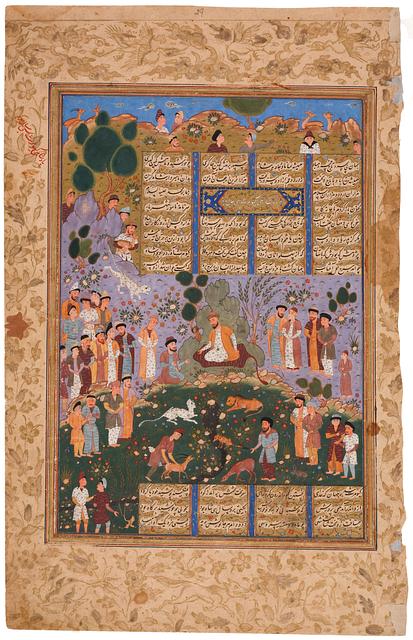
Miniature from a copy of Firdawsi’s Shahnama. ‘The Court of Gayumarth’