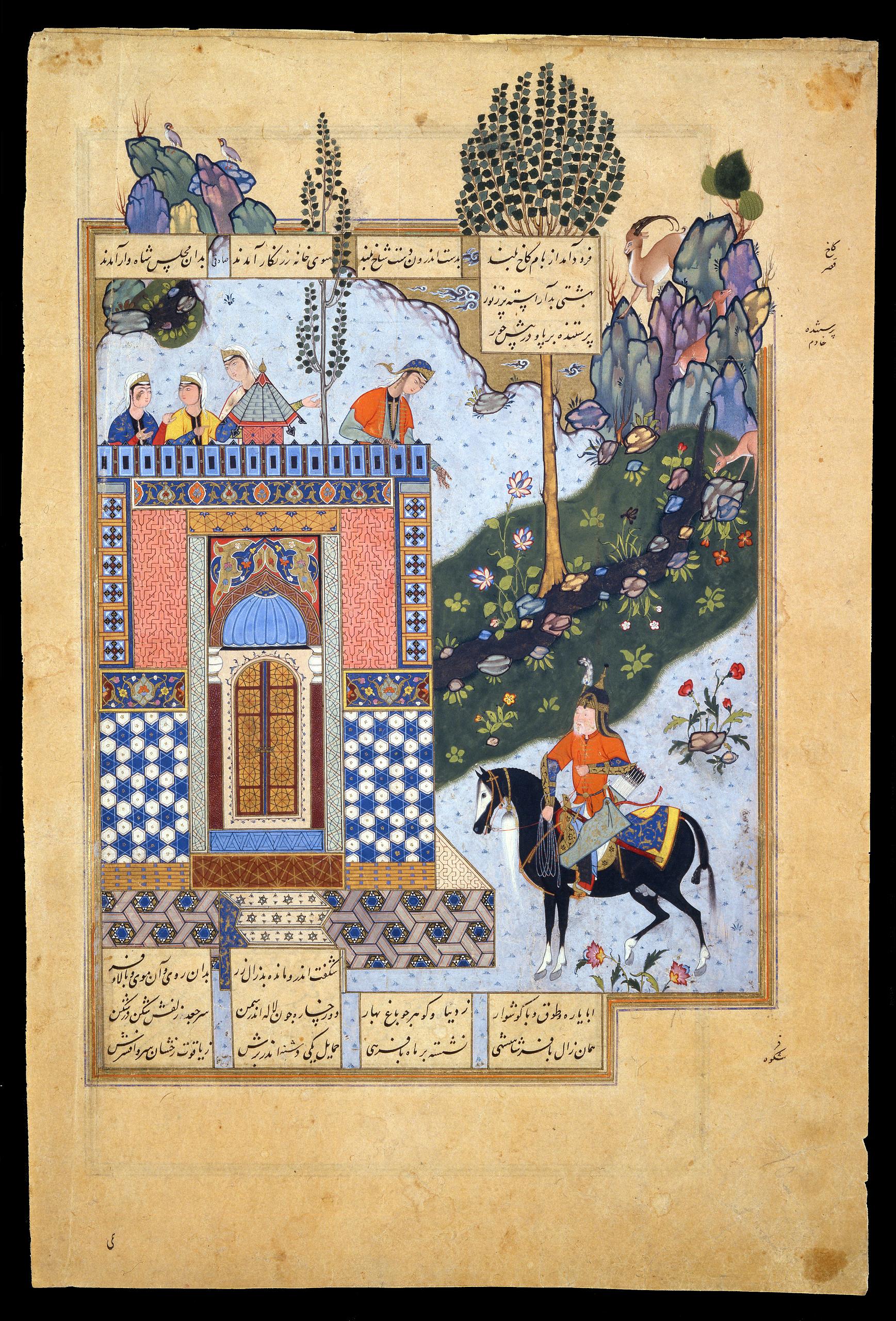
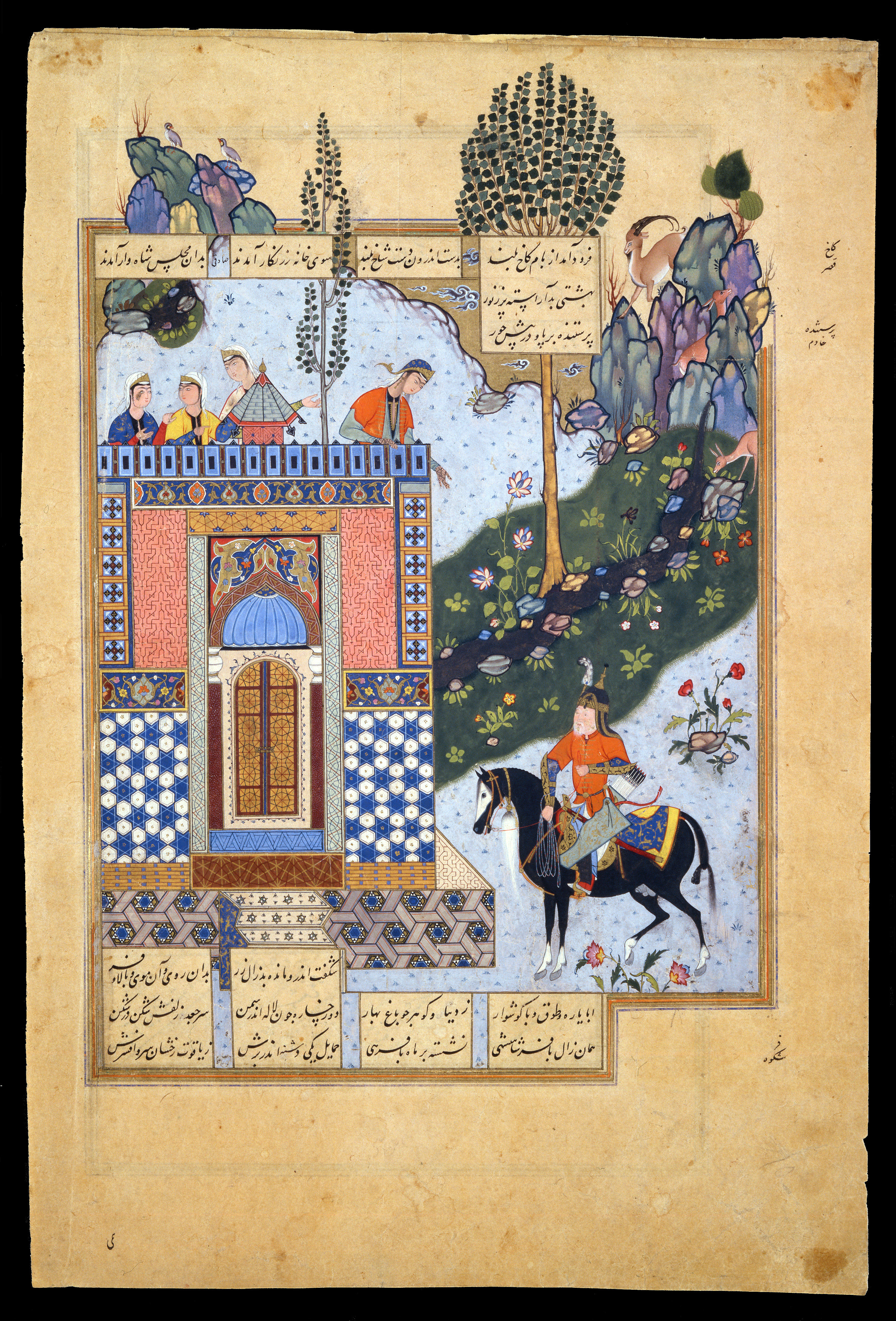
Miniature from a copy of Firdawsi’s Shahnama. ‘Zal Beneath Rudaba’s Balcony’. Ascribed to Sadiqi Beg
Iran, Qasvin; 1576-1577
Leaf: 46 × 31 cm
Inventory number 99/2006
In his later years, Shah Tahmasp developed a distaste for figurative painting, and as a result, the court studio’s artists were scattered. Not until the rule of his son, Ismail II (1576-1578), was another large manuscript made under the direct protection of the Safavids.
The Persian general Zal, who was born with white hair and for this reason was rejected by his father and raised by the mythical bird Simurgh, is in Kabul. He sees King Mihrab’s divinely beautiful daughter Rudaba, and they immediately fall in love, though they belong to opposing parties.
Rudaba makes a sign with her henna-stained hand to bold Zal, who is about to throw his lasso so that he can climb up to his beloved. The two spend the night together.
The colorful, tiled royal palace is in a mountainous landscape with peaks inhabited by birds, ibexes, and gazelles. A silver (now black) stream flows from one of the rocks. As always in dry regions, green grass and flowers are found where there is abundant life-giving water, which plays such an important role in Islamic gardens.
The Persian general Zal, who was born with white hair and for this reason was rejected by his father and raised by the mythical bird Simurgh, is in Kabul. He sees King Mihrab’s divinely beautiful daughter Rudaba, and they immediately fall in love, though they belong to opposing parties.
Rudaba makes a sign with her henna-stained hand to bold Zal, who is about to throw his lasso so that he can climb up to his beloved. The two spend the night together.
The colorful, tiled royal palace is in a mountainous landscape with peaks inhabited by birds, ibexes, and gazelles. A silver (now black) stream flows from one of the rocks. As always in dry regions, green grass and flowers are found where there is abundant life-giving water, which plays such an important role in Islamic gardens.
Published in
Published in
Sotheby’s London, 6/12-1970, lot 48;
Anthony Welch: Artists for the shah: late sixteenth-century painting at the imperial court of Iran, New Haven 1976, fig. 14;
Kjeld von Folsach: For the Privileged Few: Islamic Miniature Painting from The David Collection, Louisiana, Humlebæk 2007, cat.no. 53;
Kjeld von Folsach: Flora islamica: plantemotiver i islamisk kunst, Davids Samling, København 2013, cat.no. 2;
Joachim Meyer and Peter Wandel: Shahnama: The colorful epic about Iran's past, The David Collection, Copenhagen 2016, , cat.no. 8;
Kjeld von Folsach, Joachim Meyer: The Human Figure in Islamic Art – Holy Men, Princes, and Commoners, The David Collection, Copenhagen 2017, cat.no. 54;
Anthony Welch: Artists for the shah: late sixteenth-century painting at the imperial court of Iran, New Haven 1976, fig. 14;
Kjeld von Folsach: For the Privileged Few: Islamic Miniature Painting from The David Collection, Louisiana, Humlebæk 2007, cat.no. 53;
Kjeld von Folsach: Flora islamica: plantemotiver i islamisk kunst, Davids Samling, København 2013, cat.no. 2;
Joachim Meyer and Peter Wandel: Shahnama: The colorful epic about Iran's past, The David Collection, Copenhagen 2016, , cat.no. 8;
Kjeld von Folsach, Joachim Meyer: The Human Figure in Islamic Art – Holy Men, Princes, and Commoners, The David Collection, Copenhagen 2017, cat.no. 54;
Miniature Paintings
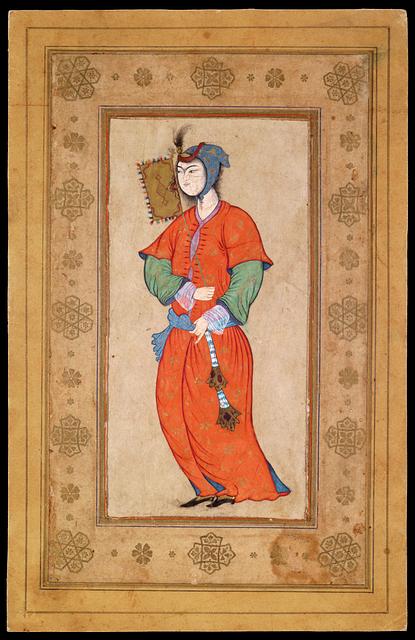
Miniature pasted on an album leaf. ‘Young Woman with a Fan’
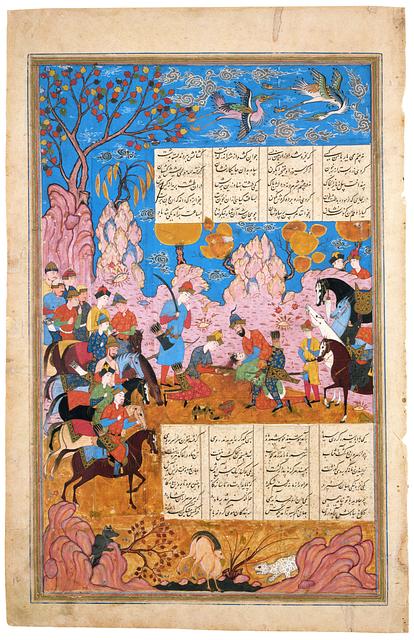
Miniature from a copy of Firdawsi’s Shahnama. ‘The Slaying of Siyawush’
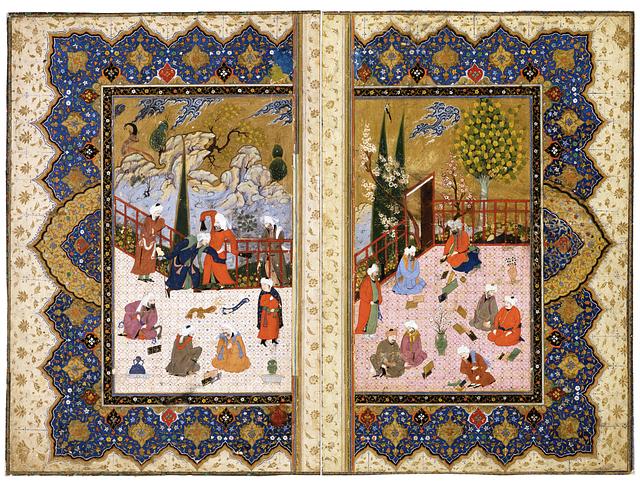
Double frontispiece painting for an unknown manuscript. ‘A Gathering of Learned Men on a Terrace’
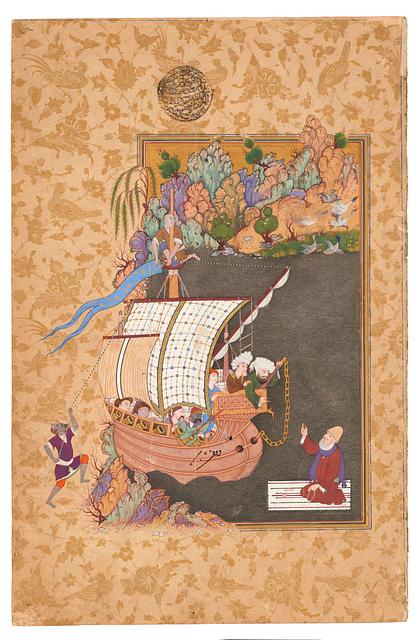
Miniature from a copy of Sadi’s Bustan. ‘The Dervish from Faryab Crosses the River on his Rug,’ attributed to Habiballah