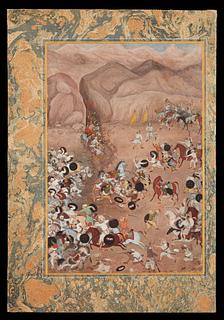
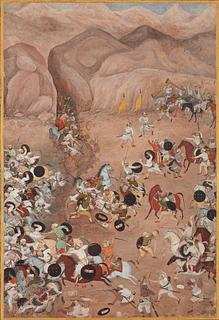
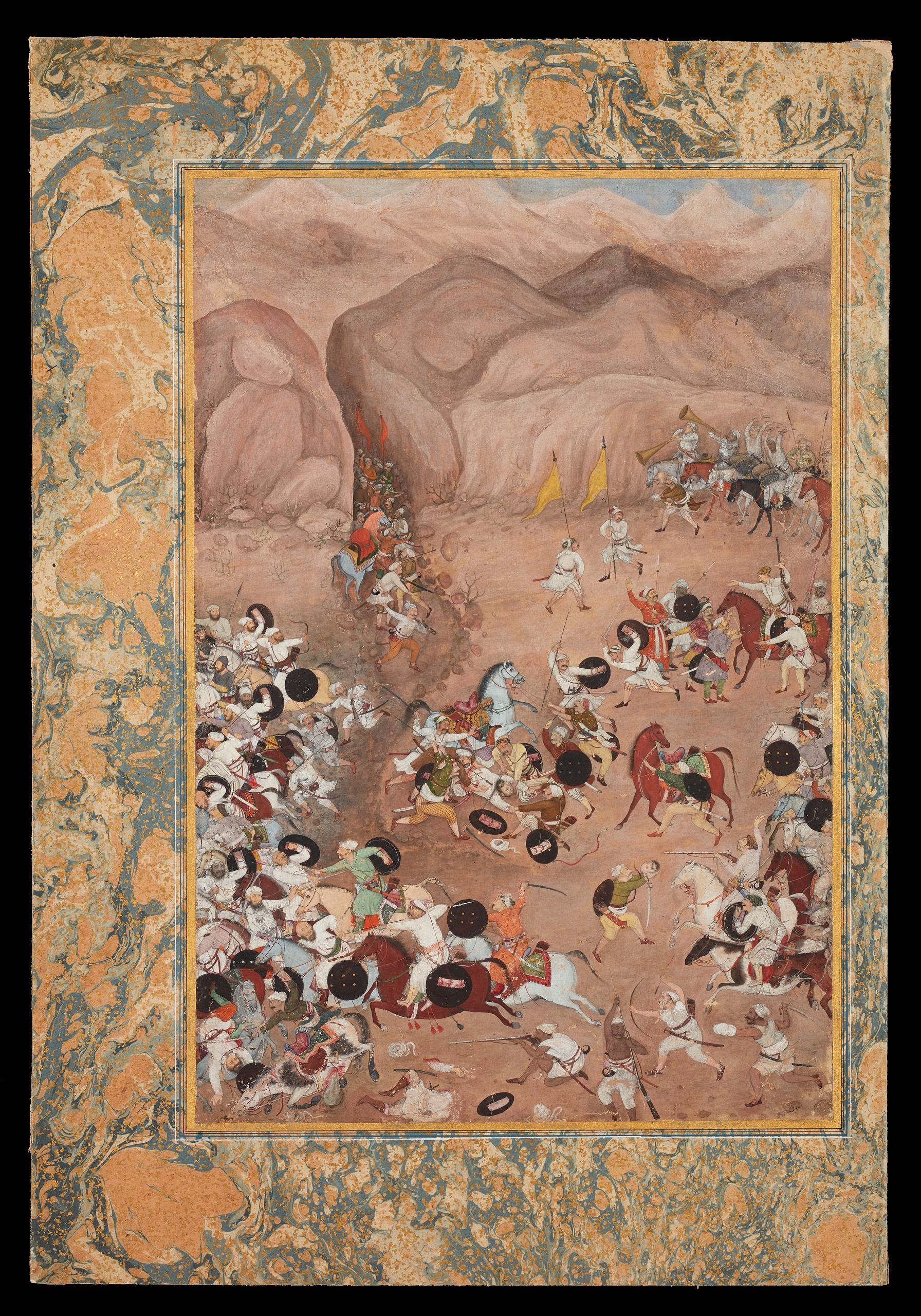
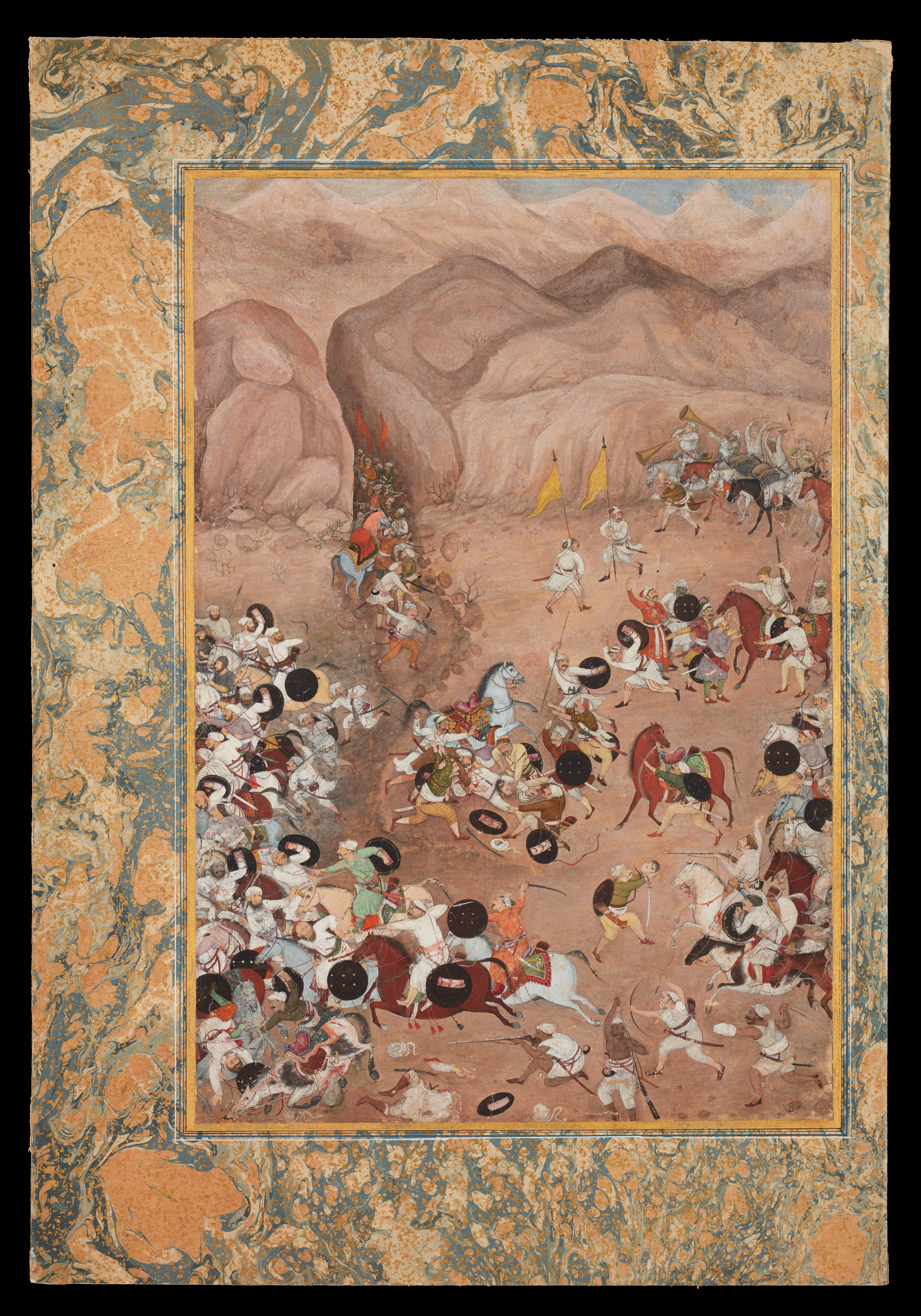
Miniature pasted on an album leaf. ‘Bikramajit’s Victory over Darya Khan in 1631’
India, Mughal; 1631–35
Leaf: 47.5 x 32.5 cm
Inventory number 37/2019
The painting depicts a historical battle in which the Hindu prince Bikramajit Bundella, acting on behalf of the Mughal emperor Shah Jahan (r. 1627–58), attacked and defeated Darya Khan Rohilla, a renegade Mughal general who had declared war on his former masters.
Bikramajit is seen on horseback with a raised rifle on the right side of the battlefield, while his warriors charge ahead armed with sabres, lances, bows and rifles. The Afghan army, sporting full beards, is depicted in a state of chaotic flight towards the left side of the picture. In the middle a man has been pulled down from his horse and is now having his throat cut. The victim is presumably the Afghan leader Darya Khan.
The entire battle scene captures the dynamics and horrors of war with great vividness and accuracy. The soldiers are not reduced to uniform figures in static battle formations; rather, they are portrayed as individually fighting, fleeing and dying warriors. In one place, a turbanless Afghan desperately grabs the lance that pierces his chest, elsewhere a Hindu warrior has stopped in the middle of the attack to parade a severed head.
The painting is attributed to the Mughal painter Balchand (1/2009) and may have been intended for inclusion in the Mughal emperor Shah Jahan’s biography, the Padshahnama. In 1635, however, Bikramajit Bundella rebelled against the Mughal emperor and was subsequently executed on the latter’s command. Bikramajit’s later betrayal is perhaps the reason why the painting of his victory over Darya Khan in 1631 did not find a place in the final version of the Padshahnama.1
Bikramajit is seen on horseback with a raised rifle on the right side of the battlefield, while his warriors charge ahead armed with sabres, lances, bows and rifles. The Afghan army, sporting full beards, is depicted in a state of chaotic flight towards the left side of the picture. In the middle a man has been pulled down from his horse and is now having his throat cut. The victim is presumably the Afghan leader Darya Khan.
The entire battle scene captures the dynamics and horrors of war with great vividness and accuracy. The soldiers are not reduced to uniform figures in static battle formations; rather, they are portrayed as individually fighting, fleeing and dying warriors. In one place, a turbanless Afghan desperately grabs the lance that pierces his chest, elsewhere a Hindu warrior has stopped in the middle of the attack to parade a severed head.
The painting is attributed to the Mughal painter Balchand (1/2009) and may have been intended for inclusion in the Mughal emperor Shah Jahan’s biography, the Padshahnama. In 1635, however, Bikramajit Bundella rebelled against the Mughal emperor and was subsequently executed on the latter’s command. Bikramajit’s later betrayal is perhaps the reason why the painting of his victory over Darya Khan in 1631 did not find a place in the final version of the Padshahnama.1
Published in
Published in
J. P. Losty: Into the Indian mind. An insight through portraits, battles and epics in Indian painting, Francesca Galloway, London 2015, pp. 18-27;
Kjeld von Folsach, Joachim Meyer and Peter Wandel: Fighting, Hunting, Impressing. Arms and Armour from the Islamic World 1500-1850, The David Collection, Copenhagen 2021, cat.no. 34 and fig. 16, p. 58;
Kjeld von Folsach, Joachim Meyer and Peter Wandel: Fighting, Hunting, Impressing. Arms and Armour from the Islamic World 1500-1850, The David Collection, Copenhagen 2021, cat.no. 34 and fig. 16, p. 58;
Footnotes
Footnotes
1.
J. P. Losty: Into the Indian Mind: An Insight through Portraits, Battles and Epics in Indian Painting, Francesca Galloway, London 2015, pp. 18–27.
Mughal India

Miniature pasted on an album leaf. ‘A Young Prince with Learned Men on a Terrace’

Miniature pasted on an album leaf. ‘A Woman Visiting a Yogini by a River’

Miniature pasted on an album leaf. ‘Portrait of Mahdi Quli Khan’. Attributed to Ram Das

Miniature pasted on an album leaf. ‘Portrait of a Turkish Ambassador at the Court of Shah Jahan’