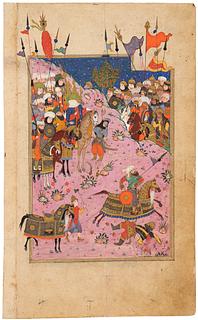
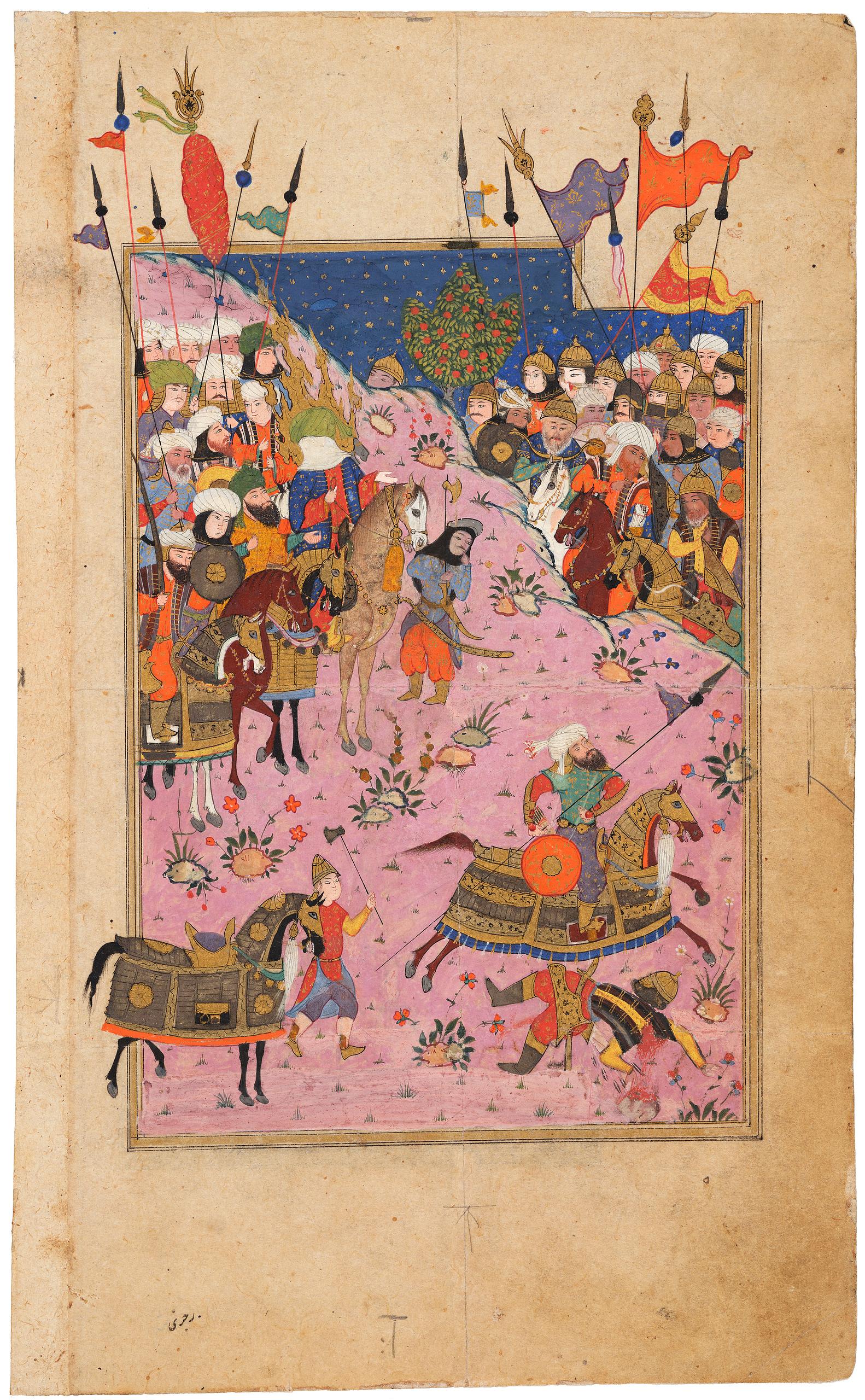
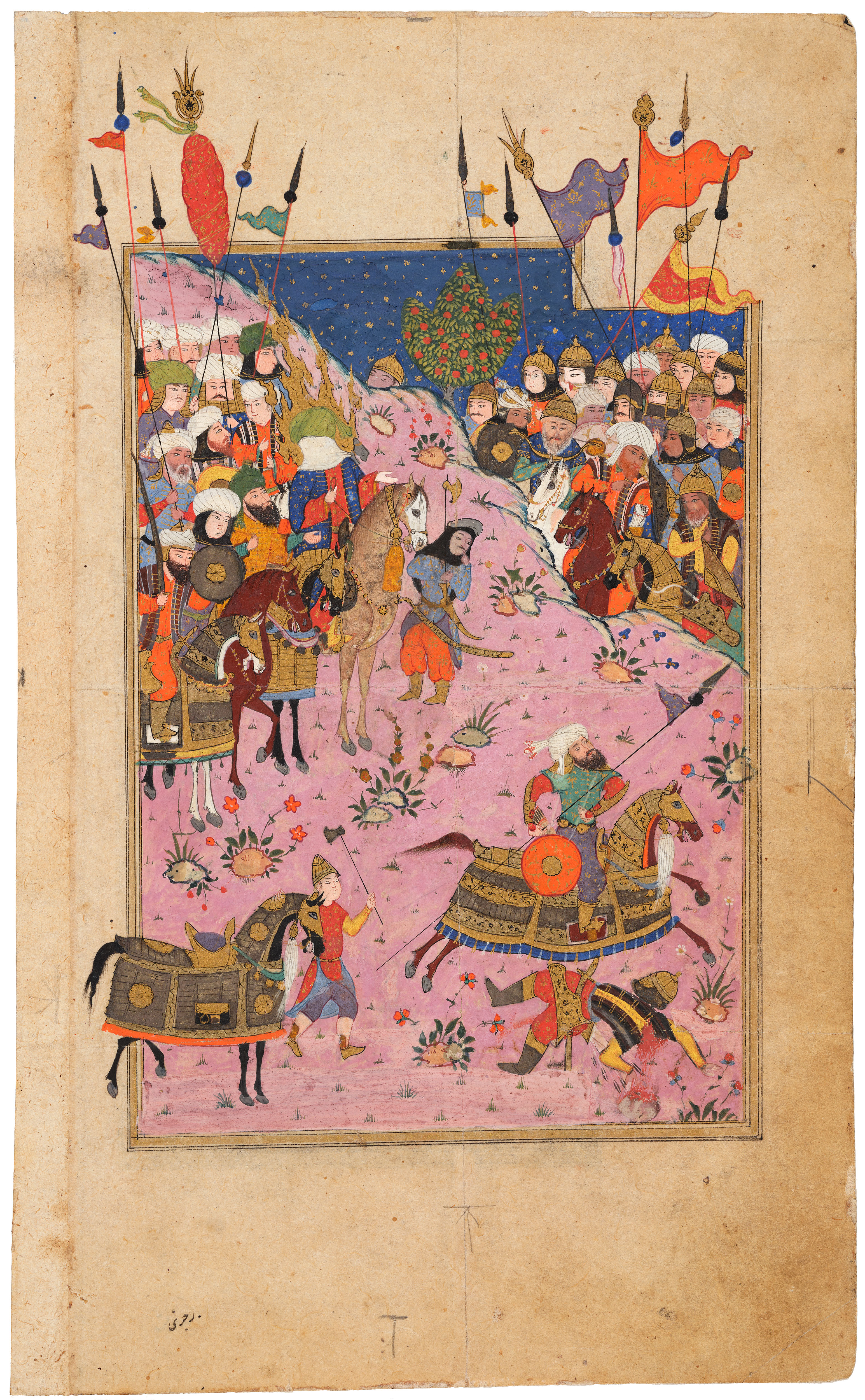
Miniature from a copy of Kashifi’s Rawdat al-Shuhada (Garden of the Martyrs). ‘Abdallah ibn Muslim ibn Aqil Riding Against the Enemy on the Plain of Kerbala’
Ottoman Empire, Baghdad; c. 1600
The leaf: 25.5 x 15.5 cm
Inventory number 22/2022
The painting shows a scene from the Battle of Kerbala in Iraq in the year 680. Here, Muhammad’s grandson, Husayn, fought alongside seventy-two faithful warriors against a numerically superior army sent by the Umayyad Caliph Yazid. In the miniature, Husayn, depicted with a veil and a flaming halo, watches his second cousin Abdallah charge the enemy lines, lance raised. Husayn and most of his supporters were slain during the battle and later came to be revered as martyrs by Shiite communities around the world.
The painting is attributed to the so-called Baghdad school of Ottoman miniature painting, which was active around the end of the sixteenth century. The artists of the Baghdad School borrowed elements from Ottoman court painting as well as from the Persian miniature tradition, but at the same time their pictures feature a number of local traits which are also evident here. One of these concerns the short and robust stature of the figures as well as their large heads. Another typical trait is the variety of ethnicities found among the soldiers in both armies. For example, Husayn’s warriors include a fair-skinned youth with sidelocks, a person with a distinctly Semitic profile, and several Mongolian or Turkish warriors. This diversity may reflect Baghdad’s unique position in the borderland between the Mediterranean, Arabia and Persia/Central Asia.1
Relatively few miniatures from the Baghdad School have been preserved, and many of the surviving examples depict scenes from the Battle of Kerbala. The keen interest in this particular subject is probably due to the city’s large Shiite population, as well as the fact that many of the martyrs from Kerbala were buried in the area.2
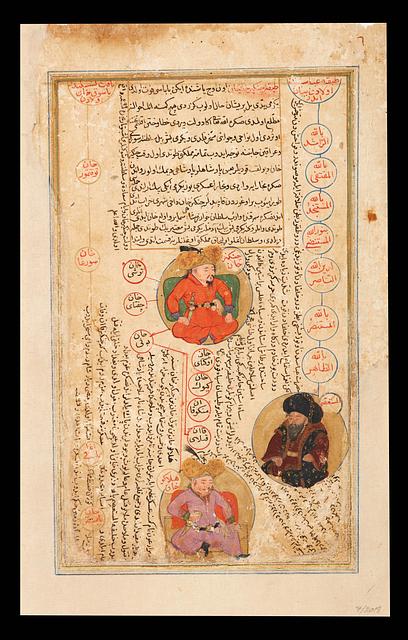
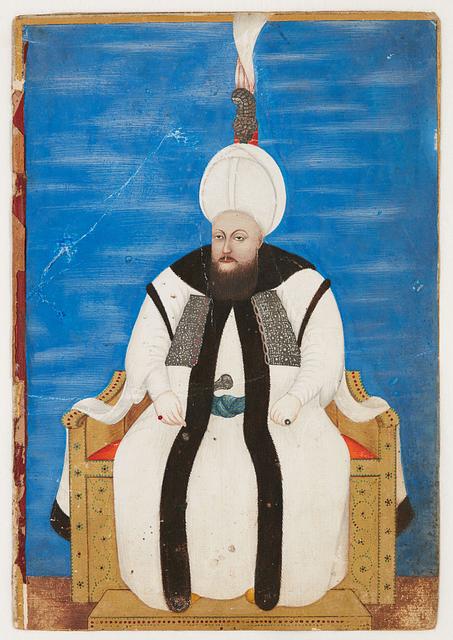
The David Collection also owns a Baghdad miniature depicting a different theme. It is a leaf from a silsilname – a genealogy of the Ottoman sultans (7/2018).
The painting is attributed to the so-called Baghdad school of Ottoman miniature painting, which was active around the end of the sixteenth century. The artists of the Baghdad School borrowed elements from Ottoman court painting as well as from the Persian miniature tradition, but at the same time their pictures feature a number of local traits which are also evident here. One of these concerns the short and robust stature of the figures as well as their large heads. Another typical trait is the variety of ethnicities found among the soldiers in both armies. For example, Husayn’s warriors include a fair-skinned youth with sidelocks, a person with a distinctly Semitic profile, and several Mongolian or Turkish warriors. This diversity may reflect Baghdad’s unique position in the borderland between the Mediterranean, Arabia and Persia/Central Asia.1
Relatively few miniatures from the Baghdad School have been preserved, and many of the surviving examples depict scenes from the Battle of Kerbala. The keen interest in this particular subject is probably due to the city’s large Shiite population, as well as the fact that many of the martyrs from Kerbala were buried in the area.2
The David Collection also owns a Baghdad miniature depicting a different theme. It is a leaf from a silsilname – a genealogy of the Ottoman sultans (7/2018).
Published in
Published in
Christie’s, London, 31/03-2022, lot 44;
Footnotes
Footnotes
1.
Melis Taner: Caught in a Whirlwind: A Cultural History of Ottoman Baghdad as Reflected in Its Illustrated Manuscripts, Leiden 2020, pp. 101–103 (Arts and Archeology of the Islamic World, Vol. 15).
2.
Rachel Milstein: Miniature Painting in Ottoman Baghdad, Costa Mesa CA. 1990, pp. 67–69 (Islamic Art and Architecture, Vol. 5)