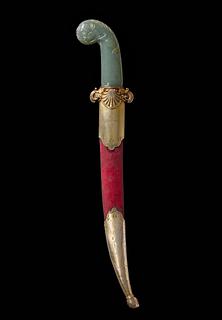
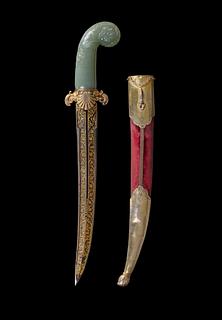
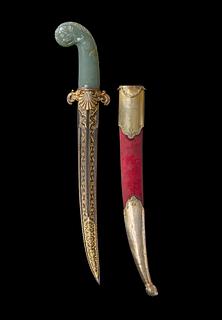
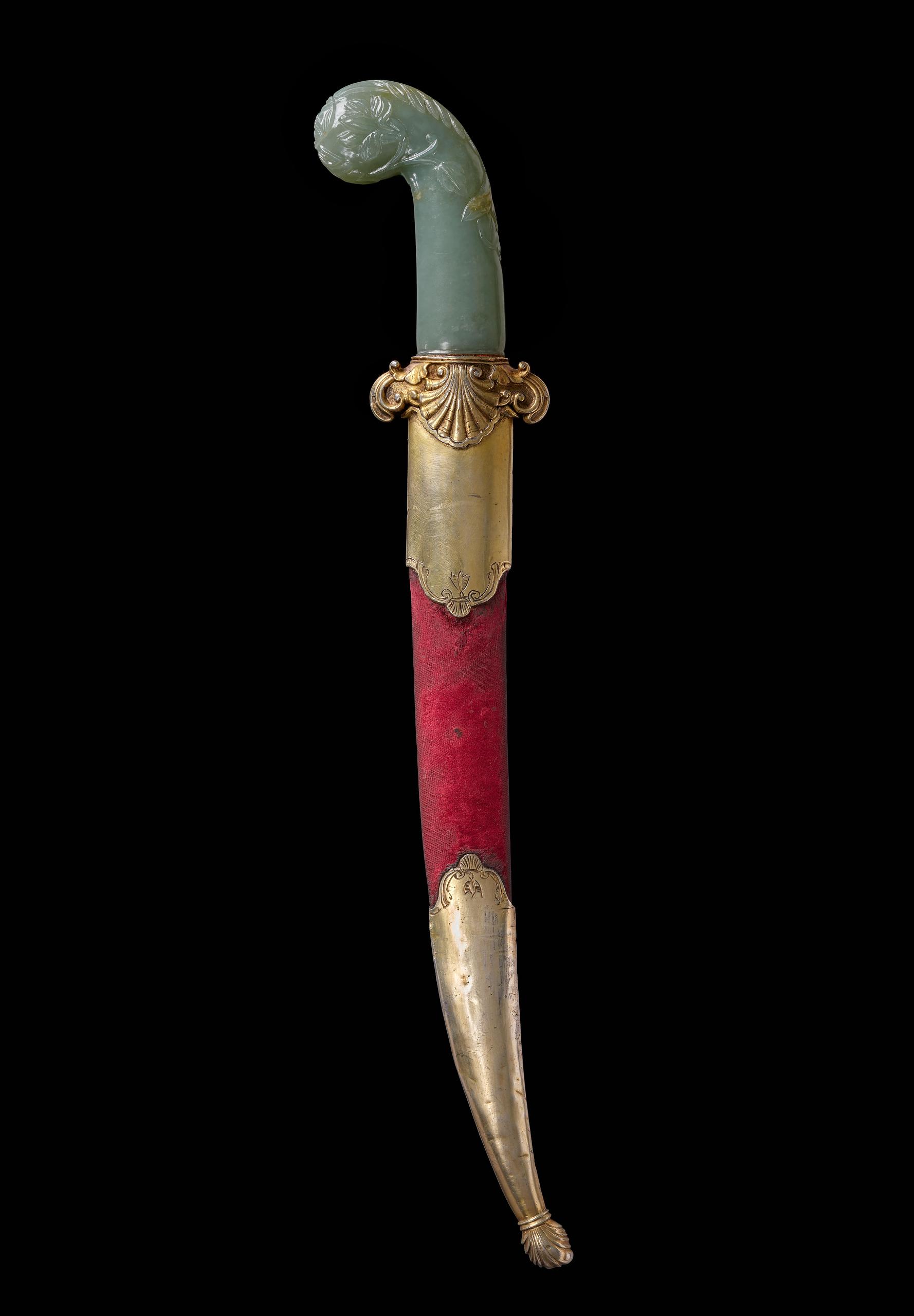
Dagger of steel, gold, jade and silver with sheath of wood, silver and velvet
Blade: Turkey, Istanbul; around 1550. Grip: India; first half of the 18th century. Guard and sheath: Turkey, Istanbul; between 1774 and 1789
L (total): 30.5; L (blade): approx. 20; L (grip): 7.4 cm
Inventory number 8a/2022 & 8b/2022
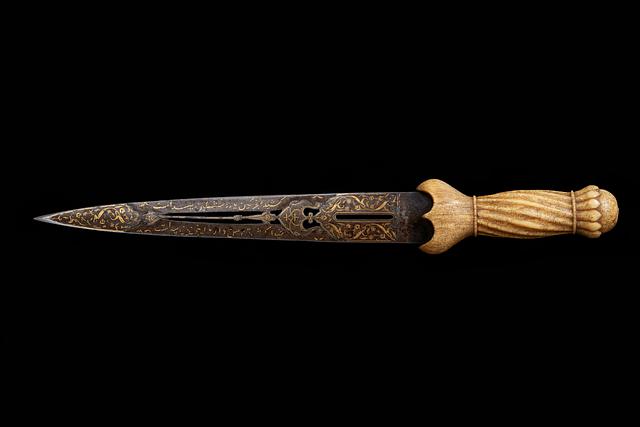
This dagger, like item 14/2022, belongs to a group of about thirty whose blades were made in sixteenth-century Turkey. Some of them have subsequently been fitted with new, fashionable grips, testifying to the high esteem in which these early blades were held. This dagger has been given an Indian jade grip with floral designs carved in relief, as well as a guard and sheath with gilt silver fittings, most likely made in Istanbul during the reign of Abd al-Hamid I (1774–1789).1 The style of the guard is influenced by European tastes and is often described as ‘Turkish Rococo’ (see for example 31/1987 and 6a-b/2022).
The slightly curved, unsharpened blade is almost identical on both sides; however, one side has a partially open slot along the middle, in which run eleven gilded steel beads. Quite unusually, the slot does not fully pierce the blade the way it does in various other designs among this group of daggers.2 Both sides are richly inlaid with various foliate and floral vines in gold, but the most striking and unusual feature is the cartouches with Chinese/Timurid-inspired bands of clouds appearing in the dark colour of the steel against a ground of gold. Such designs are known only from very few specimens and may indicate an early dating.3
The dagger is relatively small; the central part of the grip measures only 4.5 cm, suggesting that it was made for a child. The same applies to the unsharpened, gold-inlaid edges also featured on other daggers in this group, rendering it likely that they were intended more for show than for actual use.
The slightly curved, unsharpened blade is almost identical on both sides; however, one side has a partially open slot along the middle, in which run eleven gilded steel beads. Quite unusually, the slot does not fully pierce the blade the way it does in various other designs among this group of daggers.2 Both sides are richly inlaid with various foliate and floral vines in gold, but the most striking and unusual feature is the cartouches with Chinese/Timurid-inspired bands of clouds appearing in the dark colour of the steel against a ground of gold. Such designs are known only from very few specimens and may indicate an early dating.3
The dagger is relatively small; the central part of the grip measures only 4.5 cm, suggesting that it was made for a child. The same applies to the unsharpened, gold-inlaid edges also featured on other daggers in this group, rendering it likely that they were intended more for show than for actual use.
Footnotes
Footnotes
1.
See for example A. Ivanov: ‘A group of Iranian daggers of the period from the fifteenth century to the beginning of the seventeenth with Persian inscriptions’ in Robert Elgood (ed.): Islamic arms and armour, London 1979, pp. 67 and 73.
2.
See for example A. Ivanov: ‘A group of Iranian daggers of the period from the fifteenth century to the beginning of the seventeenth with Persian inscriptions’ in Robert Elgood (ed.): Islamic arms and armour, London 1979, p. 72.
3.
An almost identical guard has been stamped with the tughra of Abd al-Hamid I. See David G. Alexander, Stuart W. Pyhrr and Will Kwiatkowski: Islamic arms and armor in The Metropolitan Museum of Art, New Haven 2015, pp. 196–197.
.-The-David-Collection_Copenhagen_photo-Pernille-Klemp.jpg)
.-The-David-Collection_Copenhagen_photo-Pernille-Klemp.jpg)
.-The-David-Collection_Copenhagen_photo-Pernille-Klemp.jpg)
.-The-David-Collection_Copenhagen_photo-Pernille-Klemp.jpg)
.-The-David-Collection_Copenhagen_photo-Pernille-Klemp.jpg?disposition=attachment)
The Ottomans
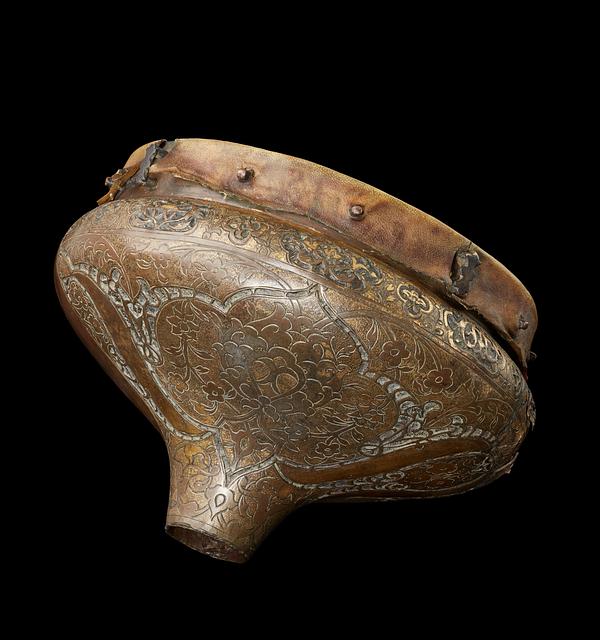
Kettledrum, engraved, gilded copper (tombac), partly inlaid with a black substance
_-Photo-Pernille-Klemp.jpg)
Dagger of steel, gold and walrus ivory
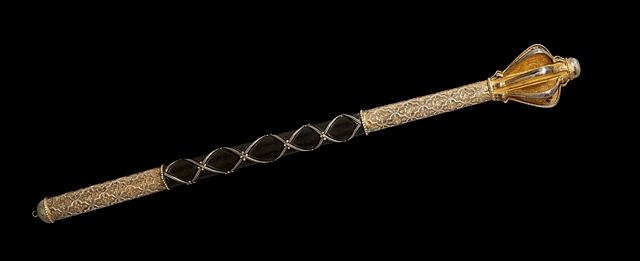
Mace head, silver and silver-gilt, chased and engraved; wooden handle covered with leather
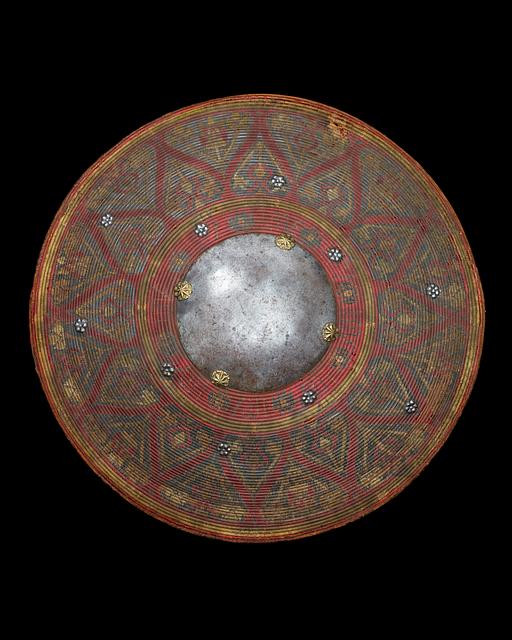
Wicker shield wrapped with colored silk and metal threads and with an umbo and metal fittings of steel and brass