Ewer, cast and engraved bronze
Eastern Iran or Afghanistan; end of 11th-12th century
H: 30.5 cm
Inventory number 58/1974
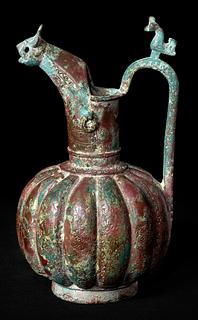
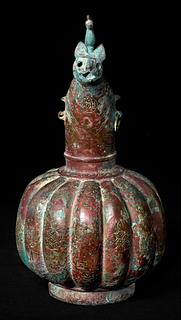
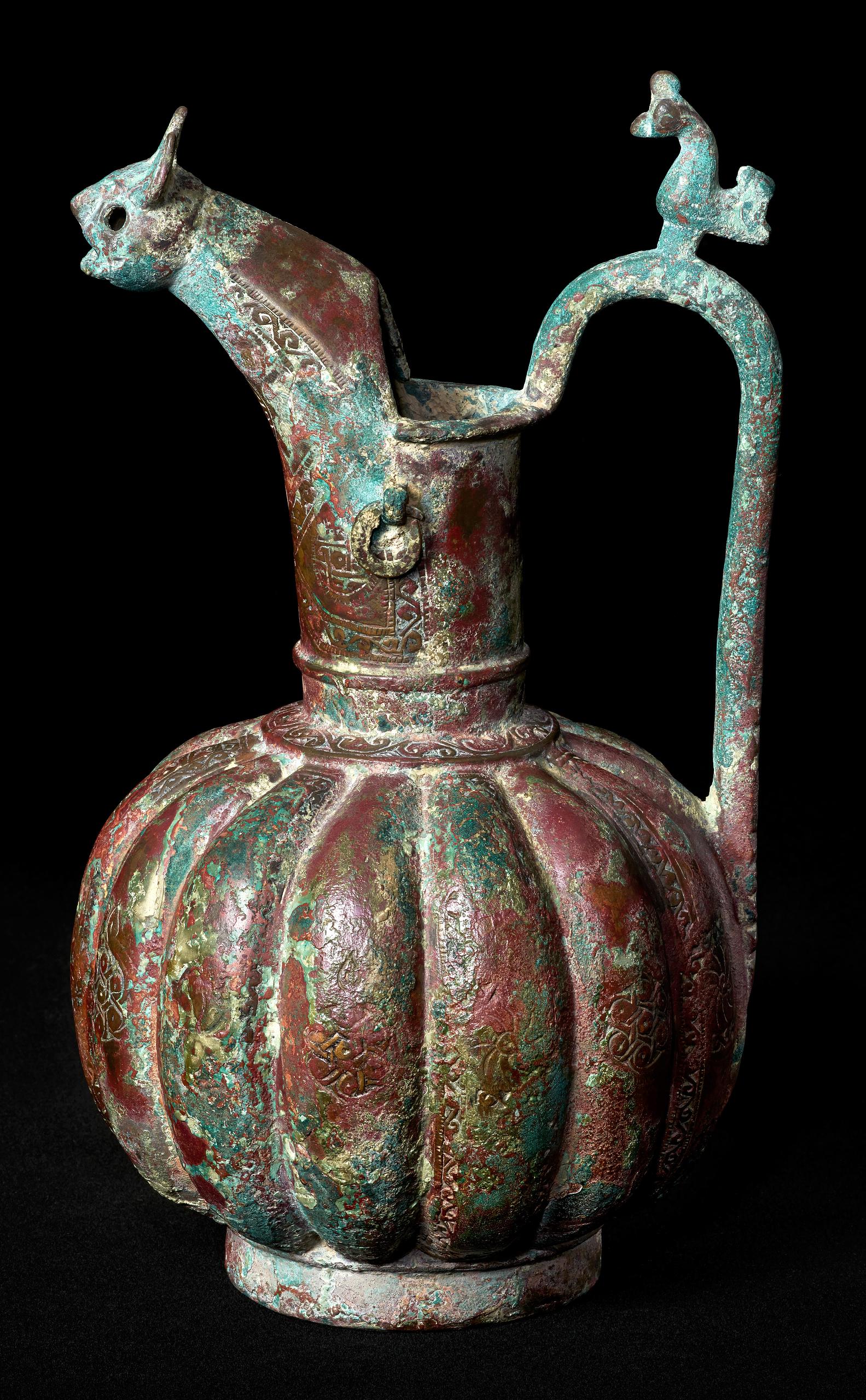
This piece belongs to a little group of distinctively shaped ewers, several of which have been excavated in Afghanistan. All have a spherical body, a thick neck, and a wide, conical spout that in this case ends in a lion’s head whose openings emitted a liquid in several thin jets.
This ewer furthermore has a bird sitting on the handle where most ewers have an abstractly shaped knob to support the hand when pouring.
No ewer of this type has been preserved with a lid, but it has been proposed that these ewers originally had a lid attached with chains to the metal rings on the neck.
This ewer furthermore has a bird sitting on the handle where most ewers have an abstractly shaped knob to support the hand when pouring.
No ewer of this type has been preserved with a lid, but it has been proposed that these ewers originally had a lid attached with chains to the metal rings on the neck.
Published in
Published in
Kjeld von Folsach: Islamic art. The David Collection, Copenhagen 1990, cat.no. 307;
Kjeld von Folsach: Art from the World of Islam in The David Collection, Copenhagen 2001, cat.no. 478:
Joachim Meyer: “Ornament or symbol. Around an early group of silver amulet cases in the David Collection” in Journal of the David Collection, 2021, 5, fig. 9, p. 15;
Elizabeth C. Kelly: Zoomorphic incense burners of Medieval Khurasan: a study of Islamic metalwork, Oxford 2024, fig. 3.5C;
Kjeld von Folsach: Art from the World of Islam in The David Collection, Copenhagen 2001, cat.no. 478:
Joachim Meyer: “Ornament or symbol. Around an early group of silver amulet cases in the David Collection” in Journal of the David Collection, 2021, 5, fig. 9, p. 15;
Elizabeth C. Kelly: Zoomorphic incense burners of Medieval Khurasan: a study of Islamic metalwork, Oxford 2024, fig. 3.5C;