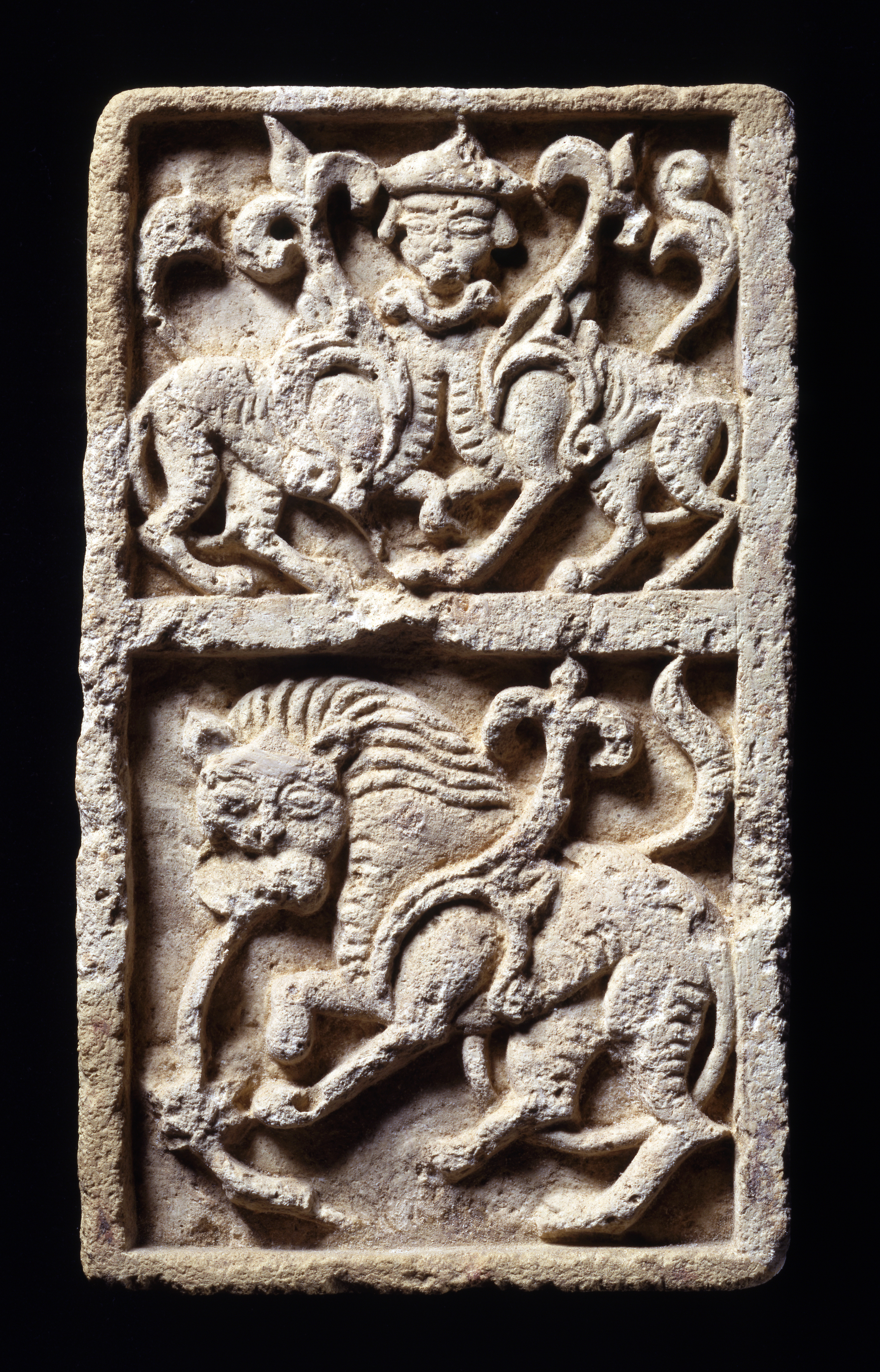
Architectural element, limestone
Jazira; 13th century
H: 33.5; W: 19.5; D: 6.5 cm
Inventory number 1/1990
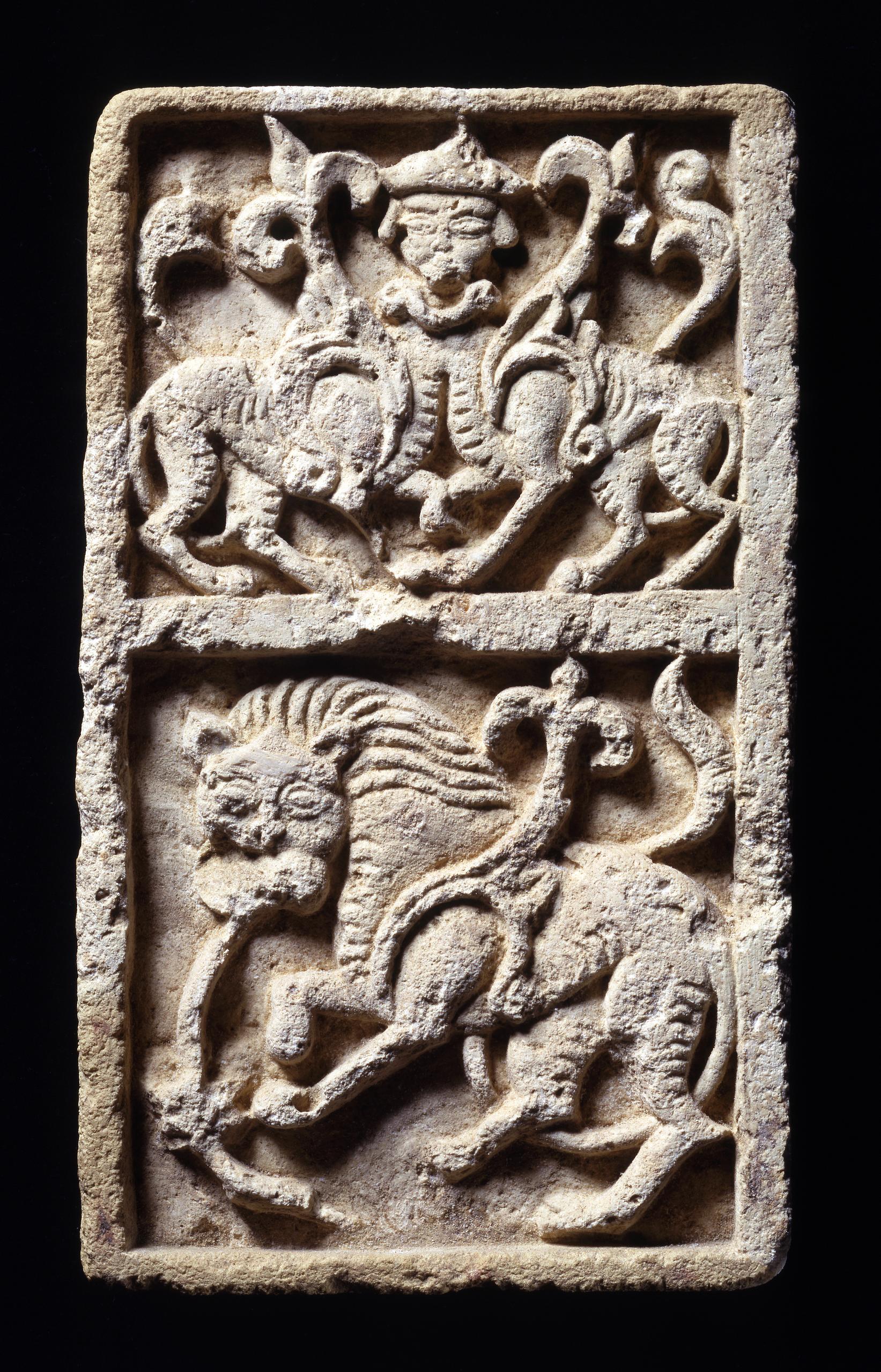
This architectural element bears witness to the imaginative new interpretation of traditional motifs that is characteristic of Anatolia and Jazira in the 13th century.
Instead of being surrounded by vine scrolls, the lion at the bottom is entwined in them, and a large leaf actually ends up in its mouth. Above is a symmetrical double sphinx whose two bodies are joined in a single head. The traditional shoulder palmettes have taken on such enormous proportions here that even the tails with dragon heads look threatened.
We do not know the position of this architectural element, but it might have been the central keystone in a gateway.
Instead of being surrounded by vine scrolls, the lion at the bottom is entwined in them, and a large leaf actually ends up in its mouth. Above is a symmetrical double sphinx whose two bodies are joined in a single head. The traditional shoulder palmettes have taken on such enormous proportions here that even the tails with dragon heads look threatened.
We do not know the position of this architectural element, but it might have been the central keystone in a gateway.
Published in
Published in
Sotheby’s, London, 16/4-1985, lot 102;
Kjeld von Folsach: Fabelvæsner fra Islams Verden, Davids Samling, København 1991, cat.no. 6;
Mentioned in Joachim Gierlichs: Mittelalterliche Tierreliefs in Anatolien und Nordmesopotamien: Untersuchungen zur figürlichen Baudekoration der Seldschuken, Artuqiden und ihrer Nachfolger bis ins 15. Jahrhundert, Tübingen 1996, p. 48 and note 393;
Kjeld von Folsach: Art from the World of Islam in The David Collection, Copenhagen 2001, cat.no. 399;
Almut v. Gladiss (ed.): Die Dschazira: Kulturlandschaft zwischen Euphrat und Tigris, Museum für Islamische Kunst, Berlin 2006, cat.no. 36, p. 91;
Kjeld von Folsach: Fabelvæsner fra Islams Verden, Davids Samling, København 1991, cat.no. 6;
Mentioned in Joachim Gierlichs: Mittelalterliche Tierreliefs in Anatolien und Nordmesopotamien: Untersuchungen zur figürlichen Baudekoration der Seldschuken, Artuqiden und ihrer Nachfolger bis ins 15. Jahrhundert, Tübingen 1996, p. 48 and note 393;
Kjeld von Folsach: Art from the World of Islam in The David Collection, Copenhagen 2001, cat.no. 399;
Almut v. Gladiss (ed.): Die Dschazira: Kulturlandschaft zwischen Euphrat und Tigris, Museum für Islamische Kunst, Berlin 2006, cat.no. 36, p. 91;