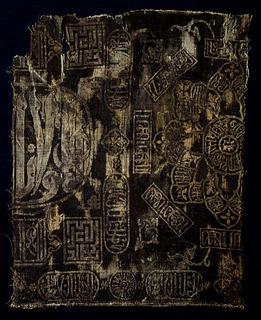
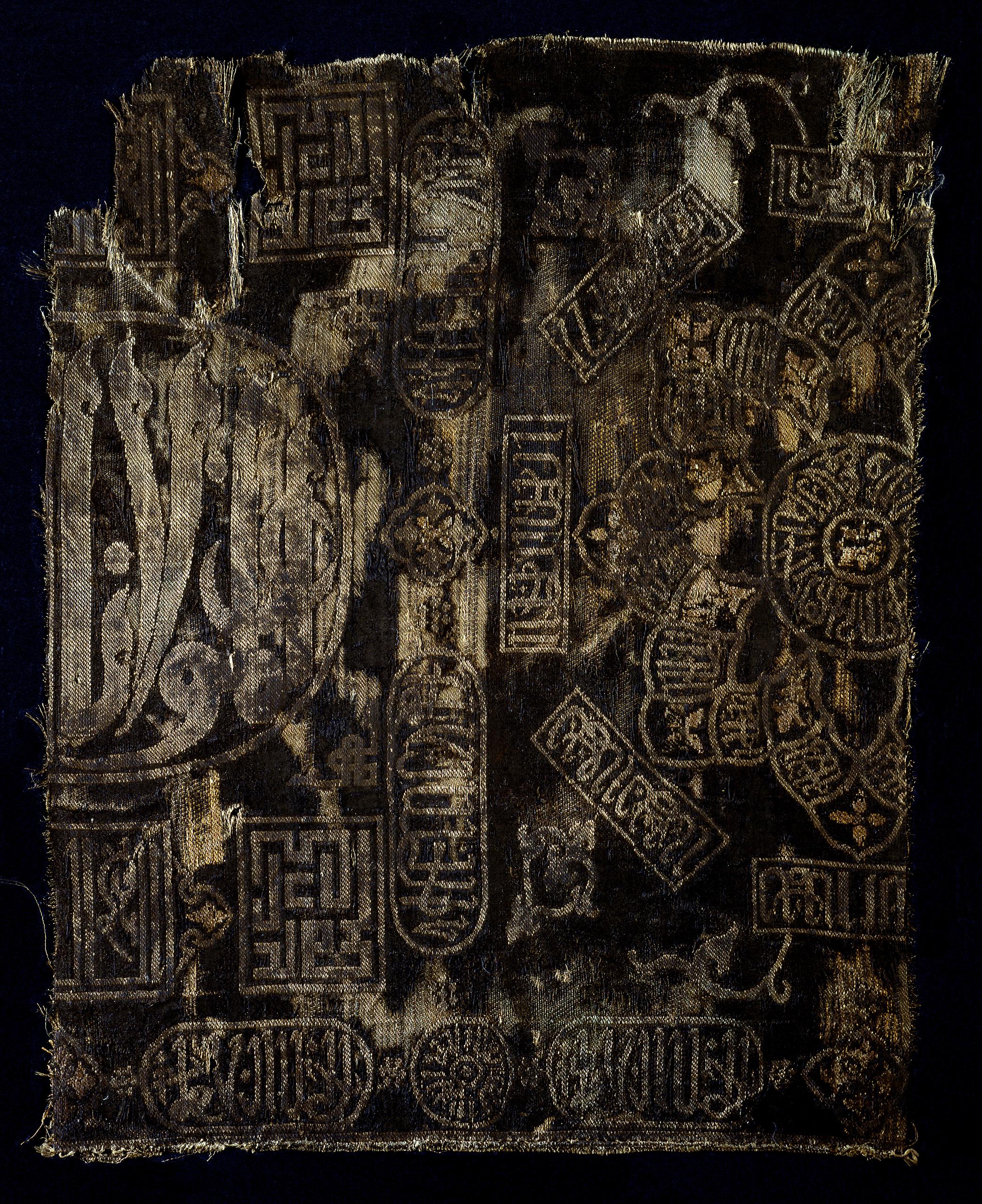
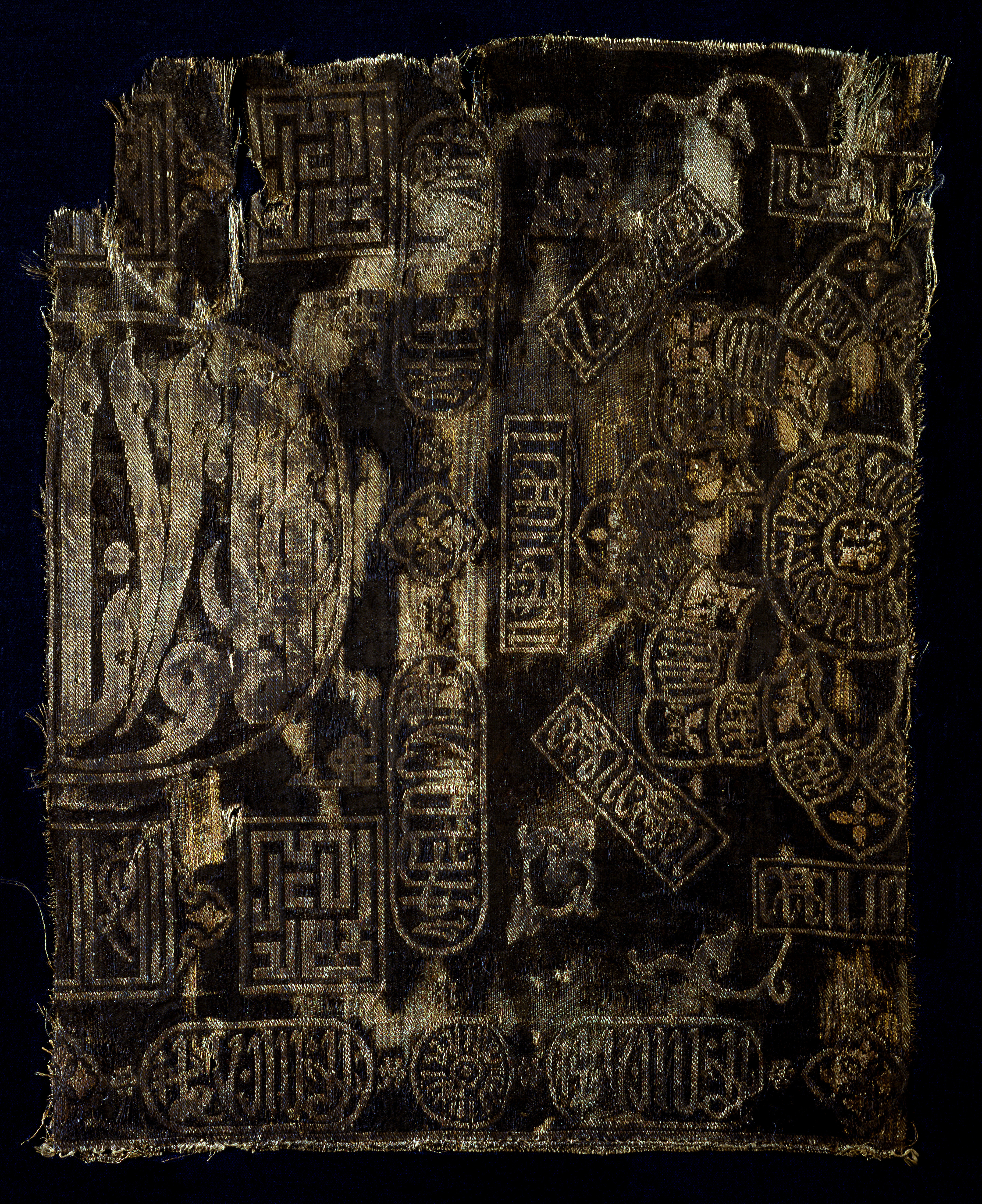
Fragment of a lampas-woven textile, silk and lamella of gilded paper
Iran, Central Asia, or China; 14th-15th century
H: 36; W: 28 cm
Gift of Højesteretssagfører C. L. Davids Legat for Slægt og Venner 52/1998
Gift of Højesteretssagfører C. L. Davids Legat for Slægt og Venner 52/1998
Inventory number 52/1998
It is difficult to say exactly where this textile was made. The decoration, which is entirely calligraphic, was written in both Persian and Arabic. The large medallion might resemble calligraphy from Mamluk Egypt, but there are also two examples of seal Kufi, which points in the direction of Iran and Central Asia under the Mongols and their successors. The gilded paper, which was used in China rather than the animal substrate that was common in the Islamic world, points in the same direction.
The use of readable calligraphy as a decoration, however, was characteristic of the Islamic world. Early examples are the tiraz textiles, and in later periods the famous textiles with religious inscriptions that covered the Kaaba in Mecca and the tombs of holy men.
The use of readable calligraphy as a decoration, however, was characteristic of the Islamic world. Early examples are the tiraz textiles, and in later periods the famous textiles with religious inscriptions that covered the Kaaba in Mecca and the tombs of holy men.
Published in
Published in
Kjeld von Folsach: Art from the World of Islam in The David Collection, Copenhagen 2001, cat. 648;
Maria Sardi: “Foreign influences in Mamluk textiles: The formation of a new aesthetic” in Nikolaos Vryzidis (ed.): The hidden life of textiles in the medieval and early modern Mediterranean: contexts and cross-cultural encounters in the Islamic Latinate and Eastern Christian worlds, Turnhout 2020, pp. 97 and 118, fig 15;
Joachim Meyer, Rasmus Bech Olsen and Peter Wandel: Beyond words: calligraphy from the World of Islam, The David Collection, Copenhagen 2024, cat. 22, pp. 150-151;
Maria Sardi: “Foreign influences in Mamluk textiles: The formation of a new aesthetic” in Nikolaos Vryzidis (ed.): The hidden life of textiles in the medieval and early modern Mediterranean: contexts and cross-cultural encounters in the Islamic Latinate and Eastern Christian worlds, Turnhout 2020, pp. 97 and 118, fig 15;
Joachim Meyer, Rasmus Bech Olsen and Peter Wandel: Beyond words: calligraphy from the World of Islam, The David Collection, Copenhagen 2024, cat. 22, pp. 150-151;