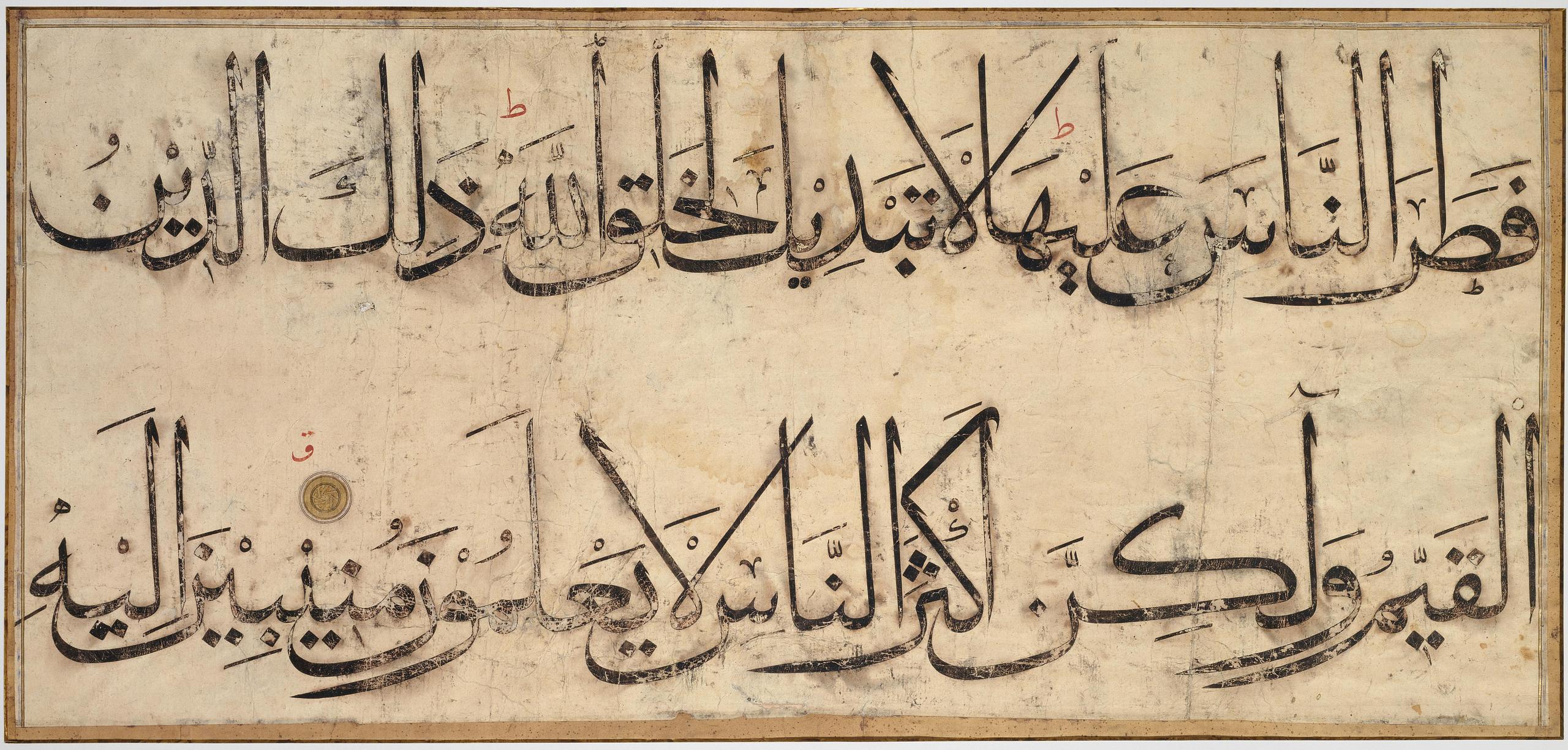
Fragment of a leaf from a gigantic Koran, written in Muhaqqaq
Central Asia, Samarkand; c. 1400-1405
45 × 98 cm (the fragment was trimmed on the sides)
Inventory number 20/1987
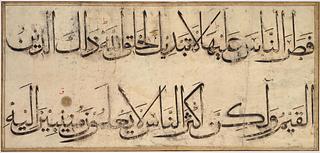
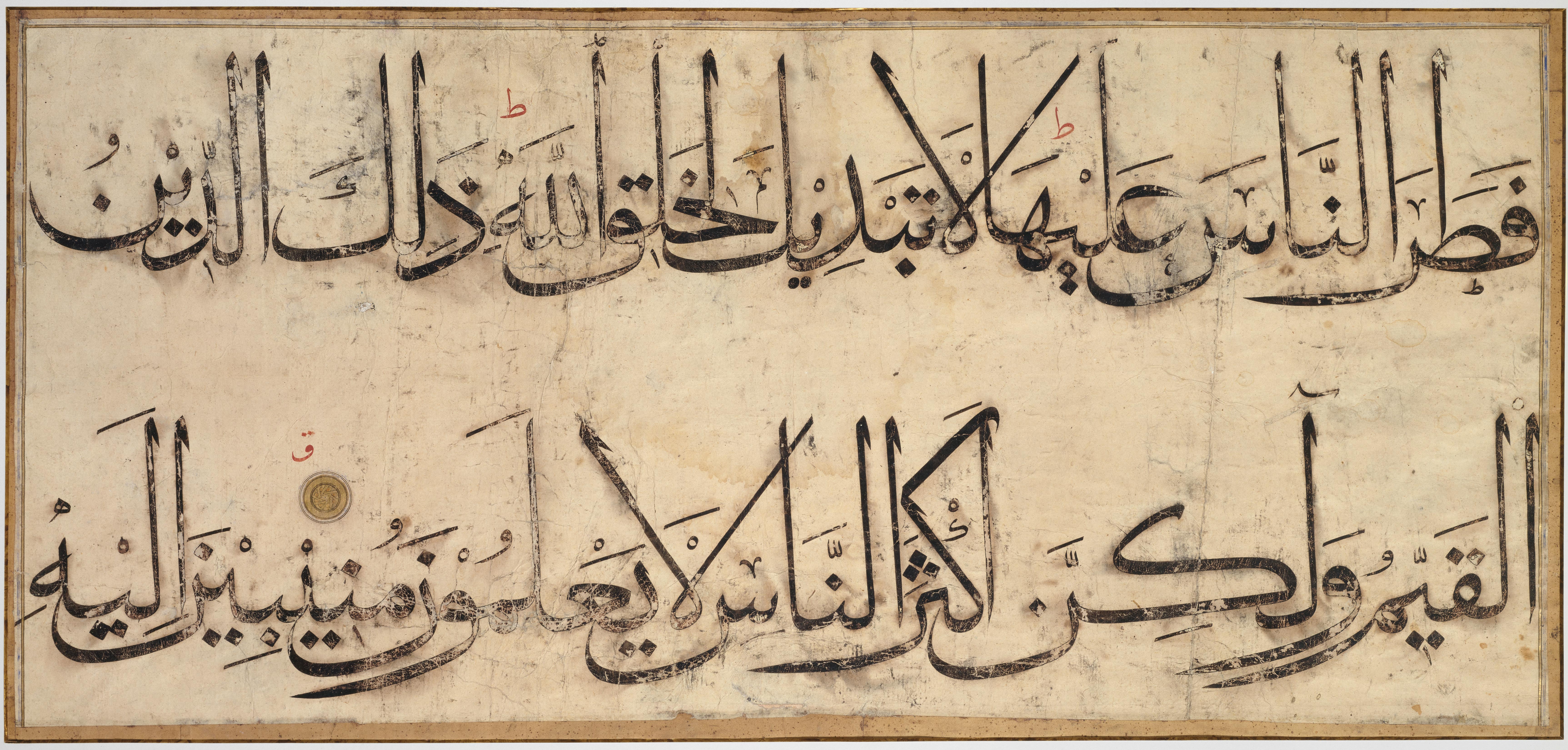
These two lines are a fragment of a leaf from the largest known Koran ever made. Each leaf had seven lines, and it would have measured 222 × 155 cm untrimmed. The Koran was copied by Umar Aqta for the world conqueror Timur in his capital of Samarkand.
Transcribing a Koran in this format must have demanded enormous concentration of the calligrapher, and the exactitude and elegance with which the gigantic script – Jalil Muhaqqaq – was written make it a masterpiece in its genre. The point of the reed pen must have measured c. 1 cm, and making the large sheets of paper must have been a technological accomplishment in itself.
Transcribing a Koran in this format must have demanded enormous concentration of the calligrapher, and the exactitude and elegance with which the gigantic script – Jalil Muhaqqaq – was written make it a masterpiece in its genre. The point of the reed pen must have measured c. 1 cm, and making the large sheets of paper must have been a technological accomplishment in itself.
Published in
Published in
Kjeld von Folsach: Islamic art. The David Collection, Copenhagen 1990, cat. 7;
Kjeld von Folsach, Torben Lundbæk and Peder Mortensen (eds.): Sultan, Shah and Great Mughal: the history and culture of the Islamic world, The National Museum, Copenhagen 1996, cat. 102;
Kjeld von Folsach: Art from the World of Islam in The David Collection, Copenhagen 2001, cat. 11;
Sheila S. Blair and Jonathan M. Bloom (eds.): Cosmophilia. Islamic Art from the David Collection, Copenhagen, McMullen Museum of Art, Boston College, Boston 2006, cat. 22;
Marie Rehakova: Koran: vyvoj umelecke tradice, Plzen 2013, fig. 22, p. 51;
Stig T. Rasmussen: Klassisk arabisk litteratur i oversættelse til dansk: en litteraturhistorisk vejvisende antologi, København 2018, p. 55;
Joachim Meyer, Rasmus Bech Olsen and Peter Wandel: Beyond words: calligraphy from the World of Islam, The David Collection, Copenhagen 2024, cat. 46, p. 183;
Rasmus Bech Olsen: “Beyond words: calligraphy from the World of Islam”, Orientations, 55:4, 2024, fig. 9, p. 39;
Kjeld von Folsach, Torben Lundbæk and Peder Mortensen (eds.): Sultan, Shah and Great Mughal: the history and culture of the Islamic world, The National Museum, Copenhagen 1996, cat. 102;
Kjeld von Folsach: Art from the World of Islam in The David Collection, Copenhagen 2001, cat. 11;
Sheila S. Blair and Jonathan M. Bloom (eds.): Cosmophilia. Islamic Art from the David Collection, Copenhagen, McMullen Museum of Art, Boston College, Boston 2006, cat. 22;
Marie Rehakova: Koran: vyvoj umelecke tradice, Plzen 2013, fig. 22, p. 51;
Stig T. Rasmussen: Klassisk arabisk litteratur i oversættelse til dansk: en litteraturhistorisk vejvisende antologi, København 2018, p. 55;
Joachim Meyer, Rasmus Bech Olsen and Peter Wandel: Beyond words: calligraphy from the World of Islam, The David Collection, Copenhagen 2024, cat. 46, p. 183;
Rasmus Bech Olsen: “Beyond words: calligraphy from the World of Islam”, Orientations, 55:4, 2024, fig. 9, p. 39;
The Timurids and the Turkmen
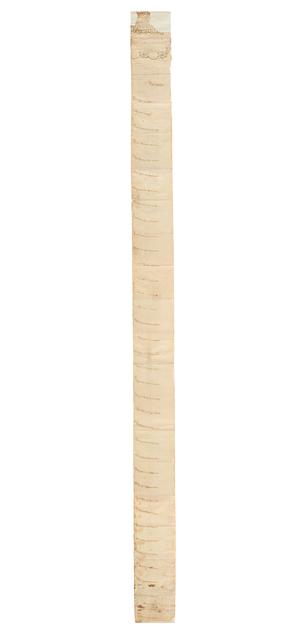
A firman (imperial decree), paper, written in Tawqi and Taliq
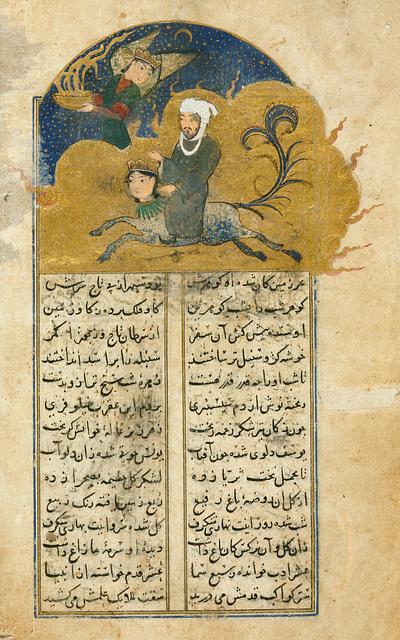
A copy of Nizami’s Makhzan al-asrar, the first book in his Khamsa. Copied by Mir Ali ibn al-Yasi al-Tabrizi al-Bawargi
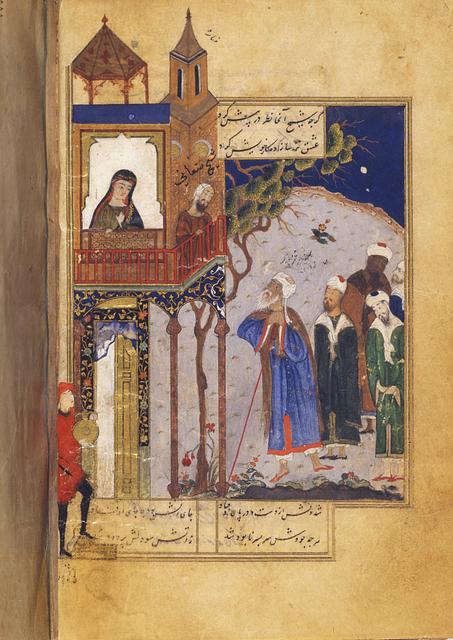
A copy of Farid al-din Attar’s Mantiq al-tayr
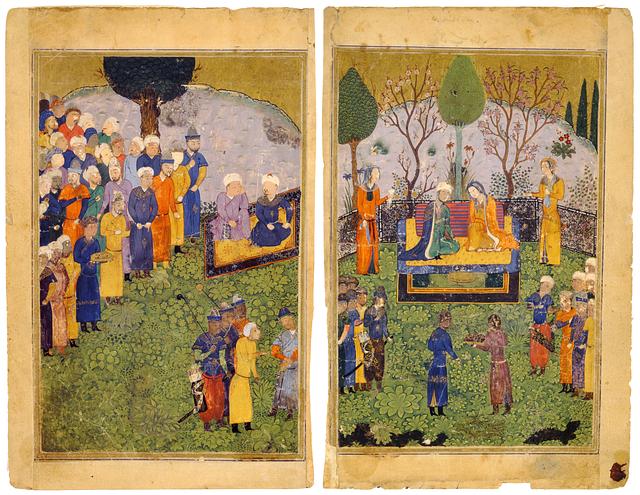
Double frontispiece painting from a copy of Firdawsi’s Shahnama. ‘A Princely Couple with Courtiers in a Garden’