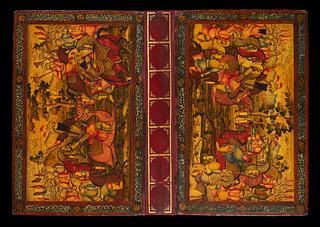
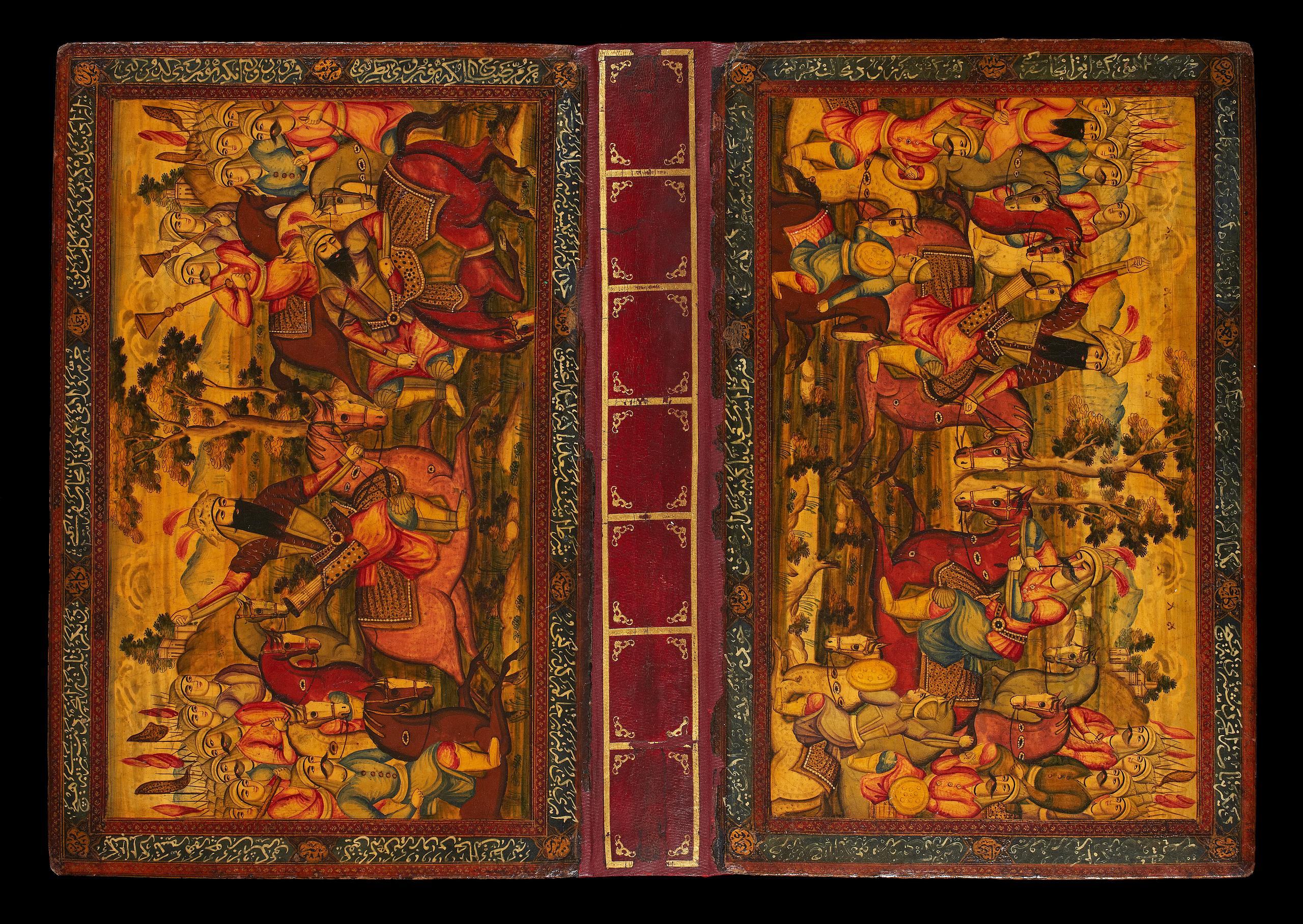
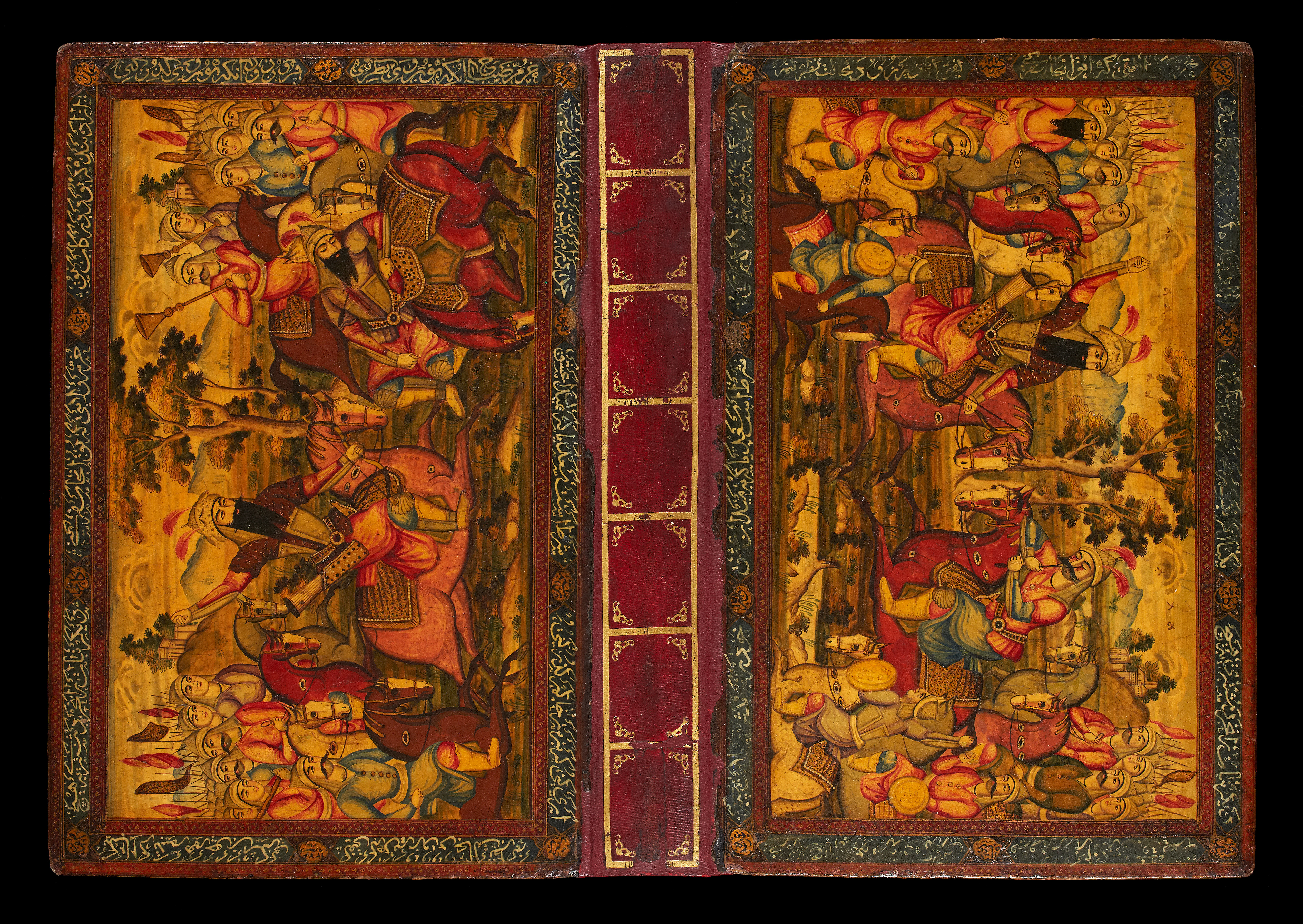
Lacquered bookbinding with battle scenes from the Shahnama
Iran, Isfahan; 1274 H = 1857-1858
H: 43; Overall W: 63 cm
Inventory number 3/2010
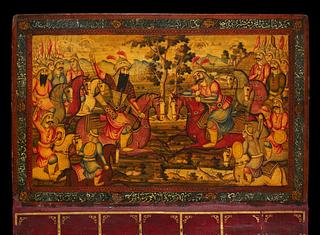
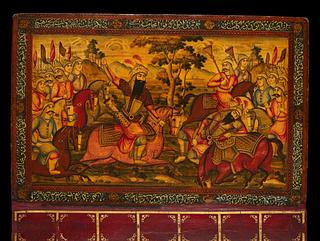
The black inscriptions in the gold cartouches state that the bookbinding was made in Ahmed’s workshop in Isfahan in the year 1274 H (1857-1858). Both the front and the back cover are embellished with a scene in which the Persian hero Rustam, wearing his characteristic tiger-skin caftan and leopard-skin helmet, is fighting an enemy between two armies. His opponent, who has been hit in the eye with a two-headed arrow, is the Persian prince Isfandiyar.
A typical element in battle scenes and hunting motifs from the Qajar period is a pronounced “hierarchical perspective,” in which important figures are made unnaturally large in an otherwise naturalistic landscape.
The prototype for this style is a series of oil paintings showing the king mounted for the hunt made for Fath Ali Shah (1797-1834).
A typical element in battle scenes and hunting motifs from the Qajar period is a pronounced “hierarchical perspective,” in which important figures are made unnaturally large in an otherwise naturalistic landscape.
The prototype for this style is a series of oil paintings showing the king mounted for the hunt made for Fath Ali Shah (1797-1834).
Published in
Published in
Joachim Meyer and Peter Wandel: Shahnama: the Colorful Epic about Iran's Past, The David Collection, Copenhagen 2016, cat.no. 19;