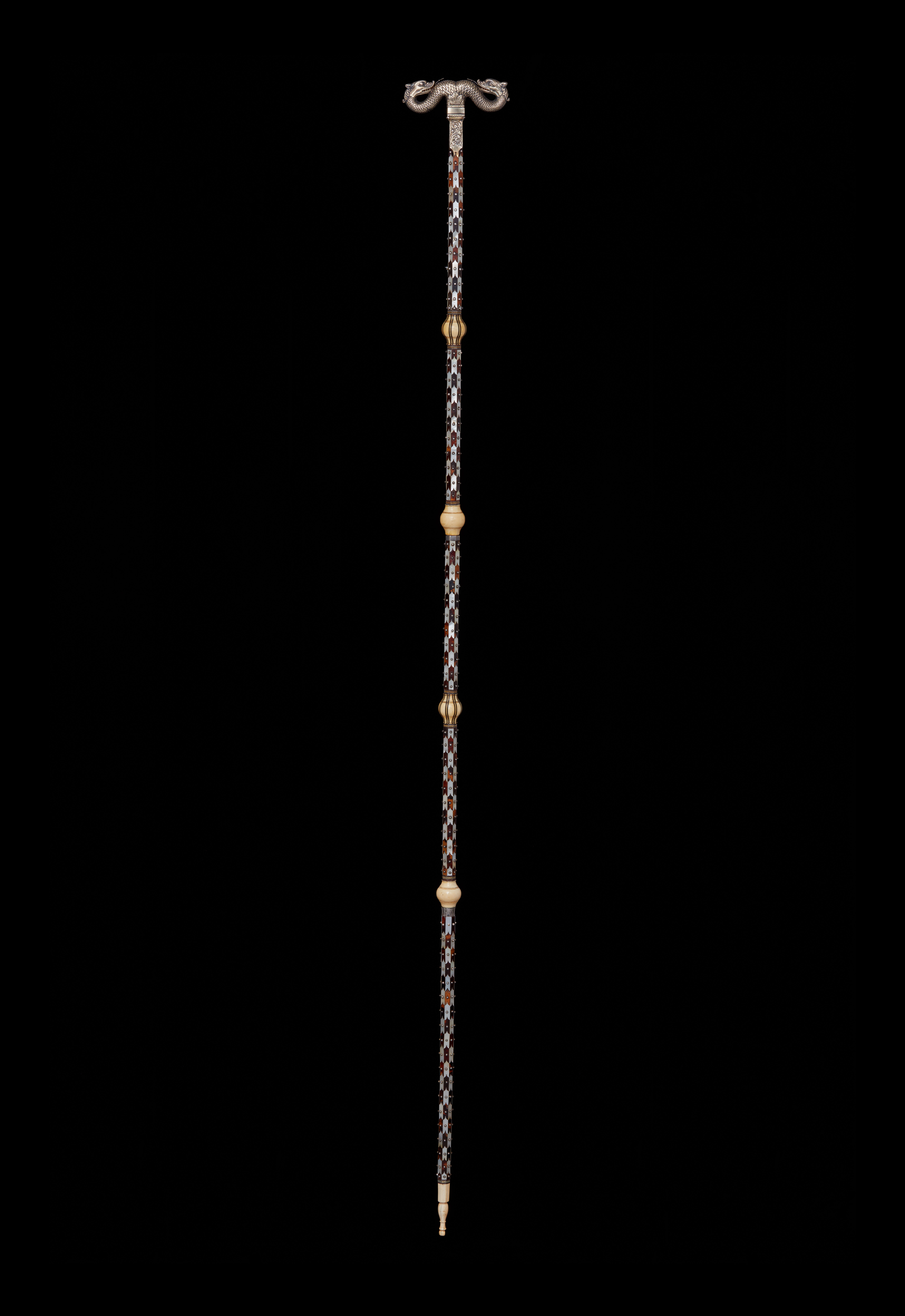
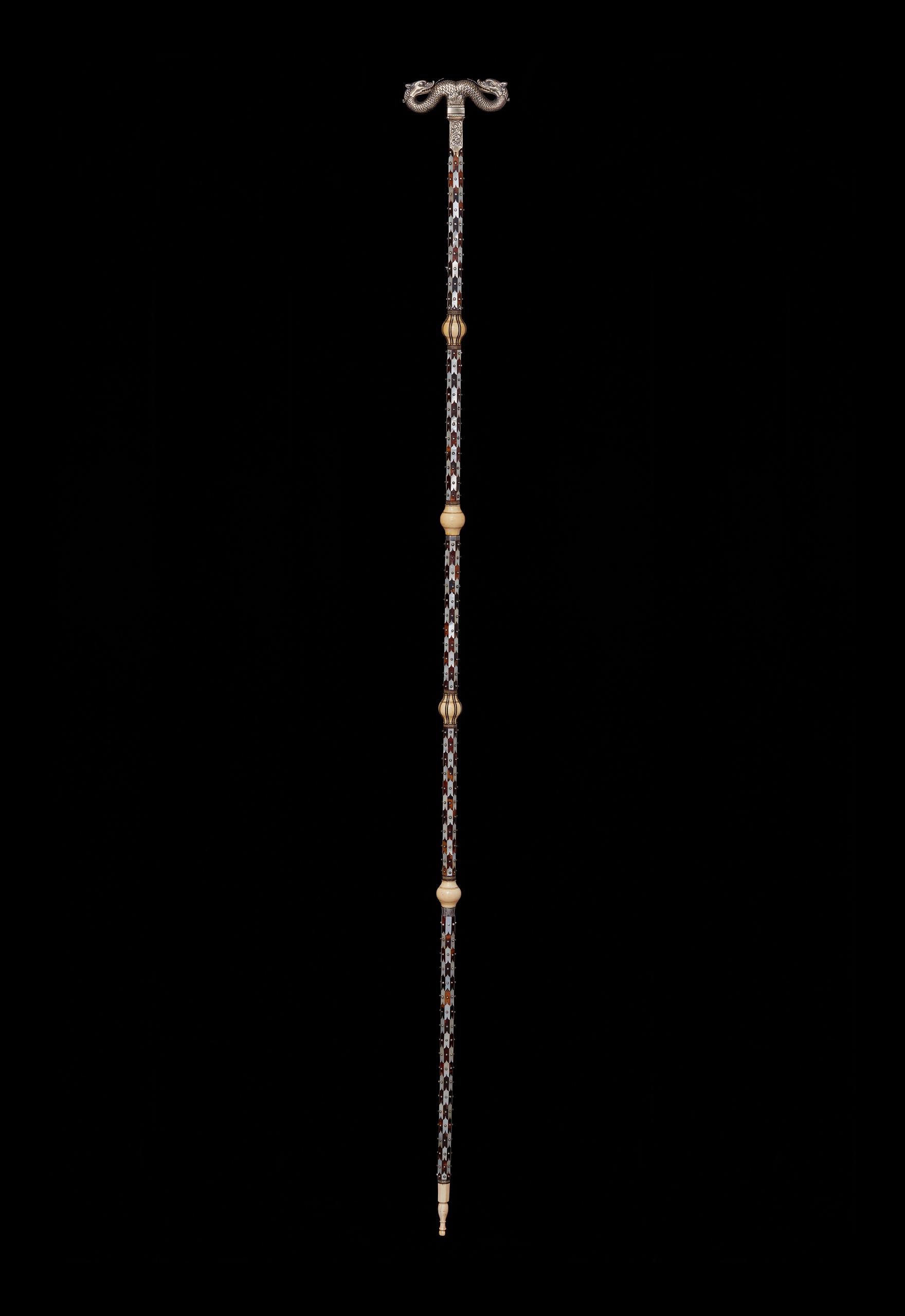
Wooden crozier mounted with plaques of tortoise shell and mother of pearl, with turned elements of ivory, and with a two-part top of cast silver
Turkey, Istanbul?; c. 1800
H: 162; Top W: 14.8 cm
Inventory number 4/2017
Many of the orthodox denominations, such as the Greek Orthodox and the Armenian lived on with clergymen such as bishops and patriarchs in the areas that the Ottomans took over from the Byzantine Empire. In many cases, their art and liturgical objects reflect the influence of the surrounding Ottoman society.
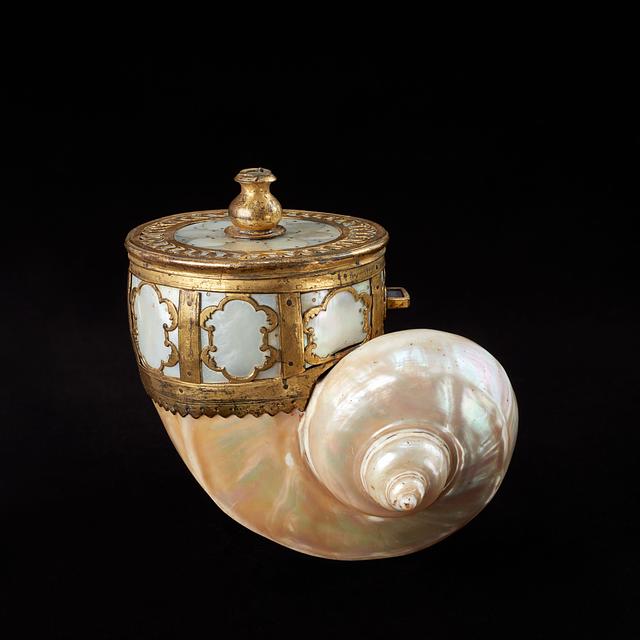
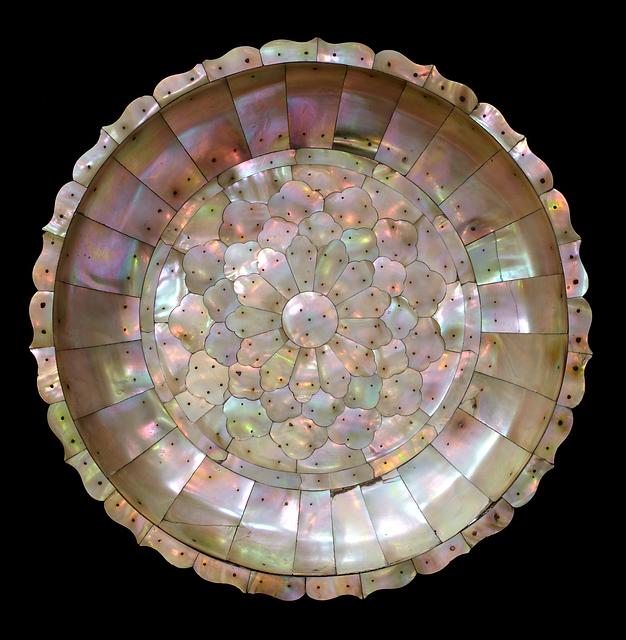
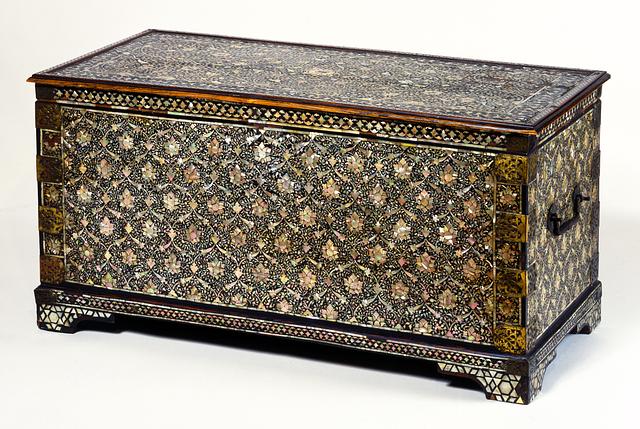
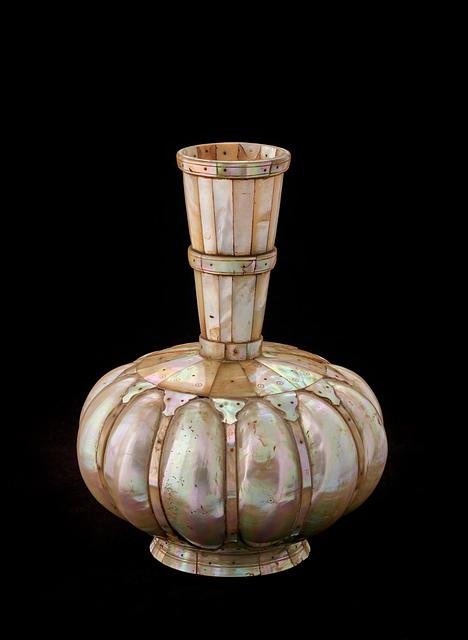
This is true, for example, of the combination of tortoise shell and mother of pearl that decorates this piece. It is characteristic of Ottoman work starting from the 16th century, from sultan’s thrones and doors to small writing desks and pen cases (39/2000 and 14/2018).1
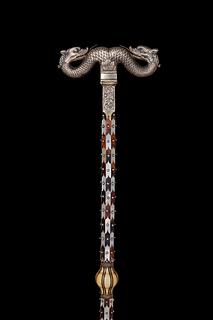
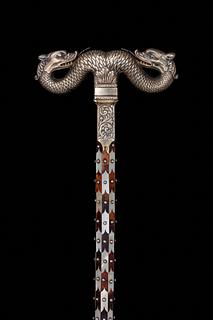
Right from the middle of the 17th century, this type of decoration was also used for croziers, 2 although the museum’s crozier, which is closely related to two others, one in the Benaki Museum and the other in the Victoria and Albert Museum, must have been made later.3 This is indicated by the silver top. Its elements, such as the acanthus leaves and dolphin-like serpent heads, seem to have been influenced by classicizing, Western art.
The spherical pieces on the crozier partly serve a practical purpose. Since the two that are not inlaid have screws and screw threads, the crozier can be taken apart into three pieces.
Croziers in Orthodox communities are often topped by paired serpents of this type, and in some cases are supplemented by a central cross as a symbol of Christianity’s concept of evil and good.
This is true, for example, of the combination of tortoise shell and mother of pearl that decorates this piece. It is characteristic of Ottoman work starting from the 16th century, from sultan’s thrones and doors to small writing desks and pen cases (39/2000 and 14/2018).1
Right from the middle of the 17th century, this type of decoration was also used for croziers, 2 although the museum’s crozier, which is closely related to two others, one in the Benaki Museum and the other in the Victoria and Albert Museum, must have been made later.3 This is indicated by the silver top. Its elements, such as the acanthus leaves and dolphin-like serpent heads, seem to have been influenced by classicizing, Western art.
The spherical pieces on the crozier partly serve a practical purpose. Since the two that are not inlaid have screws and screw threads, the crozier can be taken apart into three pieces.
Croziers in Orthodox communities are often topped by paired serpents of this type, and in some cases are supplemented by a central cross as a symbol of Christianity’s concept of evil and good.
Published in
Published in
Jean Boghossian (ed.): Couleurs d’Orient: arts et arts de vivre dans l’Empire ottoman, Villa Empain, Fondation Boghossian, Bruxelles 2010, p. 68;
Sotheby’s, London, 7/10-2015, lot 411;
Calouste Gulbenkian Museum: The rise of Islamic art, 1869-1939, Calouste Gulbenkian Museum, Lisbon 2019, cat.no. 20, pp. 87-89;
Sotheby’s, London, 7/10-2015, lot 411;
Calouste Gulbenkian Museum: The rise of Islamic art, 1869-1939, Calouste Gulbenkian Museum, Lisbon 2019, cat.no. 20, pp. 87-89;
Footnotes
Footnotes
1.
See Oliver Watson: “The Case of the Ottoman Table,” Journal of the David Collection, 3, 2010, pp. 22-53.
2.
A. A. Karakatsanis (ed.): Treasures of Mount Athos, Thessaloniki, 1997, cat. nos. 9.62 and 9.63.
3.
Inv. GE 33835 and 461:1 to 4-1977.
.-The-David-Collection_Copenhagen_Photo-Pernille-Klemp.jpg)