Flask, carved ivory with copper spout
Syria or northern Iraq; mid-13th century
H: 5.8; W: 4.3; Maximum D: 1.9 cm
Inventory number 20/2021
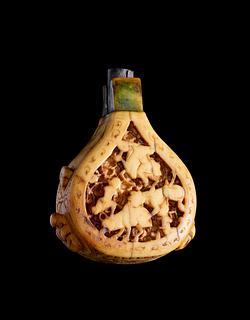
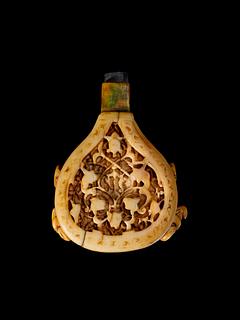
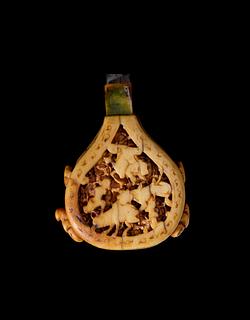
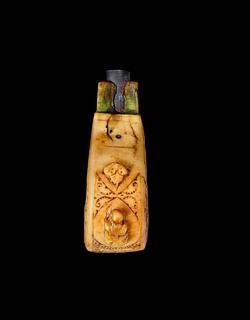
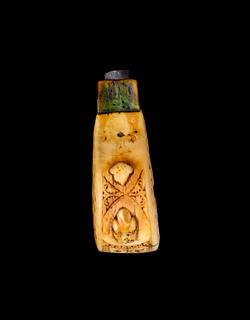
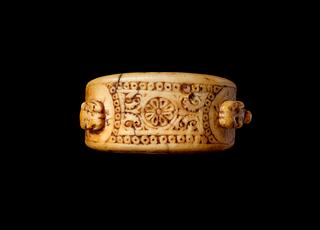
This small flask, which may have been used for kohl, is one of the very few preserved ivories that can be linked to thirteenth-century Syria/Iraq.1 The flask’s narrow sides and bottom are decorated with vegetal ornaments as well as two figures in high relief, which may represent birds, animal masks or seated lions. Each of the wide sides is adorned with a sunken relief comprising four levels with a wealth of details.
The relief on one side of the flask has an arabesque design which is symmetrical along a vertical axis. At the top of the axis is a human head wearing a three-pointed hat, while the head of a lioness is seen at the bottom. Several horned animal heads appear on each side of the axis. Animated arabesques of this type also appear in contemporary Syrian metalwork.2 The long, narrow leaves with inwardly curling tips also appear on other carvings in ivory (48/1978) and wood (40-41/2008) from the period.
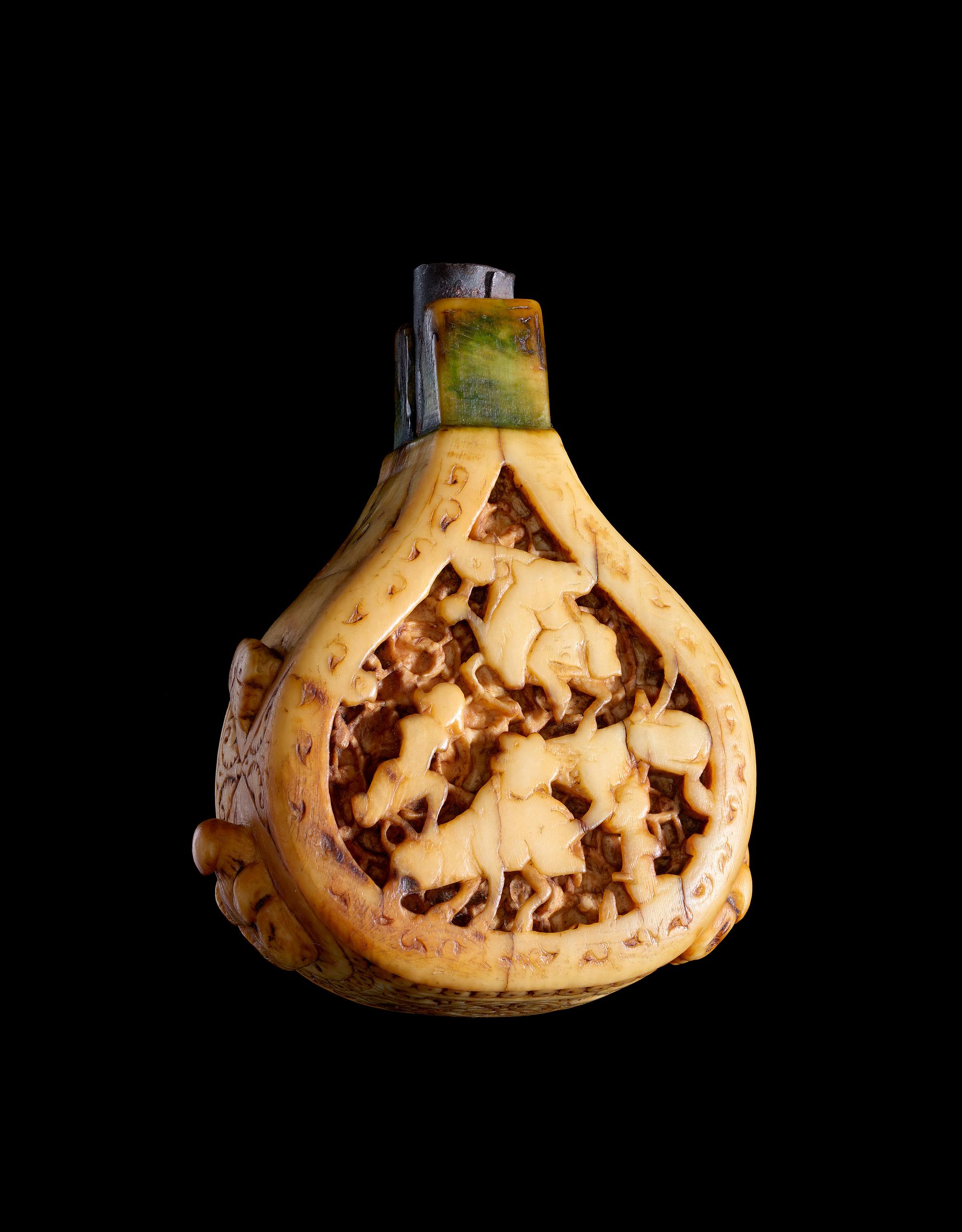
The figurative relief on the opposite side is partially undercut, making it particularly vulnerable to wear and tear. As a result, several of its more delicate elements are now lost, but even so the subject, a struggle between animals and humans, remains clear. At the bottom, an ox is attacked from behind by a lion. At the same time, a person stands above the ox with one foot on its neck while a rider hovers over the rest of the group brandishing a raised sword. The rider’s horse, which lacks its forelegs, turns its head and neck backwards in a dramatic pose.
Fighting and hunting motifs of this type are also known from other ivories, for example an Andalusian casket from the tenth century (5/2002). However, the scene on the flask shown here is more enigmatic than usual. For example, it is unclear whether the jackal-like animal under the lion’s belly is attacking the larger predator or suckling at its teat. And why does the rider raise his sword against the standing person who appears to be protecting the ox from the lion? The artist may have been more interested in creating a dynamic composition than a coherent narrative.
The relief on one side of the flask has an arabesque design which is symmetrical along a vertical axis. At the top of the axis is a human head wearing a three-pointed hat, while the head of a lioness is seen at the bottom. Several horned animal heads appear on each side of the axis. Animated arabesques of this type also appear in contemporary Syrian metalwork.2 The long, narrow leaves with inwardly curling tips also appear on other carvings in ivory (48/1978) and wood (40-41/2008) from the period.
The figurative relief on the opposite side is partially undercut, making it particularly vulnerable to wear and tear. As a result, several of its more delicate elements are now lost, but even so the subject, a struggle between animals and humans, remains clear. At the bottom, an ox is attacked from behind by a lion. At the same time, a person stands above the ox with one foot on its neck while a rider hovers over the rest of the group brandishing a raised sword. The rider’s horse, which lacks its forelegs, turns its head and neck backwards in a dramatic pose.
Fighting and hunting motifs of this type are also known from other ivories, for example an Andalusian casket from the tenth century (5/2002). However, the scene on the flask shown here is more enigmatic than usual. For example, it is unclear whether the jackal-like animal under the lion’s belly is attacking the larger predator or suckling at its teat. And why does the rider raise his sword against the standing person who appears to be protecting the ox from the lion? The artist may have been more interested in creating a dynamic composition than a coherent narrative.
Published in
Published in
Friedrich Sarre, F.R. Martin: [Supplement] : 216 photographische Original-Aufnahmen von Kunstgegenständen, die in dem grossen Ausstellungswerk von Sarre-Martin nicht veröffentlicht sind, München 1912, cat.no. 2182;
Artcurial, Paris, 7/11-2017, lot 162, p. 92 ;
Julian Raby: "An Ayyubid-era figural ivory: a sculptural miniature" in Melanie Gibson (ed.): Fruit of knowledge, Wheel of Learning: Essays in Honour of Robert Hillenbrandt, London 2022, pp. 222-239;
Artcurial, Paris, 7/11-2017, lot 162, p. 92 ;
Julian Raby: "An Ayyubid-era figural ivory: a sculptural miniature" in Melanie Gibson (ed.): Fruit of knowledge, Wheel of Learning: Essays in Honour of Robert Hillenbrandt, London 2022, pp. 222-239;
Footnotes
Footnotes
1.
Esin Atil: Islamic Metalwork in the Freer Gallery of Art, Washington D.C. 1985, cat. 18, pp. 137–147.
2.
Julian Raby presents a detailed analysis of the flask as well as a discussion of its place in Islamic art history in a forthcoming festschrift: Melanie Gibson (ed.): Fruit of knowledge, Wheel of Learning: Essays in Honour of Robert Hillenbrandt, London 2022.
.-The-David-Collection_Copenhagen_Photo-Pernille-Klemp.jpg)
.-The-David-Collection_Copenhagen_Photo-Pernille-Klemp.jpg)
.-The-David-Collection_Copenhagen_Photo-Pernille-Klemp.jpg)
.-The-David-Collection_Copenhagen_photo-Pernille-Klemp.jpg)
.-The-David-Collection_Copenhagen_Photo-Pernille-Klemp.jpg)
.-The-David-Collection_Copenhagen_Photo-Pernille-Klemp.jpg)
.-The-David-Collection_Copenhagen_Photo-Pernille-Klemp.jpg)
.-The-David-Collection_Copenhagen_Photo-Pernille-Klemp.jpg?disposition=attachment)