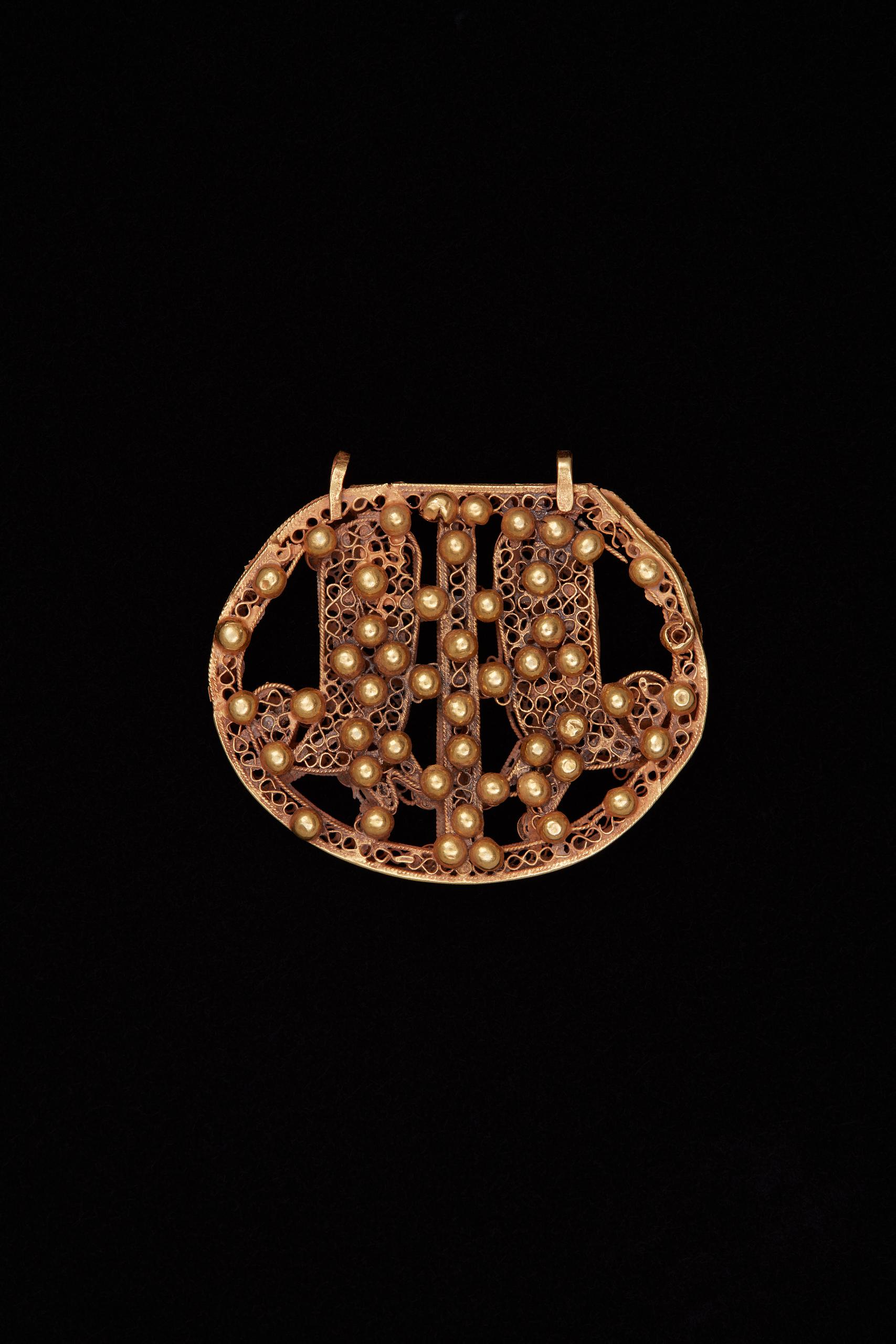
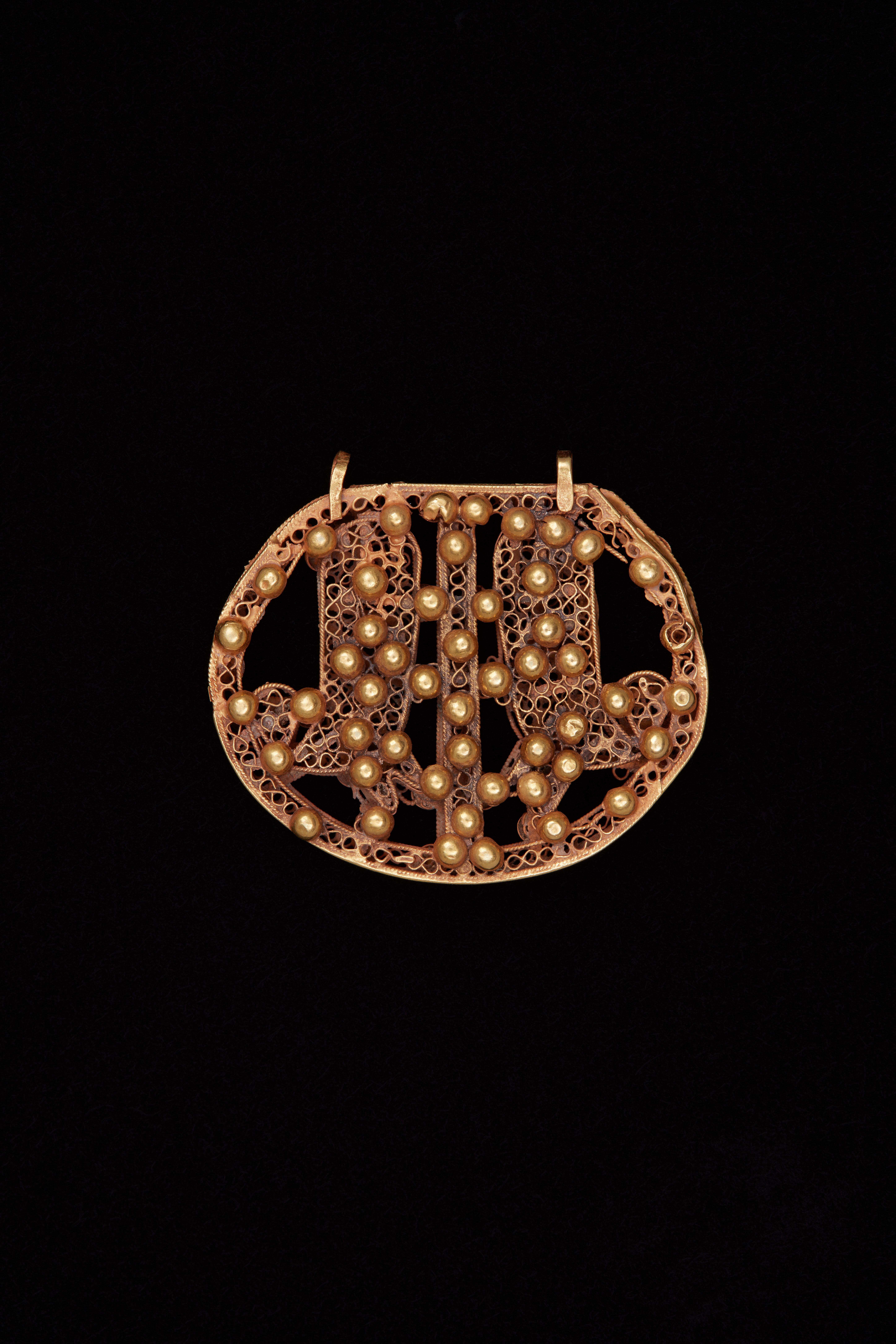
Pendant (?),sheet gold, and filigree
Egypt; 11th century
H: 3.5; W: 4.2 cm
Inventory number 5/1988
While some theological writings prohibited Muslim men from wearing gold jewelry, this did not apply to women. Their gold jewelry was made throughout the Islamic world in the early Middle Ages, when certain types became very widespread, designed locally with their own distinctive techniques and styles.
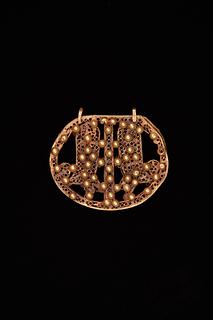
The pendant – perhaps also an earring – has large hemispheres on the filigree instead of fine granulation. Its symmetrical composition can be viewed as a stylized rendition of two peacocks or lions.
The pendant – perhaps also an earring – has large hemispheres on the filigree instead of fine granulation. Its symmetrical composition can be viewed as a stylized rendition of two peacocks or lions.
Published in
Published in
Boisgirard, Paris, 29/2-1988, lot 344;
Kjeld von Folsach: Islamic art. The David Collection, Copenhagen 1990, cat.no. 372;
Kjeld von Folsach, Torben Lundbæk and Peder Mortensen (eds.): Sultan, Shah and Great Mughal: the history and culture of the Islamic world, The National Museum, Copenhagen 1996, cat.no. 150;
Kjeld von Folsach: Art from the World of Islam in The David Collection, Copenhagen 2001, cat.no. 582;
Sheila S. Blair and Jonathan M. Bloom (eds.): Cosmophilia. Islamic Art from the David Collection, Copenhagen, McMullen Museum of Art, Boston College, Boston 2006, cat.no. 19;
Kjeld von Folsach: Islamic art. The David Collection, Copenhagen 1990, cat.no. 372;
Kjeld von Folsach, Torben Lundbæk and Peder Mortensen (eds.): Sultan, Shah and Great Mughal: the history and culture of the Islamic world, The National Museum, Copenhagen 1996, cat.no. 150;
Kjeld von Folsach: Art from the World of Islam in The David Collection, Copenhagen 2001, cat.no. 582;
Sheila S. Blair and Jonathan M. Bloom (eds.): Cosmophilia. Islamic Art from the David Collection, Copenhagen, McMullen Museum of Art, Boston College, Boston 2006, cat.no. 19;