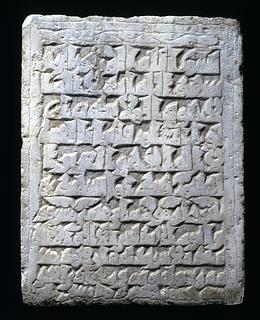
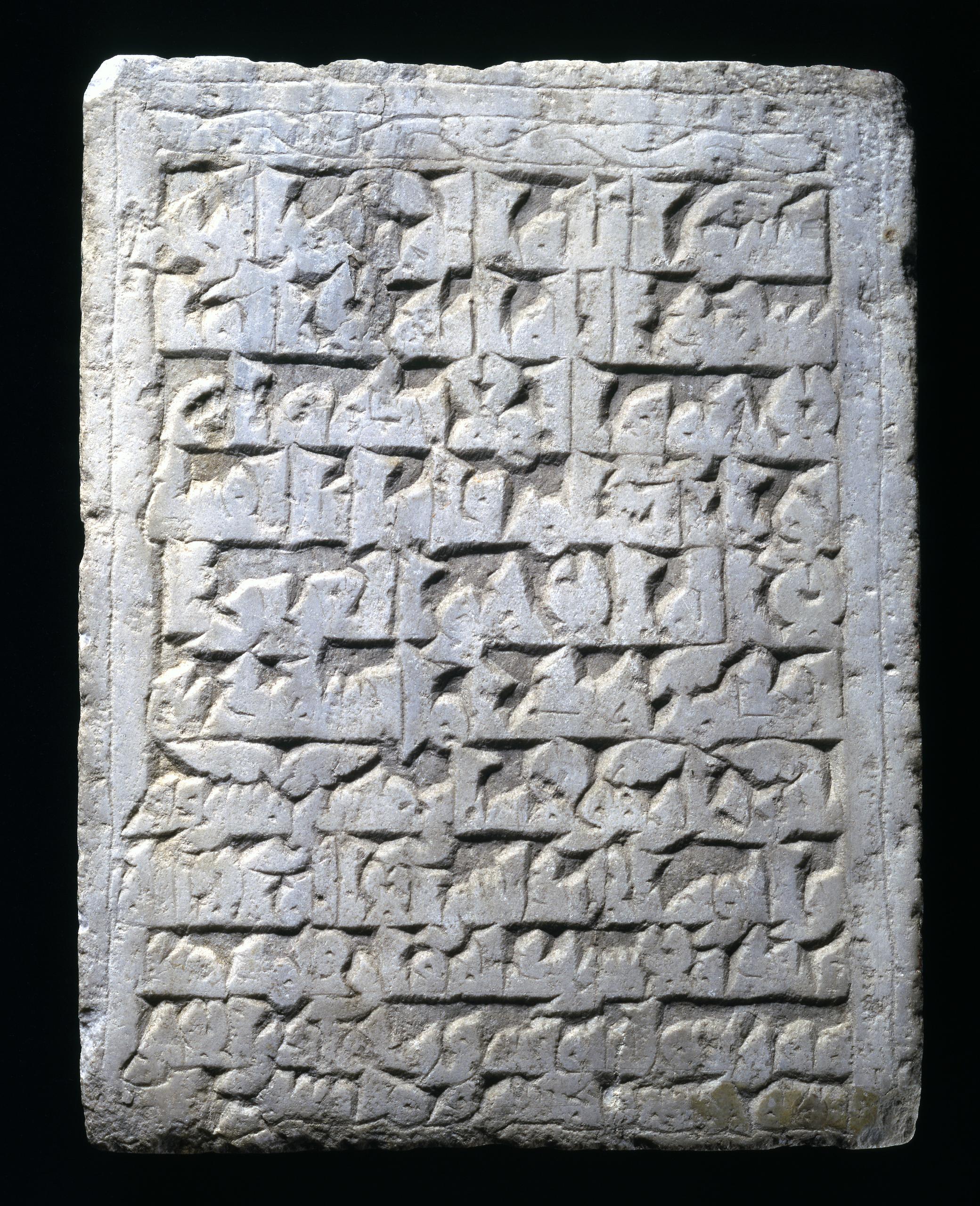
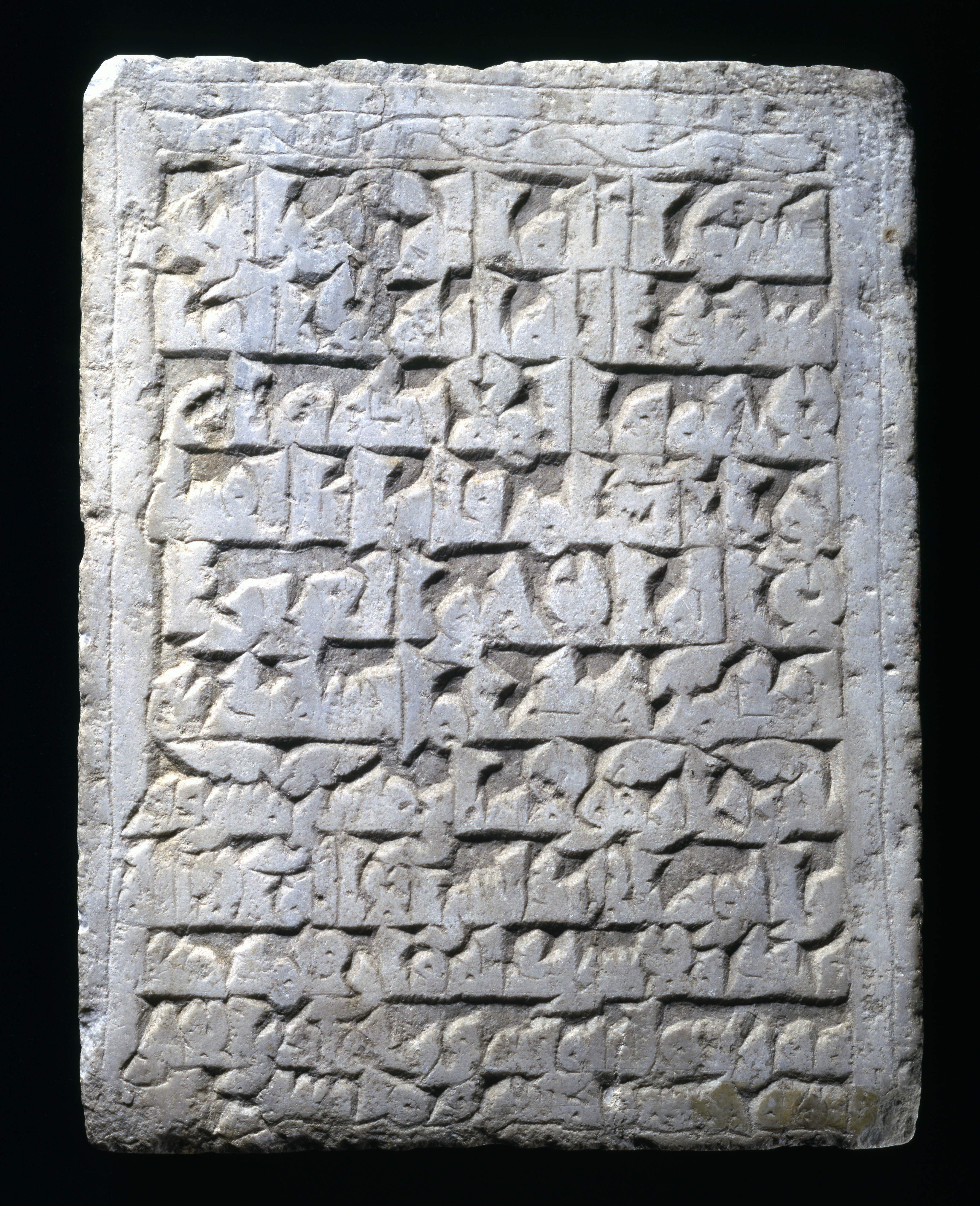
Tombstone, marble, with carved Kufi inscription
Egypt (?); Jumada al-akhar 255 H = April 869
H: 58.5; B: 44 cm
Inventory number 11/1990
The inscription on the tombstone was carved in an unusual “fat” Kufi. The letters of the top six lines are slightly larger than those in the five below. While the upper lines contain religious maxims of a more general nature that could be carved in advance, the lower lines contain the name of the deceased.
In this case, it is Khayzuran (?), who died in April 869 and was affiliated with Abu Isa Masrur ibn Ayyub al-Andalusi. It is unknown what kind of affiliation the deceased had with Abu Isa Masrur. He might have been a freed slave or a person from a non-Islamic faith who had formed ties after he converted to Islam with another Muslim, in this case a man whose family came from Andalusia.
In this case, it is Khayzuran (?), who died in April 869 and was affiliated with Abu Isa Masrur ibn Ayyub al-Andalusi. It is unknown what kind of affiliation the deceased had with Abu Isa Masrur. He might have been a freed slave or a person from a non-Islamic faith who had formed ties after he converted to Islam with another Muslim, in this case a man whose family came from Andalusia.
Published in
Published in
Christie's, London, 15/10-1980, lot 60;
Sotheby’s, London, 10/10-1992, lot 32;
Kjeld von Folsach, Torben Lundbæk and Peder Mortensen (eds.): Sultan, Shah and Great Mughal: the history and culture of the Islamic world, The National Museum, Copenhagen 1996, cat.no. 372;
Kjeld von Folsach: Art from the World of Islam in The David Collection, Copenhagen 2001, cat.no. 386;
Sotheby’s, London, 10/10-1992, lot 32;
Kjeld von Folsach, Torben Lundbæk and Peder Mortensen (eds.): Sultan, Shah and Great Mughal: the history and culture of the Islamic world, The National Museum, Copenhagen 1996, cat.no. 372;
Kjeld von Folsach: Art from the World of Islam in The David Collection, Copenhagen 2001, cat.no. 386;