Vilhelm Hammershøi (1864–1916)
Interior with a View of an Exterior Gallery, 1903
Oil on canvas
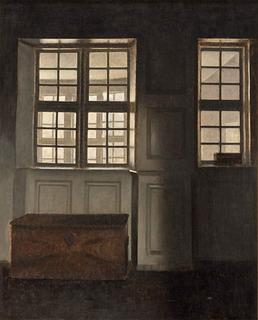
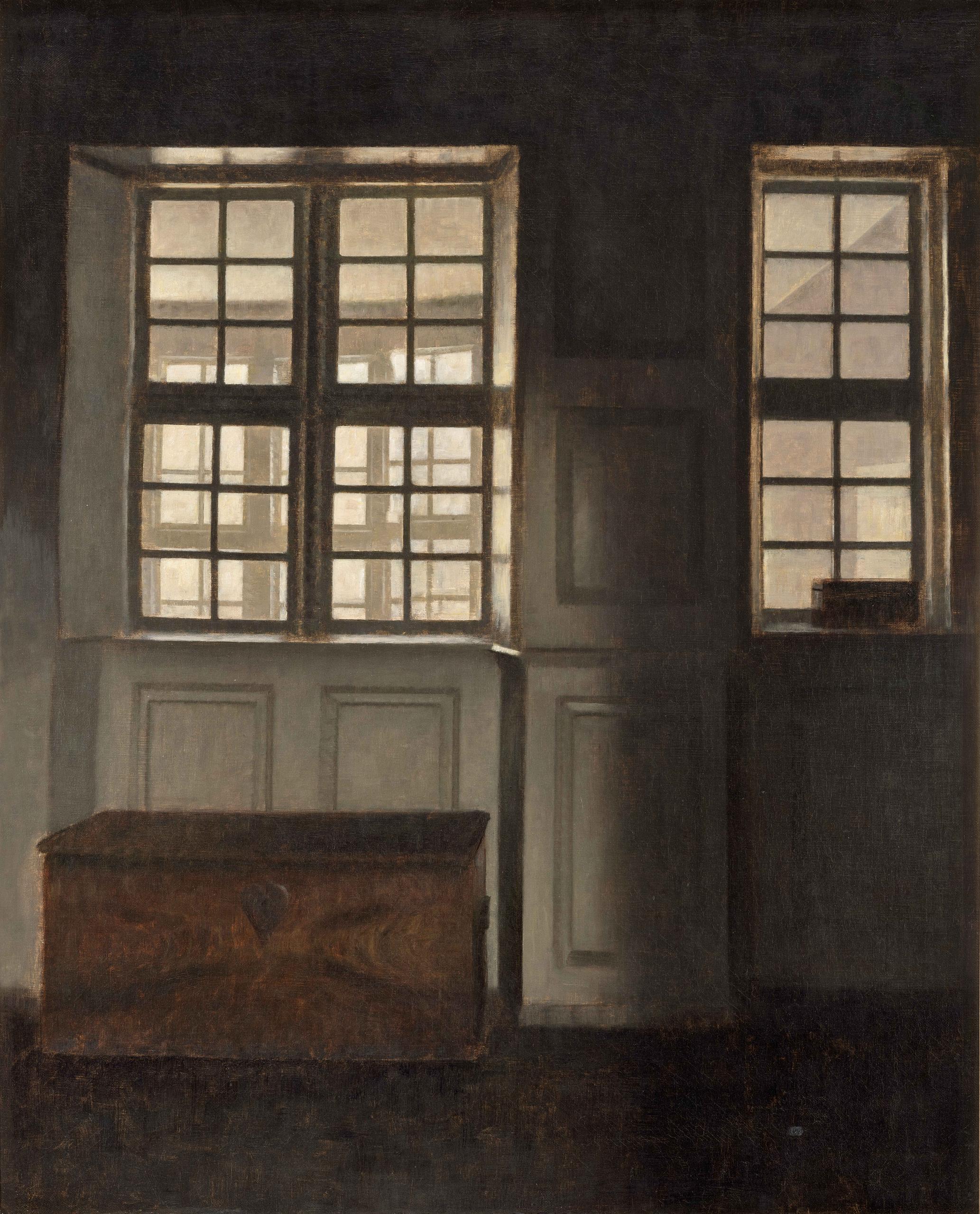
In his home at Strandgade 30, Vilhelm Hammershøi was keenly interested in the many possibilities for working with light provided by the old flat’s rooms and layout. The floor plan was unusual, combining Late Baroque and Neoclassical features while boasting several small reception rooms, larger rooms and an exterior gallery, the latter being a later addition running along the façade between the two side wings of the house. Like the rest of the house, the windows of the gallery had small panes of glass mounted in distinctive glazing bars.
The composition of Interior with a View of an Exterior Gallery is striking, because Hammershøi has sought to capture the shift in level and tone between the exterior gallery’s outer windows towards the courtyard and the inner windows opening on the living room. The result is a complicated interplay of windows, of light and darkness, of interior and exterior, all coming together to conjure up a distinctive, almost claustrophobic atmosphere where the room seems detached from its function as a place where people live.
Hammershøi’s placement of furniture in his interiors does not always seem logical, as is the case here, where the sturdy lidded chest marks a break in the structuring geometry of the white panels. Nevertheless, the chest conveys a sense of the room – or rather of the light falling in from the adjacent room. The closed, finite shape of the chest also contrasts with the windows, in which light from the outside world is revealed. As in B 312, the windows are closed and offer no view of any world outside, giving us to sense that in this context, the inside is all that exists.
Lent to the exhibition
Hammershøi. The Eye that Listens
Museo Nacional Thyssen-Bornemisza, Madrid, Spain
17 February - 31 May 2026
Kunsthaus Zürich, Zürich, Switzerland
3 July - 25 October 2026
Published in
Published in
Fortegnelse over arbejder af Vilhelm Hammershøi, booklet 2, Kunstforeningen, Copenhagen 1916, p. 5, cat. 26;
Sophus Michaëlis and Alfred Bramsen: Vilhelm Hammershøi. Kunstneren og hans Værk, Copenhagen 1918, p. 101, cat. 240;
Alfred Bramsen: Udvalg af Vilh. Hammershøis arbejder, Copenhagen 1930, p. 8, cat. 14;
Erik Zahle: “Billedkunst,” in C.L. Davids Samling. Vol. 1, Nogle Studier, Copenhagen 1948, p. 207;
Det besjälade rummet, Malmö Museum, Malmø 1975, p. 21;
Knud Voss and Verner Aspenström: Vilhelm Hammershøi, Prins Eugens Waldemarsudde, Stockholm 1976, p. 13, cat. 21;
Hanne Finsen and Inge Vibeke Raaschou-Nielsen: Vilhelm Hammershøi. En retrospektiv udstilling, Ordrupgaard, Ordrupgaard, Charlottenlund 1981, p. 107, cat. 87;
Poul Vad: Vilhelm Hammershøi and Danish Art at the Turn of the Century, New Haven 1992, fig. 123, p. 240;
Henrik Wivel: Symbolisme og impressionisme. Vol. 5 of Nyere Dansk Kunsthistorie, Copenhagen 1994, p. 107;
Henrik Wivel: Vilhelm Hammershøi. Dansk klassikerkunst, Copenhagen 1996, fig. 17, pp. 35-36;
Bente Scavenius and Jens Lindhe: Hammershøis København, Kunstforeningen Gl. Strand, Copenhagen 2003, pp. 62-63;
Poul Vad: Hammershøi. Værk og liv, 5th ed., Copenhagen 2003, pp. 119-121;
Tone Sinding Steinsvik, Ida Lorentzen and Bente Scavenius: Den forunderlige stillheten. Ida Lorentzen (f.1951), Vilhelm Hammershøi (1864-1916), Stiftelsen Modums Blaafarveværk, Modum 2005, pp. 91, 94, cat. 56;
Annette Rosenvold Hvidt (ed.): Hammershøi, Dreyer. Billedmagi, Ordrupgaard, Charlottenlund 2006, pp. 70, 93, cat. 14;
Felix Krämer, Naoki Sato and Anne-Birgitte Fonsmark: Hammershøi, Royal Academy of Arts, London 2008, pp. 108, 151, cat. 38;
Kasper Monrad et al.: Hammershøi og Europa, Statens Museum for Kunst, Copenhagen 2012, pp. 98, 103, cat. 79;
Anne-Birgitte Fonsmark and Jacob Bach Riis (ed.): Hjemme hos Hammershøi, Ordrupgaard, Charlottenlund 2016, fig. 35, pp. 40-41 and fig. 101, pp. 112-113, cat. 65;
Henrik Wivel: Hammershøi in The David Collection, Copenhagen 2017, pp. 70-71;
Annette Rosenvold Hvidt and Gertrud Oelsner: Vilhelm Hammershøi. På sporet af det åbne billede, Copenhagen 2018, pp. 348-349;
Annette Rosenvold Hvidt and Gertrud Oelsner (ed.): Fremkaldelser. Vilhelm Hammershøi, Valdemar Schønheyder Møller og fotografiet, Den Hirschsprungske Samling, Copenhagen 2021, fig. 129, pp. 141, 143;
Luca Esposito: “Dipingere il silenzio. Vilhelm Hammershøi e I luoghi dell’inespresso = Painting the Silence. Vilhelm Hammershøi and the Places of the Unexpressed,” in Claudia Cieri Via and Micol Forti (ed.): Il silenzio delle immagini. Teorie e processi dell'invenzione artistica = The Silence of Images. Theories and Processes of Artistic Invention, Citta del Vaticano 2023, fig. 2, pp. 120-123;
Henrik Wivel: Vilhelm Hammershøi. Maleri som poesi, Copenhagen 2026, fig. 72, pp. 165-166 (incorrect title given);