Niels Skovgaard (1858–1938)
Rain at Rondane, 1911
Oil on canvas
54.5 x 105 cm
Inventory number B 432
In his formative years, Niels Skovgaard adhered to the naturalistic landscape tradition which in Denmark was greatly associated with his father, P.C. Skovgaard (1817–1875) (21/1969) and his friend and fellow painter Janus la Cour (1837–1909). When Niels Skovgaard set out for Paris in 1883, he became acquainted with French plein air painting, after which he put a great deal of emphasis on working on his pieces in the open air. This in turn had an impact on his painterly mode of expression, which over time was also influenced by other new artistic currents.
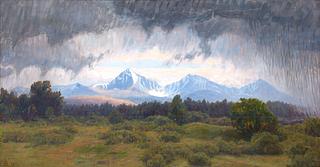
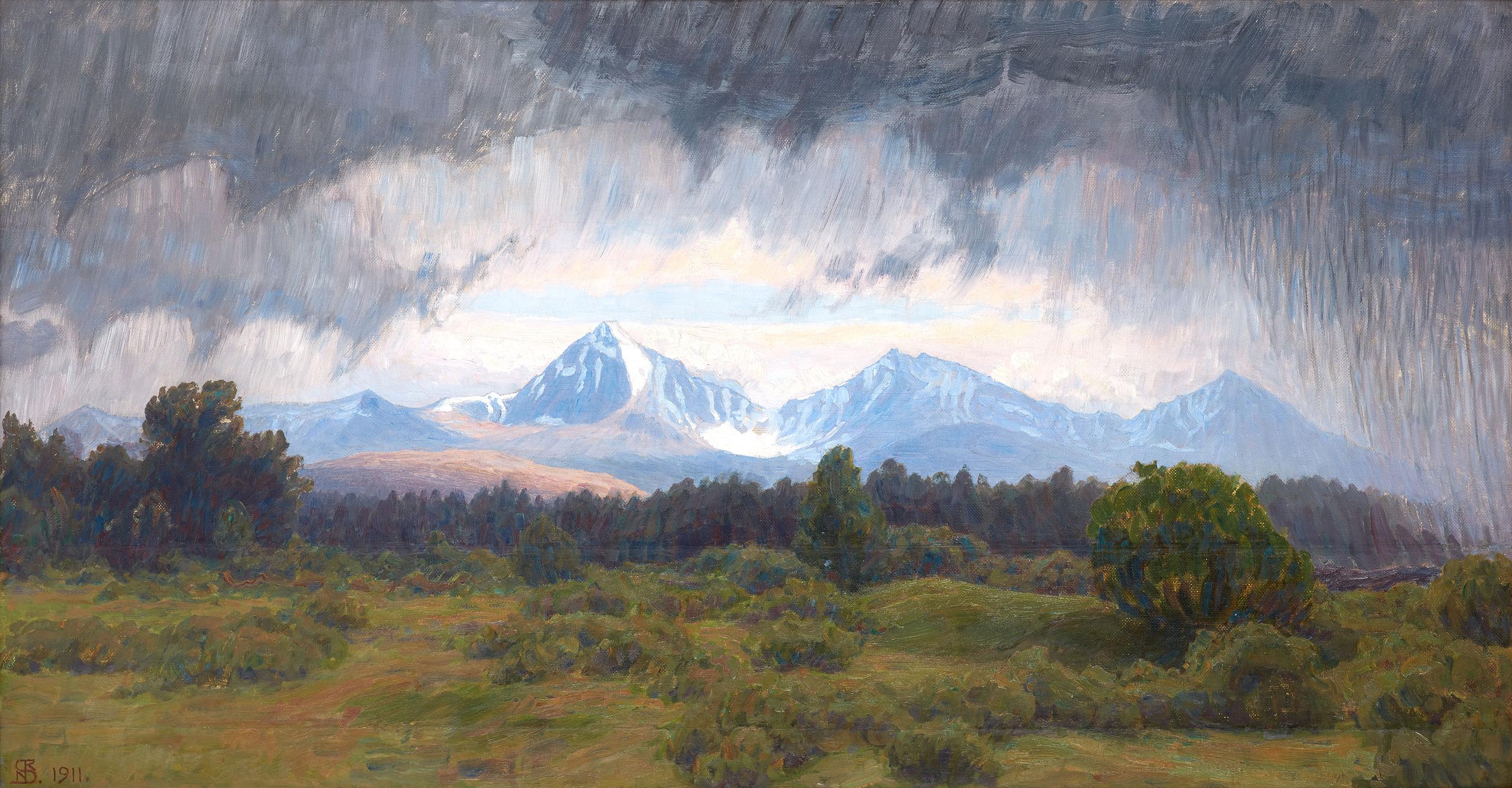
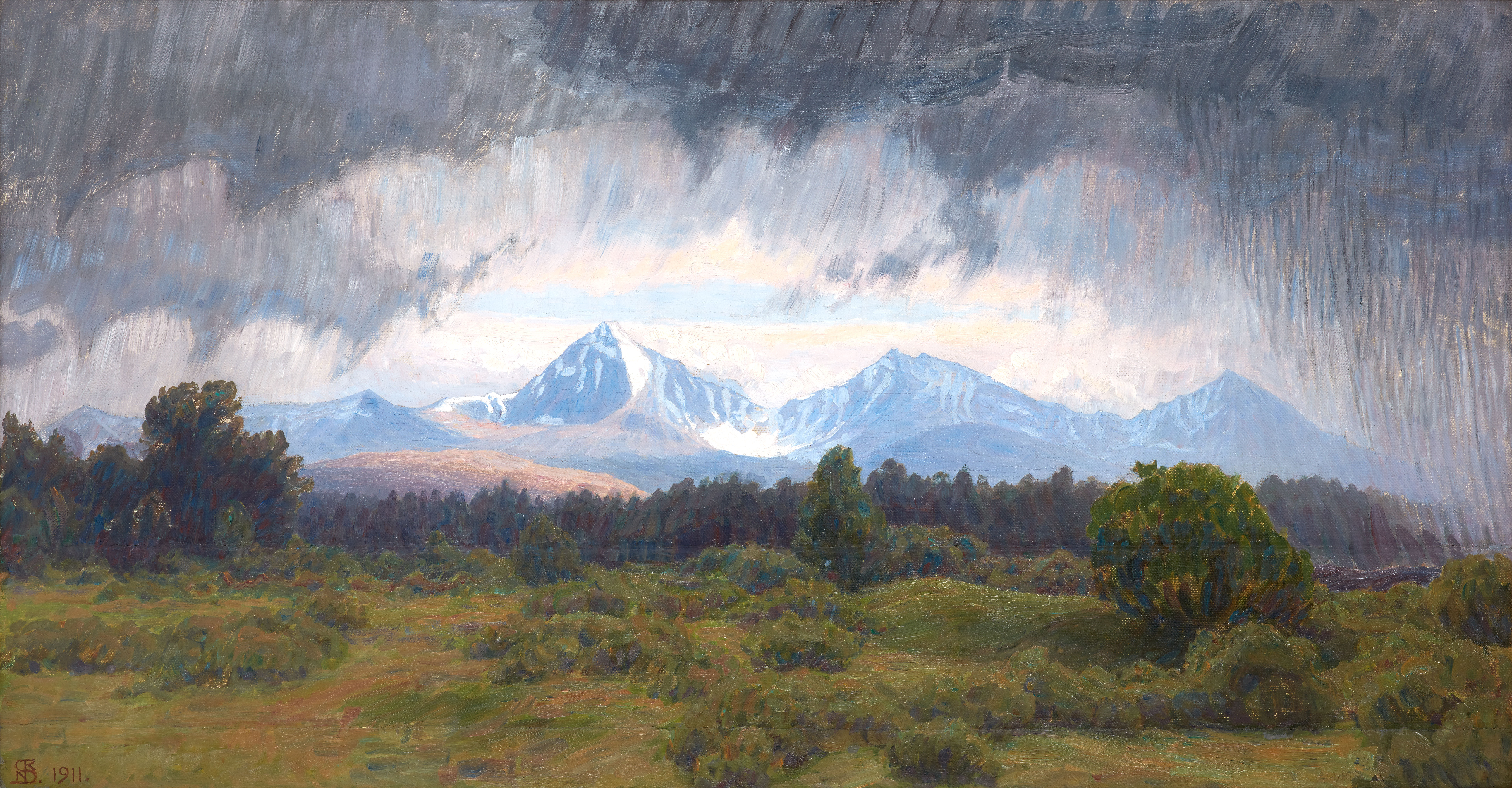
Weather conditions are obviously important to an outdoor painter, and this is also clearly evident when it comes to Skovgaard, who worked diligently in the open air on his many trips abroad. In several of his pictures from Norway one sees how the changing weather affected his motifs, including Rain at Rondane, where a heavy rainstorm is raging. Skovgaard has depicted the rain by means of powerful, rapid brushstrokes describing a downward motion from the clouds to the ground. In addition, he has taken advantage of how the heavy clouds and the darkness they cast over the landscape in the foreground contrasts sharply up against the light blue sky in the distance, making the snow-capped peaks of Rondane light up as the undisputed centre of the painting.
In addition to the distinctive technique and colour contrasts, the elongated format used here is striking. Even so, using such a format was not unusual for Skovgaard as it enabled him to depict how the Norwegian mountains ran like long bands through the landscape.1
The David Collection is also home to another work (B 433) painted by Skovgaard on his trip to Norway in 1911.
Weather conditions are obviously important to an outdoor painter, and this is also clearly evident when it comes to Skovgaard, who worked diligently in the open air on his many trips abroad. In several of his pictures from Norway one sees how the changing weather affected his motifs, including Rain at Rondane, where a heavy rainstorm is raging. Skovgaard has depicted the rain by means of powerful, rapid brushstrokes describing a downward motion from the clouds to the ground. In addition, he has taken advantage of how the heavy clouds and the darkness they cast over the landscape in the foreground contrasts sharply up against the light blue sky in the distance, making the snow-capped peaks of Rondane light up as the undisputed centre of the painting.
In addition to the distinctive technique and colour contrasts, the elongated format used here is striking. Even so, using such a format was not unusual for Skovgaard as it enabled him to depict how the Norwegian mountains ran like long bands through the landscape.1
The David Collection is also home to another work (B 433) painted by Skovgaard on his trip to Norway in 1911.
Published in
Published in
Den frie Udstilling, Den frie Udstilling, København 1912, cat.no. 185;
Niels Skovgaard – katalog over udstilling arrangeret af Den Frie Udstilling i anledning af kunstnerens 70-års fødselsdag, oktober 1928, Den frie Udstilling, København 1928, cat.no. 136;
Mindeudstilling Karl Schou og Niels Skovgaard, Den frie Udstilling, København 1939, cat.no. 220;
Aksel Rode: Niels Skovgaard : Med en Fortegnelse over hans malede Arbejder ved Ebbe Skovgaard, København 1943, pp. 292-293;
Ebbe Skovgaard: ”Fortegnelse over Niels Skovgaards malerier og studier i olie, tempera og cassein” in Aksel Rode: Niels Skovgaard, København 1943, cat.no. 471, p. 420;
Erik Zahle: ”Billedkunst” in C.L. Davids Samling. Nogle Studier, [1], København 1948, p. 209;
Kathrine Svanum Andersen: ”Bjergenes magt over menneskesindet” in Anne-Mette Villumsen, Teresa Nielsen (eds.): Niels Skovgaard. Maler – Billedhugger – Keramiker – Illustrator, Skovgaard Museet, Fuglsang Kunstmuseum, Vejen Kunstmuseum, Vejen 2018, fig. 10, pp. 261-262;
Niels Skovgaard – katalog over udstilling arrangeret af Den Frie Udstilling i anledning af kunstnerens 70-års fødselsdag, oktober 1928, Den frie Udstilling, København 1928, cat.no. 136;
Mindeudstilling Karl Schou og Niels Skovgaard, Den frie Udstilling, København 1939, cat.no. 220;
Aksel Rode: Niels Skovgaard : Med en Fortegnelse over hans malede Arbejder ved Ebbe Skovgaard, København 1943, pp. 292-293;
Ebbe Skovgaard: ”Fortegnelse over Niels Skovgaards malerier og studier i olie, tempera og cassein” in Aksel Rode: Niels Skovgaard, København 1943, cat.no. 471, p. 420;
Erik Zahle: ”Billedkunst” in C.L. Davids Samling. Nogle Studier, [1], København 1948, p. 209;
Kathrine Svanum Andersen: ”Bjergenes magt over menneskesindet” in Anne-Mette Villumsen, Teresa Nielsen (eds.): Niels Skovgaard. Maler – Billedhugger – Keramiker – Illustrator, Skovgaard Museet, Fuglsang Kunstmuseum, Vejen Kunstmuseum, Vejen 2018, fig. 10, pp. 261-262;
Footnotes
Footnotes
1.
Kathrine Svanum Andersen: ’Bjergenes magt over menneskesindet’ in Anne-Mette Villumsen, Teresa Nielsen (eds.): Niels Skovgaard. Maler – Billedhugger – Keramiker – Illustrator, Skovgaard Museet, Fuglsang Kunstmuseum, Vejen Kunstmuseum, Viborg 2018, pp. 260–263.