Niels Skovgaard (1858–1938)
Plateau at Gudbrandsdalen, 1911
Oil on canvas
46.8 x 74.5 cm
Inventory number B 433
Niels Skovgaard worked with several different artistic genres and materials throughout his life, including painting, ceramics, drawing and sculpture. His great love of nature found particularly poignant expression in his paintings, partly because he was fascinated by the Nordic landscapes throughout his career, eagerly venturing out into them to search for motifs and to paint.
The Norwegian landscapes became a recurring subject in Skovgaard’s art, and he made many visits to the country during the period 1906 to 1922, as is reflected in many paintings and drawings. He was especially fascinated by the Gudbrandsdalen– an approximately 200 km valley located in the part of Norway called Østlandet (Eastern Norway). Skovgaard explored an impressively large part of this imposing area, depicting its mountains and forests repeatedly.
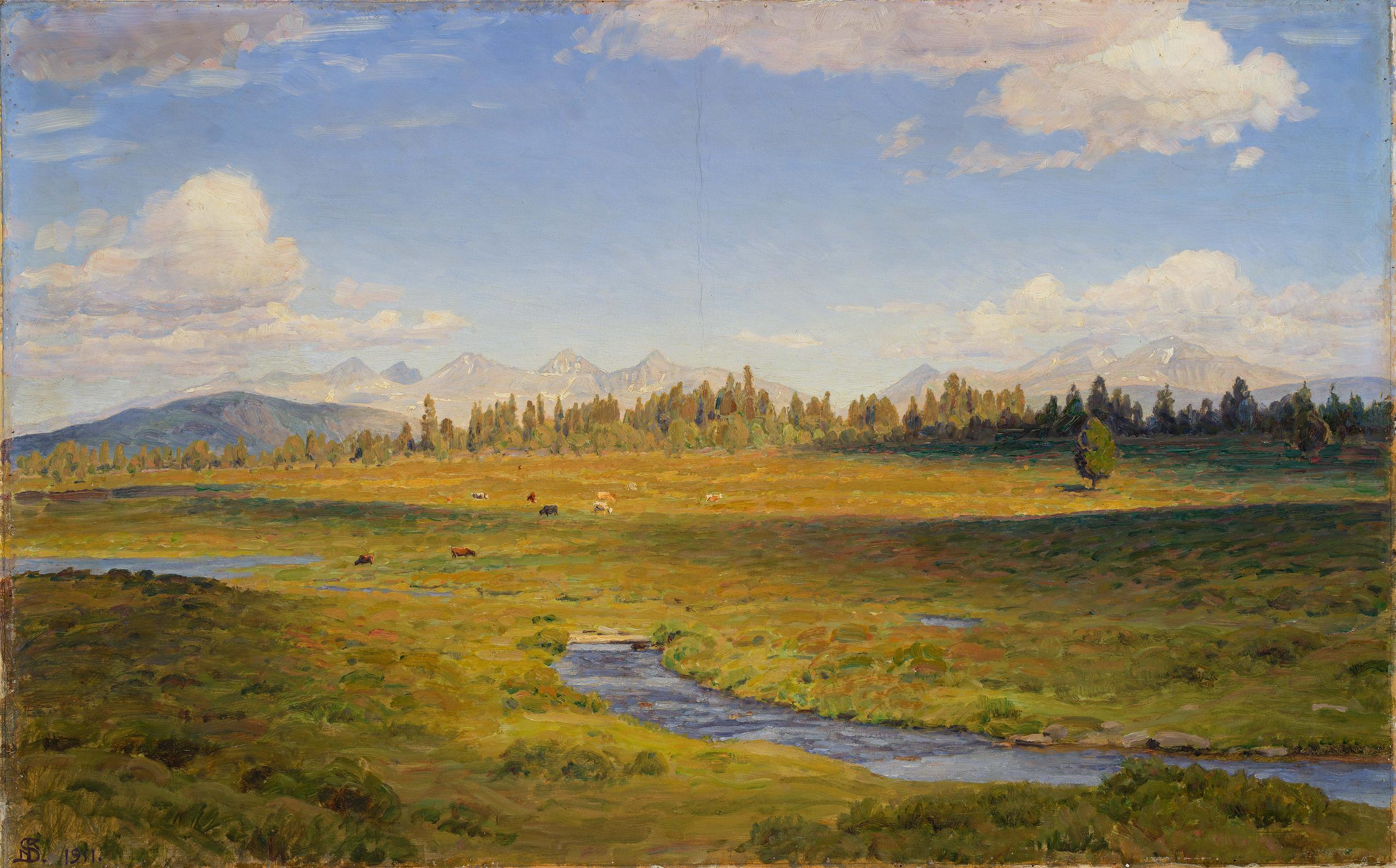
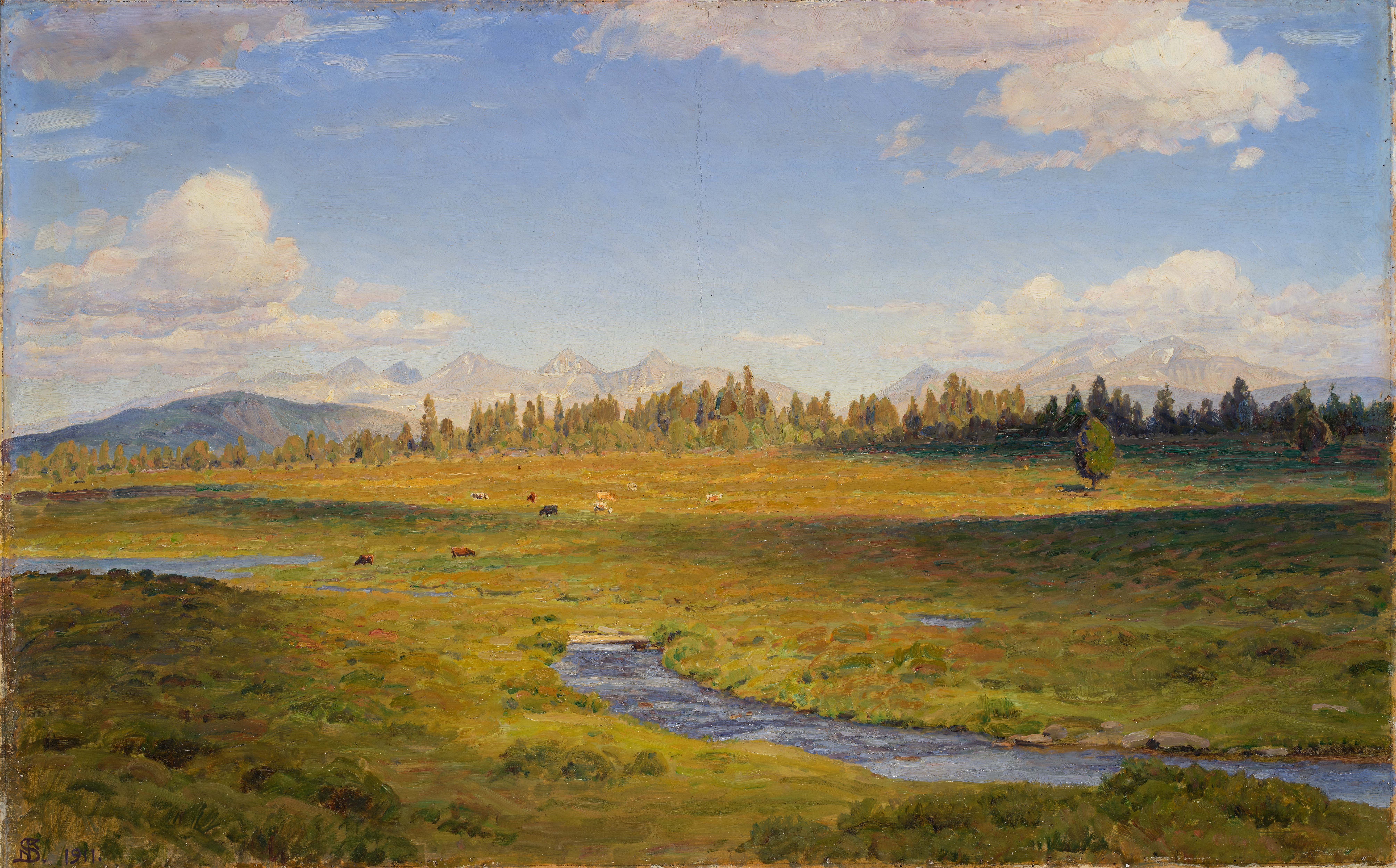
The subject of this picture is a place called Sandsæter, which Skovgaard visited as part of a prolonged stay in Norway with his family from July to September 1911. The scene shows the lush mountain plain, painted in hues of green, yellow and orange. A brook and grazing cows mark the transition to the middle ground, leading on to the high peaks of the Rondane mountains in the background.
Skovgaard often let weather conditions play a prominent role in his works. Hence, one of the characteristic features of the paintings he created in Norway is the changeable weather he experienced during his visits there1 (see also B 432). In Plateau at Gudbrandsdalen, Skovgaard has captured the fleeting rays of sunlight and the shadows cast by the clouds down upon the open, flat landscape. Thus he succeeds in creating a naturalistic depiction of the movements one can find in nature.
Mountain Plain at Gudbrandsdalen is a preparatory work for a larger oil painting of the same name.2
The Norwegian landscapes became a recurring subject in Skovgaard’s art, and he made many visits to the country during the period 1906 to 1922, as is reflected in many paintings and drawings. He was especially fascinated by the Gudbrandsdalen– an approximately 200 km valley located in the part of Norway called Østlandet (Eastern Norway). Skovgaard explored an impressively large part of this imposing area, depicting its mountains and forests repeatedly.
The subject of this picture is a place called Sandsæter, which Skovgaard visited as part of a prolonged stay in Norway with his family from July to September 1911. The scene shows the lush mountain plain, painted in hues of green, yellow and orange. A brook and grazing cows mark the transition to the middle ground, leading on to the high peaks of the Rondane mountains in the background.
Skovgaard often let weather conditions play a prominent role in his works. Hence, one of the characteristic features of the paintings he created in Norway is the changeable weather he experienced during his visits there1 (see also B 432). In Plateau at Gudbrandsdalen, Skovgaard has captured the fleeting rays of sunlight and the shadows cast by the clouds down upon the open, flat landscape. Thus he succeeds in creating a naturalistic depiction of the movements one can find in nature.
Mountain Plain at Gudbrandsdalen is a preparatory work for a larger oil painting of the same name.2
Published in
Published in
Den frie Udstilling, Den frie Udstilling, København 1912, cat.186;
Niels Skovgaard – katalog over udstilling arrangeret af Den Frie Udstilling i anledning af kunstnerens 70-års fødselsdag, oktober 1928, Den frie Udstilling, København 1928, cat. 137;
Aksel Rode: Niels Skovgaard : Med en Fortegnelse over hans malede Arbejder ved Ebbe Skovgaard, København 1943, pp. 293-294, 305;
Ebbe Skovgaard: ”Fortegnelse over Niels Skovgaards malerier og studier i olie, tempera og cassein” in Aksel Rode: Niels Skovgaard, København 1943, cat. 466, p. 420;
Erik Zahle: ”Billedkunst” in C.L. Davids Samling. Nogle Studier, [1], København 1948, p. 209;
Kathrine Svanum Andersen: ”Bjergenes magt over menneskesindet” in Anne-Mette Villumsen, Teresa Nielsen (red.): Niels Skovgaard. Maler – Billedhugger – Keramiker – Illustrator, Skovgaard Museet, Fuglsang Kunstmuseum, Vejen Kunstmuseum, Vejen 2018, fig. 10, pp. 261-262;
Niels Skovgaard – katalog over udstilling arrangeret af Den Frie Udstilling i anledning af kunstnerens 70-års fødselsdag, oktober 1928, Den frie Udstilling, København 1928, cat. 137;
Aksel Rode: Niels Skovgaard : Med en Fortegnelse over hans malede Arbejder ved Ebbe Skovgaard, København 1943, pp. 293-294, 305;
Ebbe Skovgaard: ”Fortegnelse over Niels Skovgaards malerier og studier i olie, tempera og cassein” in Aksel Rode: Niels Skovgaard, København 1943, cat. 466, p. 420;
Erik Zahle: ”Billedkunst” in C.L. Davids Samling. Nogle Studier, [1], København 1948, p. 209;
Kathrine Svanum Andersen: ”Bjergenes magt over menneskesindet” in Anne-Mette Villumsen, Teresa Nielsen (red.): Niels Skovgaard. Maler – Billedhugger – Keramiker – Illustrator, Skovgaard Museet, Fuglsang Kunstmuseum, Vejen Kunstmuseum, Vejen 2018, fig. 10, pp. 261-262;
Footnotes
Footnotes
1.
Niels Skovgaard, Højslette ved Gudbrandsdalen, 1911, Bornholms Kunstmuseum, inv.no. 670x61.
2.
Kathrine Svanum Andersen: ’Bjergenes magt over menneskesindet’ in Anne-Mette Villumsen, Teresa Nielsen (eds.): Niels Skovgaard. Maler – Billedhugger – Keramiker – Illustrator, Skovgaard Museet, Fuglsang Kunstmuseum, Vejen Kunstmuseum, Viborg 2018, pp. 261–263.