Albert Gottschalk (1866–1906)
A Summer’s Day at Nivaa, 1903
Oil on canvas
50 x 69 cm
Inventory number B 299
Albert Gottschalk died in the winter of 1906 at the age of 39. In a memorial essay, Karl Madsen (1855–1938) praised his friend and former student for his perception of nature and colouristic talent. At the same time, however, he also looked askance at Gottschalk’s persistently expressive, sketch-like style, which Madsen believed was partly due to insufficient academy training. He nevertheless asserted that Gottschalk would occasionally succeed in thoroughly finishing a canvas and achieving a ‘beautiful’ result, as in the case of A Summer’s Day at Nivaa.1
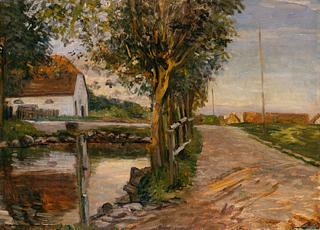
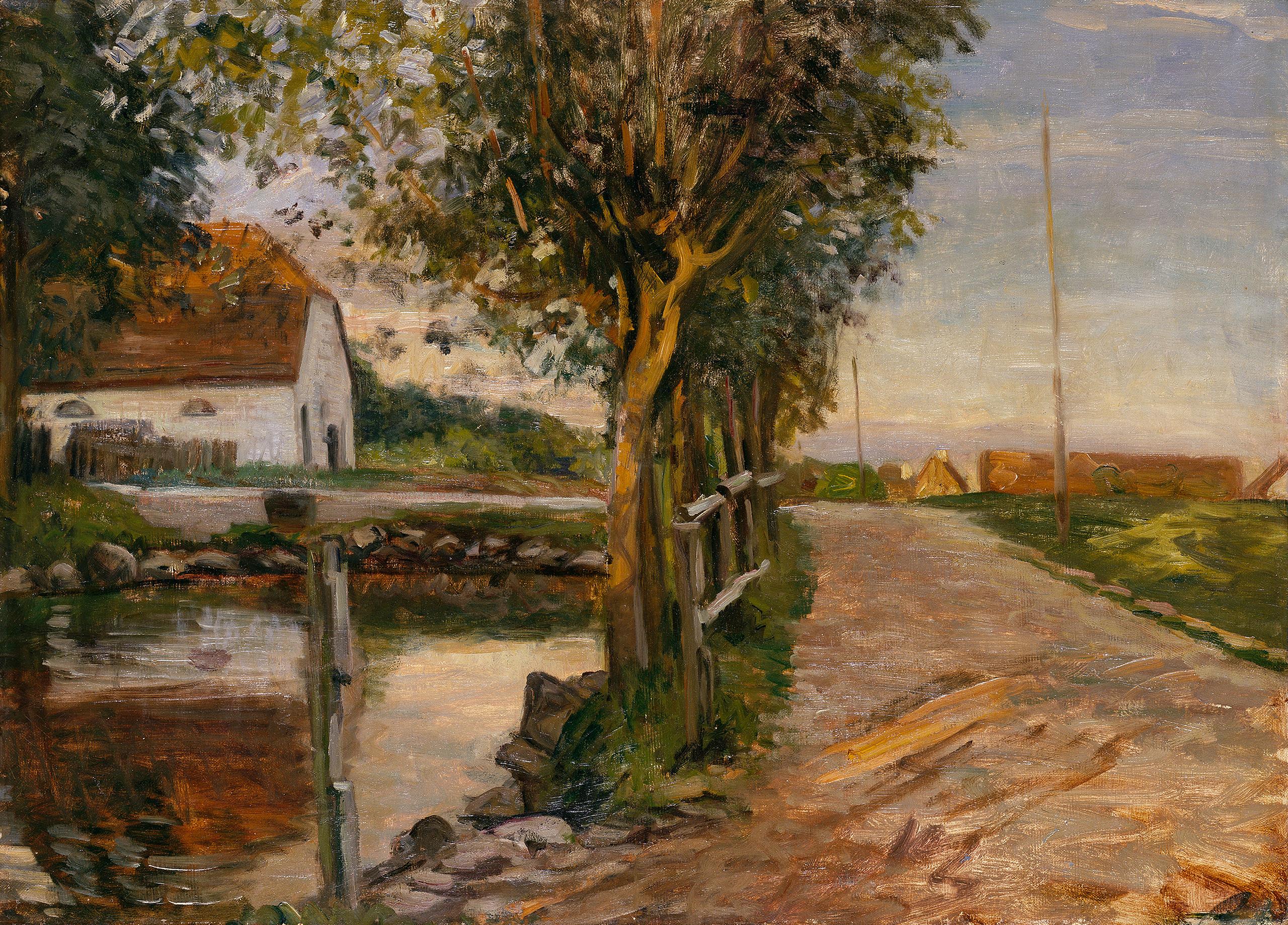
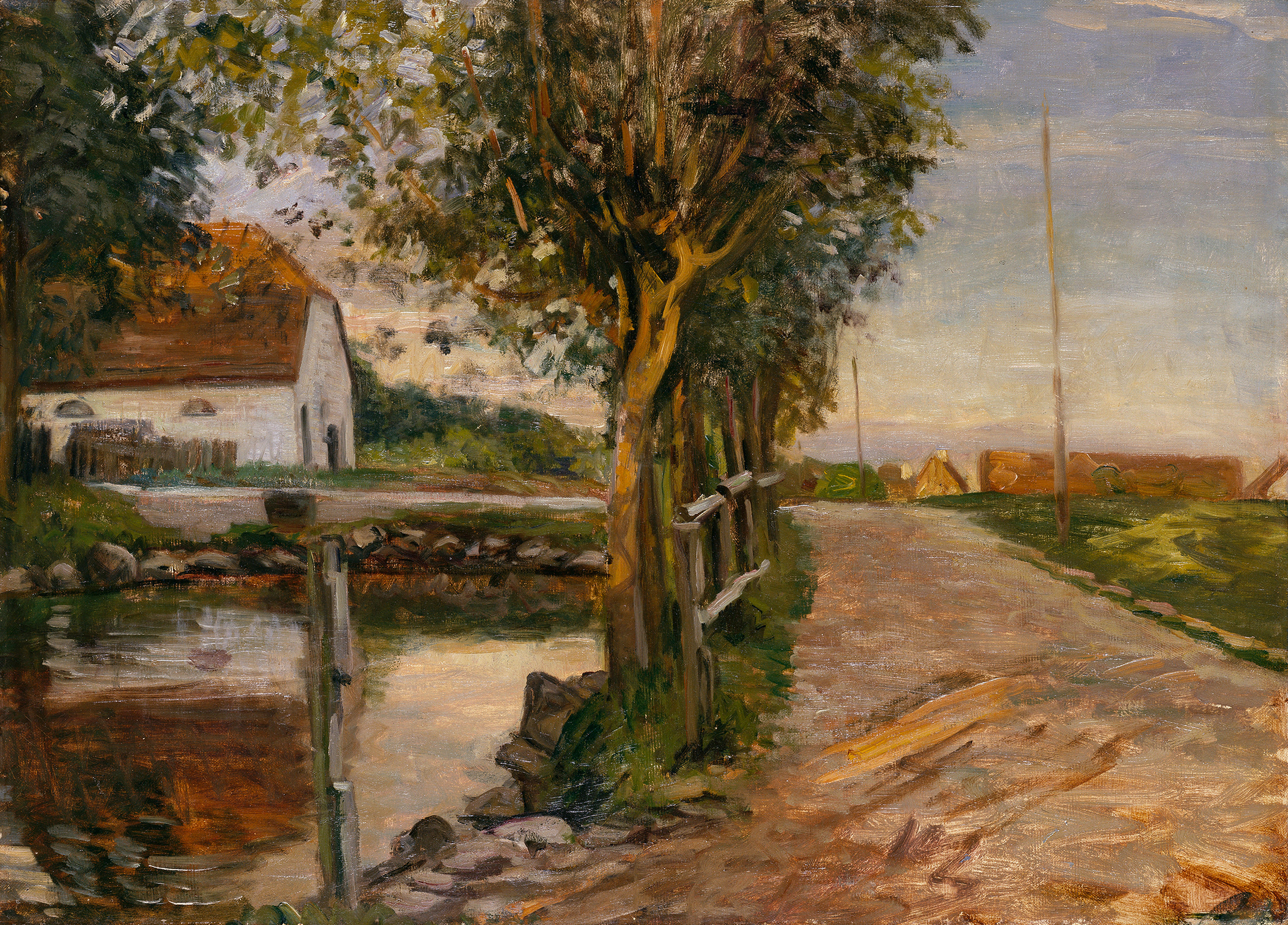
The atmospheric village scene is based on a composition involving a prominent division of the picture plane. In the middle is a brightly lit tree, from which a fence, seen in extreme foreshortening, divides the picture in two. To the right, the road leads towards the houses on the horizon, the light blue and peach-coloured sky arching above. To the left is a whitewashed farmhouse with an orange-red roof which, like the sky and the trees, is reflected in the village pond in the foreground. As in B 297, Gottschalk uses the road as an important compositional element, helping to add depth to the pictorial space while also emphasising the horizontal centre line further reinforced by the picket fence to the left and the rooftops to the right. A Summer’s Day at Nivaa also clearly demonstrates Gottschalk’s skills as a colourist. Particularly prominent are the green field, the tree crowns and the shrubbery, which lend character to the red tones in the picture.
Gottschalk found this subject in North Zealand, which he often visited with the express purpose of finding inspiration. He painted in locations such as Tisvilde, Helsingør, Lyngby and Dyrehaven in Klampenborg (B 302).
The atmospheric village scene is based on a composition involving a prominent division of the picture plane. In the middle is a brightly lit tree, from which a fence, seen in extreme foreshortening, divides the picture in two. To the right, the road leads towards the houses on the horizon, the light blue and peach-coloured sky arching above. To the left is a whitewashed farmhouse with an orange-red roof which, like the sky and the trees, is reflected in the village pond in the foreground. As in B 297, Gottschalk uses the road as an important compositional element, helping to add depth to the pictorial space while also emphasising the horizontal centre line further reinforced by the picket fence to the left and the rooftops to the right. A Summer’s Day at Nivaa also clearly demonstrates Gottschalk’s skills as a colourist. Particularly prominent are the green field, the tree crowns and the shrubbery, which lend character to the red tones in the picture.
Gottschalk found this subject in North Zealand, which he often visited with the express purpose of finding inspiration. He painted in locations such as Tisvilde, Helsingør, Lyngby and Dyrehaven in Klampenborg (B 302).
Published in
Published in
Fortegnelse over Albert Gottschalks arbejder: udstillede i Kunstforeningen i København, November-December 1906, København 1906, cat.no. 161, p. 12;
Karl Madsen: ”Albert Gottschalk” in Tilskueren, 1906, p. 987;
Albert Gottschalk, født i Stege 3. Juli 1866, død i København 13. Februar 1906, Den Frie Udstilling, Oktober 1930, København 1930, cat.no. 197, p. 29;
Poul Uttenreitter: Albert Gottschalk, København 1943 (Vor tids kunst; 36), p. 40;
Erik Zahle: ”Malerisamlingens vækst” in C.L. Davids Samling, Tredie del, København 1958, pp. 128, 166-167;
C.L. David: C.L. Davids Samling, København 1960, p. 24;
Troels Andersen: Albert Gottschalk: 1866-1906, 2. rev. ed., Valby 2013, cat.no. 275, pp. 60, 70, 166;
Troels Andersen in Kjeld von Folsach and Nana Lund (eds.): Dansk kunst i Davids Samling – fra Philipsen til Saxbo, København 1995, cat.no. 61, pp. 150-151;
Gertrud Oelsner (ed.): I maleriets udkant - Albert Gottschalk (1866-1906) = Men denna eftermiddag = But this afternoon, Storstrøms Kunstmuseum and Faaborg Museum, Maribo 2002, cat.no. 40;
Karl Madsen: ”Albert Gottschalk” in Tilskueren, 1906, p. 987;
Albert Gottschalk, født i Stege 3. Juli 1866, død i København 13. Februar 1906, Den Frie Udstilling, Oktober 1930, København 1930, cat.no. 197, p. 29;
Poul Uttenreitter: Albert Gottschalk, København 1943 (Vor tids kunst; 36), p. 40;
Erik Zahle: ”Malerisamlingens vækst” in C.L. Davids Samling, Tredie del, København 1958, pp. 128, 166-167;
C.L. David: C.L. Davids Samling, København 1960, p. 24;
Troels Andersen: Albert Gottschalk: 1866-1906, 2. rev. ed., Valby 2013, cat.no. 275, pp. 60, 70, 166;
Troels Andersen in Kjeld von Folsach and Nana Lund (eds.): Dansk kunst i Davids Samling – fra Philipsen til Saxbo, København 1995, cat.no. 61, pp. 150-151;
Gertrud Oelsner (ed.): I maleriets udkant - Albert Gottschalk (1866-1906) = Men denna eftermiddag = But this afternoon, Storstrøms Kunstmuseum and Faaborg Museum, Maribo 2002, cat.no. 40;
Footnotes
Footnotes
1.
Karl Madsen’s memorial essay on Albert Gottschalk in Tilskueren, Copenhagen 1906, p. 987.