Christen Købke
‘Day’ (after Bertel Thorvaldsen’s relief), 1834–1835
Oil on canvas
Diameter: 76.5 cm
Inventory number B 358
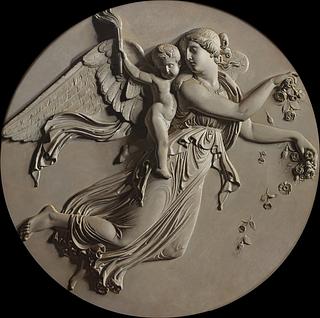
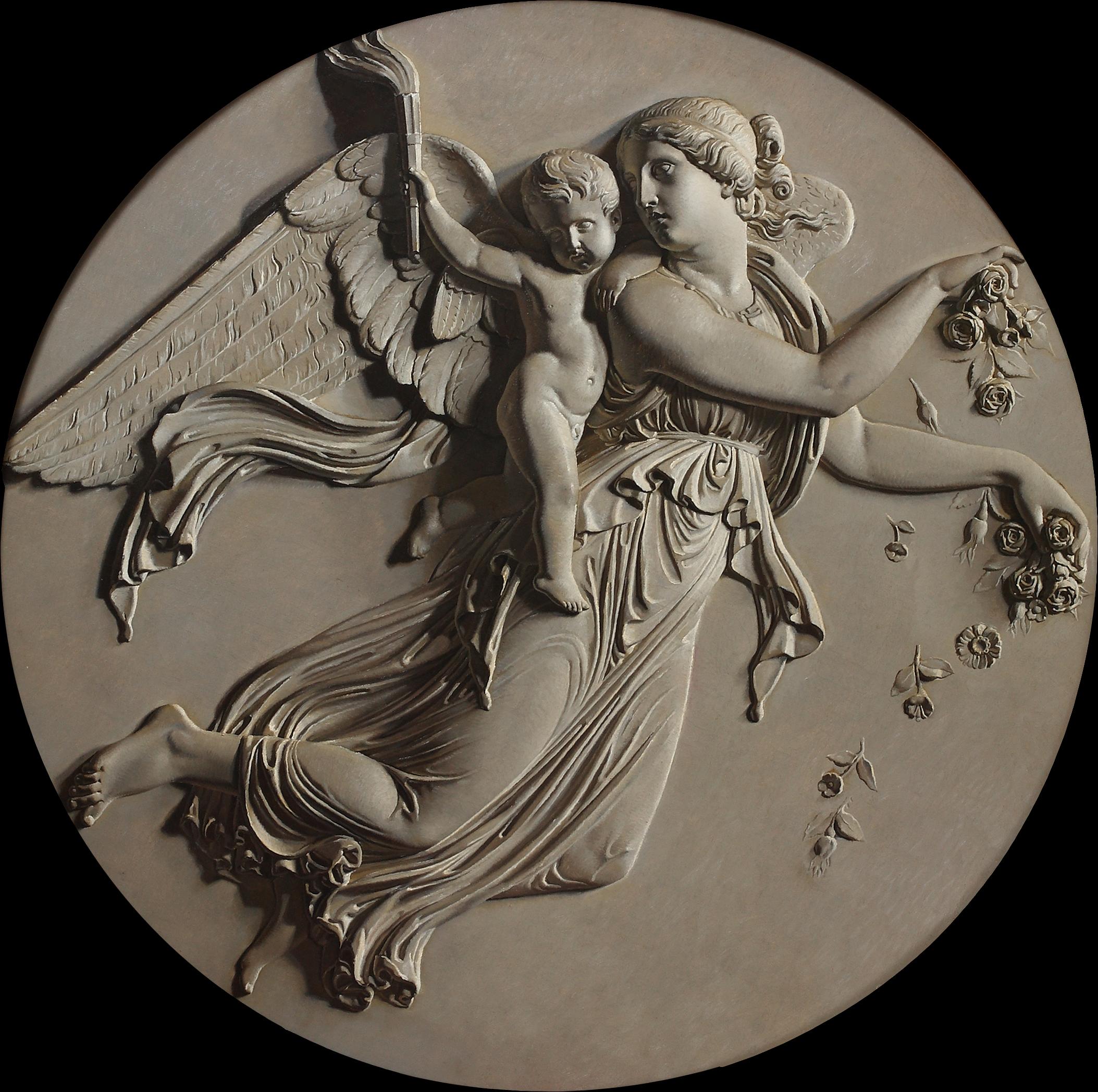
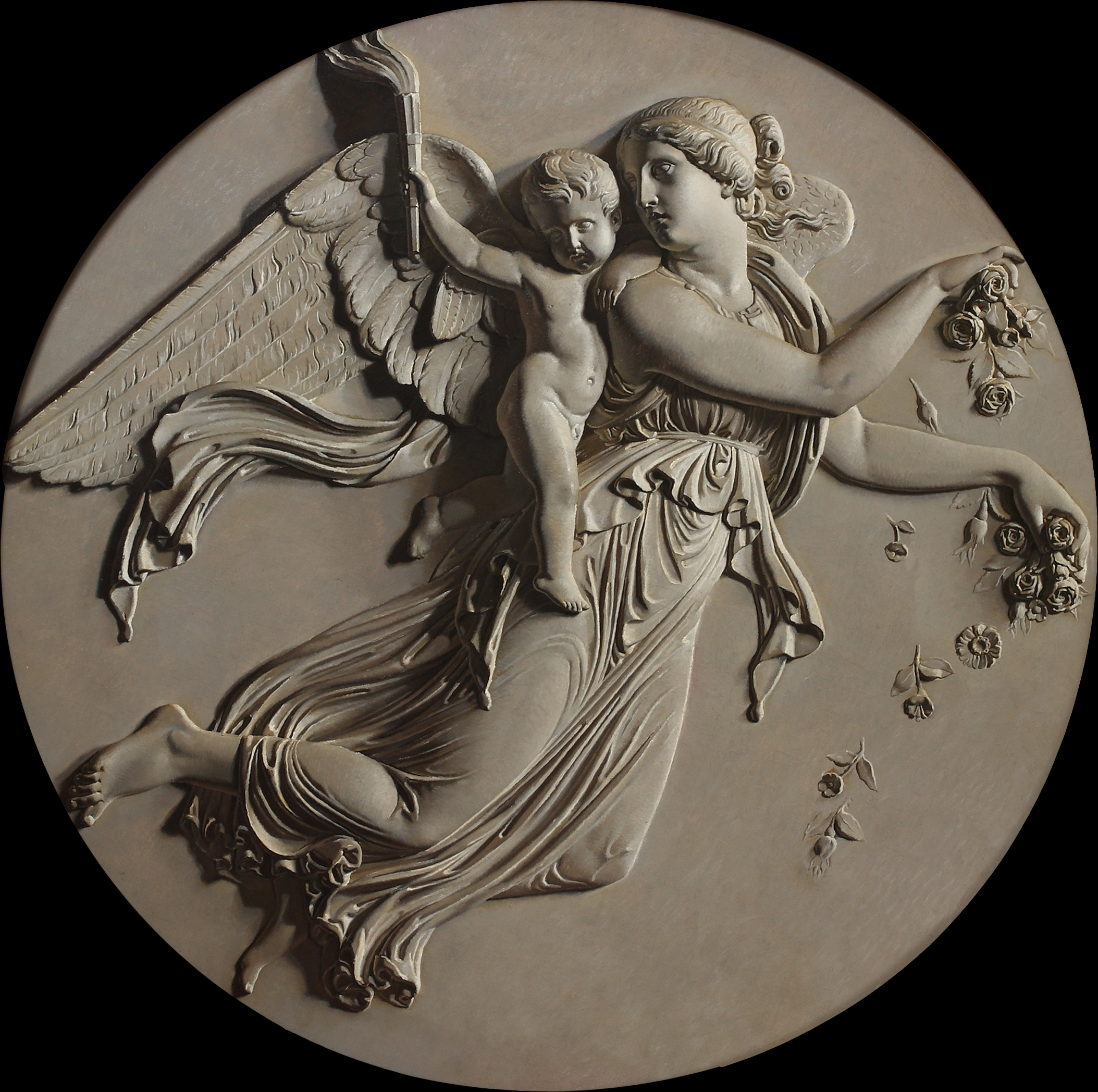
In the mid-1830s, Christen Købke executed the circular painting Day after one of the Danish sculptor Bertel Thorvaldsen’s (1770-1844) most popular reliefs of the same name.1 The scene has the floating Hemera, a personification of day in Greek mythology, as its main figure. While scattering flowers, she looks back over her shoulder and directs her gaze at a small, winged and torch-carrying boy sitting on her back. He symbolises light and the sun.
In mythology, Day (Hemera) is often referred to as the opposite of Night (Nyx). Thorvaldsen had this in mind, too as he concurrently with the Day relief created its counterpart, the relief Night.2 Being opposites, they symbolise the two halves of the day. Together they represent the whole. They can also be seen as opposites in terms of light versus dark, awakening versus sleep, life versus death. Thorvaldsen was by no means the first artist to address the two goddesses and the symbolism associated with them, but in his version the motifs appear distinctly well-thought-out and well-executed, infused with the harmony and balance that was his particular hallmark.3
Købke’s two paintings were originally part of the decoration of his parents’ dining room in their home in Blegdammen in Copenhagen, where the artist also lived with his family. On the opposite end wall of the dining room were two large landscape paintings based on Købke’s small paintings 20/1969 and 31/2014.
Købke’s painting Night, the counterpart to Day, is also part of The David Collection (B 359).
In mythology, Day (Hemera) is often referred to as the opposite of Night (Nyx). Thorvaldsen had this in mind, too as he concurrently with the Day relief created its counterpart, the relief Night.2 Being opposites, they symbolise the two halves of the day. Together they represent the whole. They can also be seen as opposites in terms of light versus dark, awakening versus sleep, life versus death. Thorvaldsen was by no means the first artist to address the two goddesses and the symbolism associated with them, but in his version the motifs appear distinctly well-thought-out and well-executed, infused with the harmony and balance that was his particular hallmark.3
Købke’s two paintings were originally part of the decoration of his parents’ dining room in their home in Blegdammen in Copenhagen, where the artist also lived with his family. On the opposite end wall of the dining room were two large landscape paintings based on Købke’s small paintings 20/1969 and 31/2014.
Købke’s painting Night, the counterpart to Day, is also part of The David Collection (B 359).
Published in
Published in
Emil Hannover: Maleren Christen Købke: En Studie i dansk Kunsthistorie, København 1893, cat. 76, p. 140 (the note);
Fortegnelse over Christen Købkes Malerier: Kunstforeningen Marts-April 1912, København 1912, cat. 87;
Karl Madsen: "Christen Købke og hans Billeder paa Galleriet", in Kunstmuseets Aarsskrift, 1, 1914, p. 39;
Mario Krohn: Maleren Christen Købkes Arbejder, København 1915, no. 89;
Jørn Rubow: ”Christen Købke” in Danmark, year 1, 1940-41, p. 243;
Dansk Kunsthåndværk gennem 400 Aar. Kunstindustrimuseets Jubilæumsudstilling Maj-Juni 1946, København 1946, cat. 150, p. 54;
Erik Zahle: ”Billedkunst” in C.L. Davids Samling. Nogle Studier, [1], København 1948, pp. 203-205, 238-239;
Christen Købke: udstilling 31. januar – 28. februar 1953, Kunstforeningen, København 1953, cat. 53;
Erik Zahle (ed.): Danmarks Malerkunst. Fra middelalder til nutid, 4. ed, København 1956, p. 141;
C.L. David: C.L. Davids Samling: Kronprinsessegade 30, København 1960, p. 9;
Dansk guldålder: Målningar, teckningar, skulpturer, Nationalmuseum, Stockholm 1964, cat. 170, p. 47;
Vagn Poulsen: ”Guldalderbilleder” in C.L. Davids Samling. Fjerde del, Jubilæumsskrift 1945-1970, København 1970, p. 24;
Dansk kunst og kunsthåndværk, Davids Samling, København 1972, p. 11;
Vagn Poulsen, Erik Lassen and Jan Danielsen (eds.): Dansk kunsthistorie: billedkunst og skulptur. Vol. 3, Akademiet og guldalderen, 1750-1850, København 1972, p. 343;
Kasper Monrad and Erik Fischer: Købke på Blegdammen og ved Sortedamssøen, Statens Museum for Kunst, København 1981, p. 21 and cat. 71, p. 37;
Verner Jul Andersen: Dansk kunst og kunsthåndværk, Davids Samling, 2.ed., København 1983, cat. 423;
Hans Edvard Nørregaard-Nielsen: Dansk kunst. Vol. 1. København 1983, p. 200;
Kasper Monrad in L’âge d’or de la peinture danoise 1800-1850, Grand Palais, Paris 1984, pp. 219-220 ;
Kasper Monrad: Hverdagsbilleder: dansk guldalder – kunstnerne og deres vilkår, København 1989, pp. 36 and 235;
Sanford Schwartz: Christen Købke, New York 1992, pp. 40-42 and plate 42;
Hans Edvard Nørregård-Nielsen: The golden age of Danish art: drawings from the Royal Museum of Fine Arts, Copenhagen, The Frick Collection, New York, The Frick Art Museum, Pittsburgh og Crocker Art Museum, Sacramento, Alexandria 1996, p. 66;
Hans Edvard Nørregård-Nielsen and Kasper Monrad (eds.): Christen Købke, 1810-1848, Statens Museum for Kunst, København 1996, pp. 71, 204, fig. 128, p. 200 and cat. 89;
David Jackson and Kasper Monrad: Christen Købke: Danish master of light, National Gallery, London and National Gallery Complex, Edinburgh 2010, pp. 77-78 and fig. 55.
Cecilie Høgsbro Østergaard (ed.): Dansk Guldalder: verdenskunst mellem to katastrofer, Statens Museum for Kunst, København 2019, p. 322;
Fortegnelse over Christen Købkes Malerier: Kunstforeningen Marts-April 1912, København 1912, cat. 87;
Karl Madsen: "Christen Købke og hans Billeder paa Galleriet", in Kunstmuseets Aarsskrift, 1, 1914, p. 39;
Mario Krohn: Maleren Christen Købkes Arbejder, København 1915, no. 89;
Jørn Rubow: ”Christen Købke” in Danmark, year 1, 1940-41, p. 243;
Dansk Kunsthåndværk gennem 400 Aar. Kunstindustrimuseets Jubilæumsudstilling Maj-Juni 1946, København 1946, cat. 150, p. 54;
Erik Zahle: ”Billedkunst” in C.L. Davids Samling. Nogle Studier, [1], København 1948, pp. 203-205, 238-239;
Christen Købke: udstilling 31. januar – 28. februar 1953, Kunstforeningen, København 1953, cat. 53;
Erik Zahle (ed.): Danmarks Malerkunst. Fra middelalder til nutid, 4. ed, København 1956, p. 141;
C.L. David: C.L. Davids Samling: Kronprinsessegade 30, København 1960, p. 9;
Dansk guldålder: Målningar, teckningar, skulpturer, Nationalmuseum, Stockholm 1964, cat. 170, p. 47;
Vagn Poulsen: ”Guldalderbilleder” in C.L. Davids Samling. Fjerde del, Jubilæumsskrift 1945-1970, København 1970, p. 24;
Dansk kunst og kunsthåndværk, Davids Samling, København 1972, p. 11;
Vagn Poulsen, Erik Lassen and Jan Danielsen (eds.): Dansk kunsthistorie: billedkunst og skulptur. Vol. 3, Akademiet og guldalderen, 1750-1850, København 1972, p. 343;
Kasper Monrad and Erik Fischer: Købke på Blegdammen og ved Sortedamssøen, Statens Museum for Kunst, København 1981, p. 21 and cat. 71, p. 37;
Verner Jul Andersen: Dansk kunst og kunsthåndværk, Davids Samling, 2.ed., København 1983, cat. 423;
Hans Edvard Nørregaard-Nielsen: Dansk kunst. Vol. 1. København 1983, p. 200;
Kasper Monrad in L’âge d’or de la peinture danoise 1800-1850, Grand Palais, Paris 1984, pp. 219-220 ;
Kasper Monrad: Hverdagsbilleder: dansk guldalder – kunstnerne og deres vilkår, København 1989, pp. 36 and 235;
Sanford Schwartz: Christen Købke, New York 1992, pp. 40-42 and plate 42;
Hans Edvard Nørregård-Nielsen: The golden age of Danish art: drawings from the Royal Museum of Fine Arts, Copenhagen, The Frick Collection, New York, The Frick Art Museum, Pittsburgh og Crocker Art Museum, Sacramento, Alexandria 1996, p. 66;
Hans Edvard Nørregård-Nielsen and Kasper Monrad (eds.): Christen Købke, 1810-1848, Statens Museum for Kunst, København 1996, pp. 71, 204, fig. 128, p. 200 and cat. 89;
David Jackson and Kasper Monrad: Christen Købke: Danish master of light, National Gallery, London and National Gallery Complex, Edinburgh 2010, pp. 77-78 and fig. 55.
Cecilie Høgsbro Østergaard (ed.): Dansk Guldalder: verdenskunst mellem to katastrofer, Statens Museum for Kunst, København 2019, p. 322;
Footnotes
Footnotes
1.
Kasper Monrad: Hverdagsbilleder. Dansk Guldalder – kunstnerne og deres vilkår, Copenhagen 1989, p. 36.
2.
Bertel Thorvaldsen, Night, 1815, Thorvaldsens Museum, cat. no. A901.
3.
Bertel Thorvaldsen, Day, 1815, Thorvaldsens Museum, cat. no. A902.