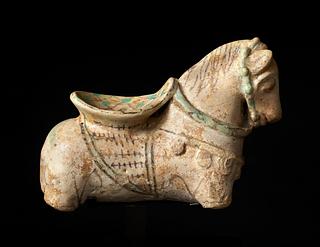
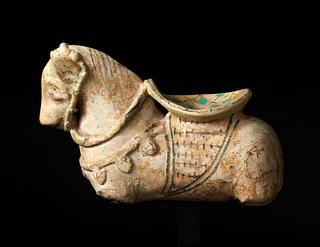
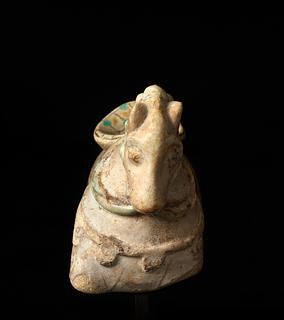
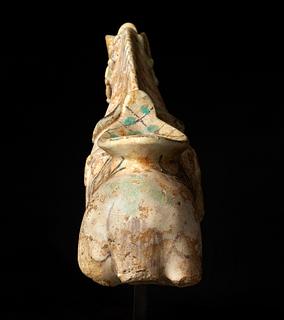
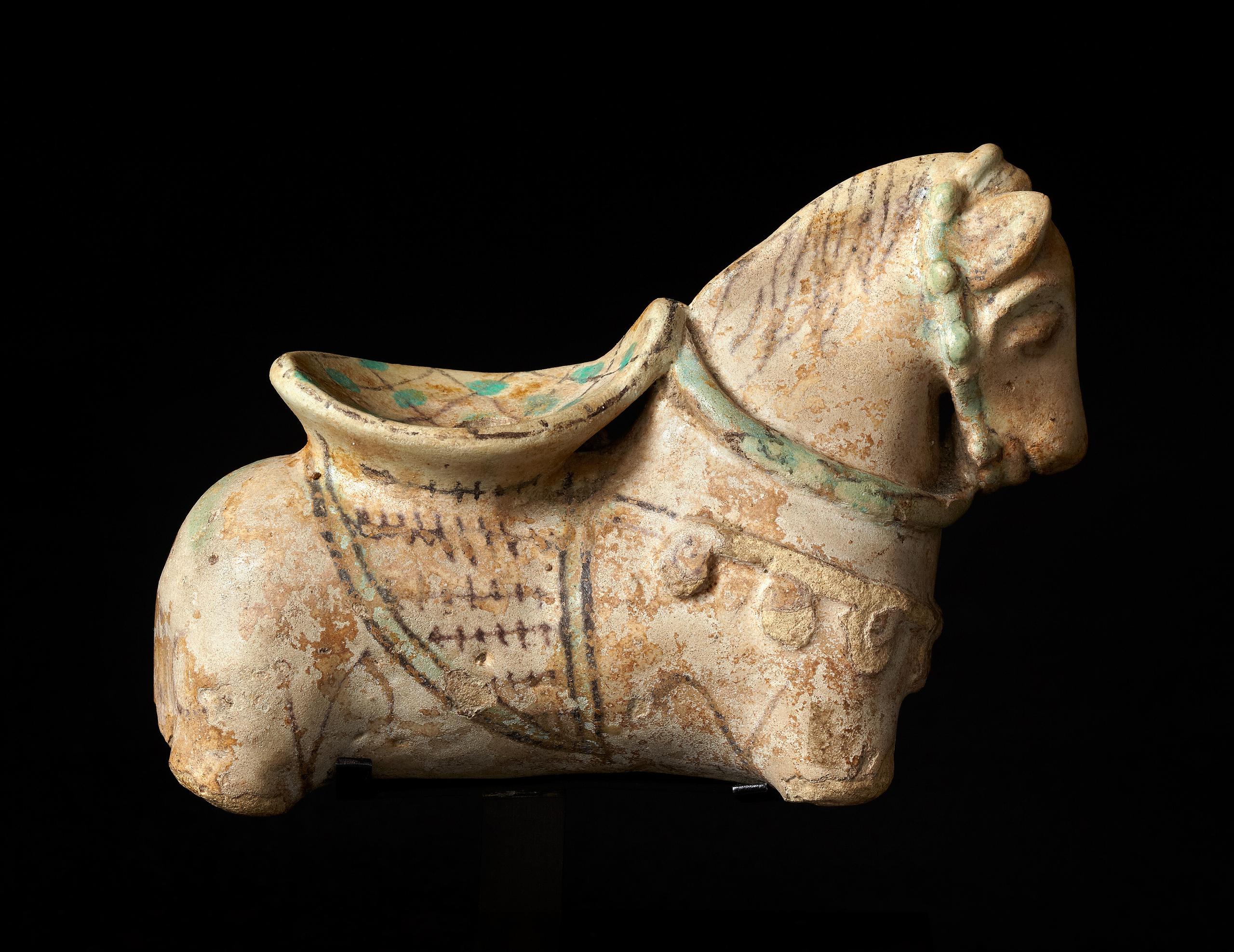
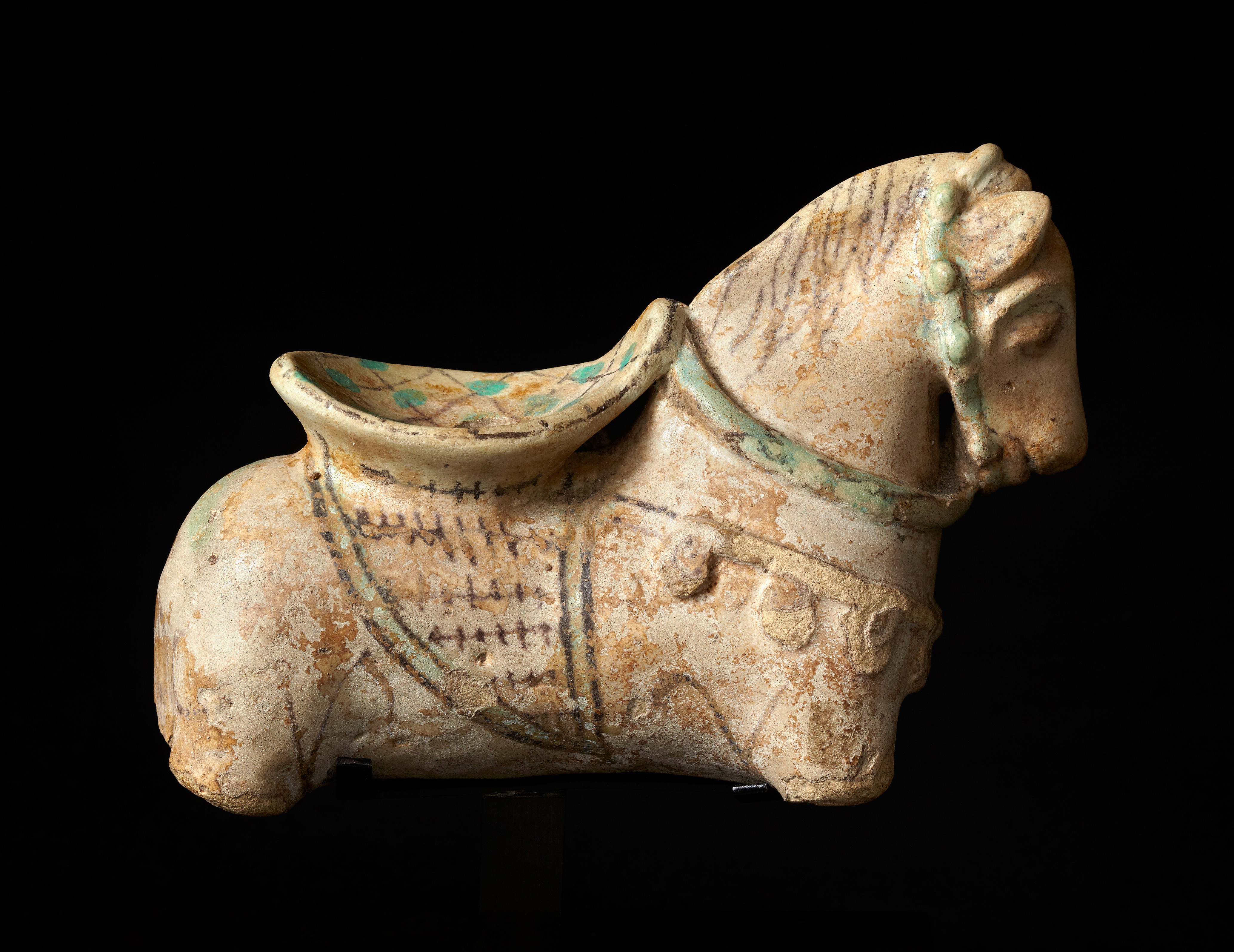
Fragmented figure of a horse, earthenware covered with a whitish slip and painted in green and manganese under a slightly toned, poorly preserved glaze
Spain; 10th century
H: 9; W: 5.2; L: 13.6 cm
Inventory number 13/2011
The black-violet and green palette as well as the rather coarse painted decoration are characteristic of Spanish Umayyad pottery. The horse’s slightly stylized head, with almond-shaped eyes, is moreover comparable to the heads of bronze fountain figures from Spain during this period.
The function of the horse is a mystery. Other four-legged earthenware animal figures of about the same size are known from Umayyad Spain. They have holes in the back and mouth and must have been used as aquamaniles for pouring liquids. This figure of a horse has only a hole in the saddle, and the fact that it is not glazed inside also makes it unlikely that it was intended to hold a liquid.
The function of the horse is a mystery. Other four-legged earthenware animal figures of about the same size are known from Umayyad Spain. They have holes in the back and mouth and must have been used as aquamaniles for pouring liquids. This figure of a horse has only a hole in the saddle, and the fact that it is not glazed inside also makes it unlikely that it was intended to hold a liquid.
Published in
Published in
Christie’s, London 31/3 2009, lot 113;
Sotheby’s, London 6/4 2011, lot 289;
Eduardo Manzano Moreno: La corte del califa. Cuatro años en la Córdoba de los omeyas, Barcelona 2023, the cover;
Sotheby’s, London 6/4 2011, lot 289;
Eduardo Manzano Moreno: La corte del califa. Cuatro años en la Córdoba de los omeyas, Barcelona 2023, the cover;