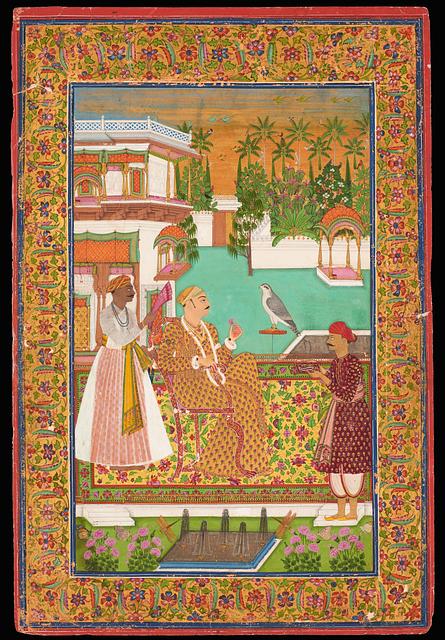
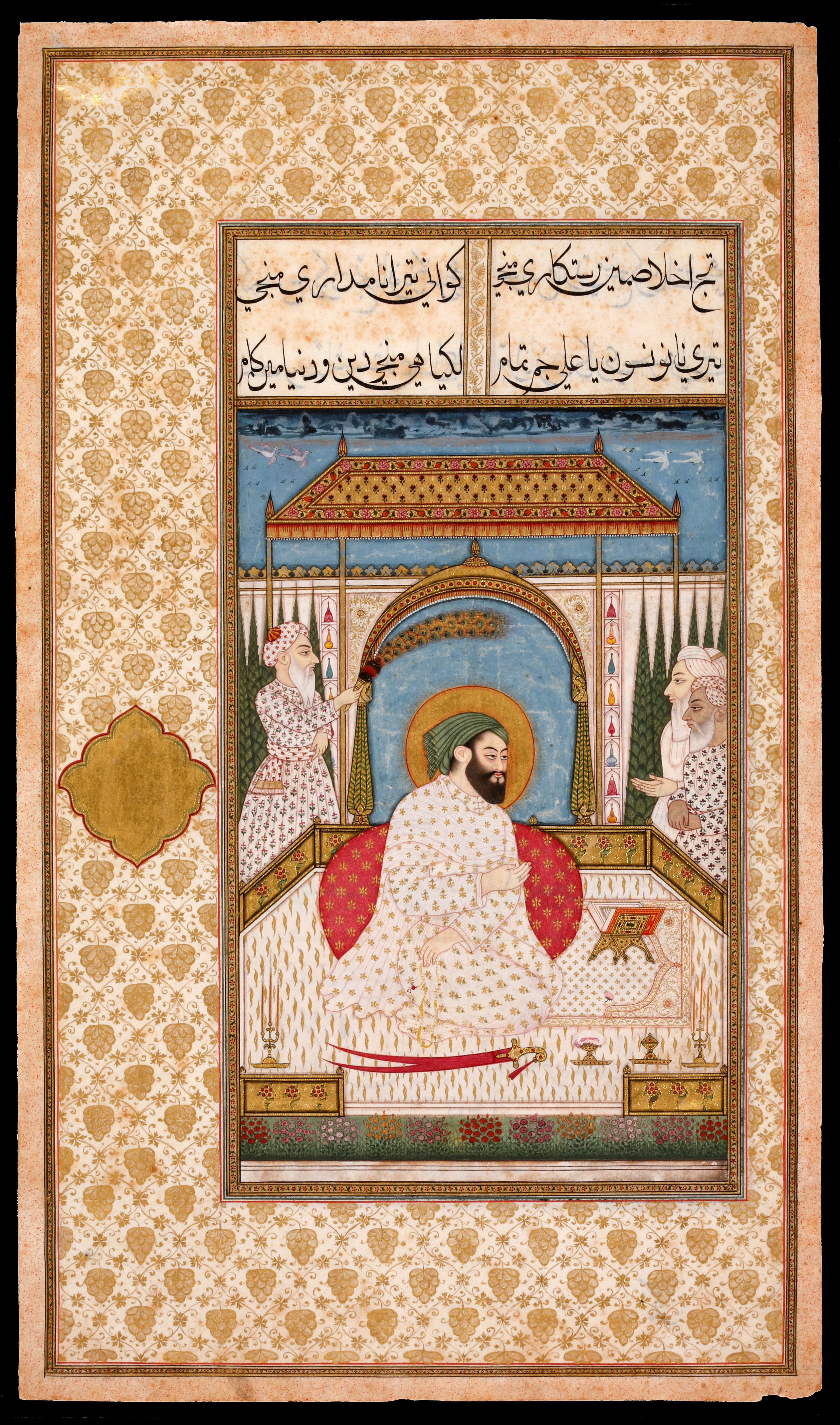
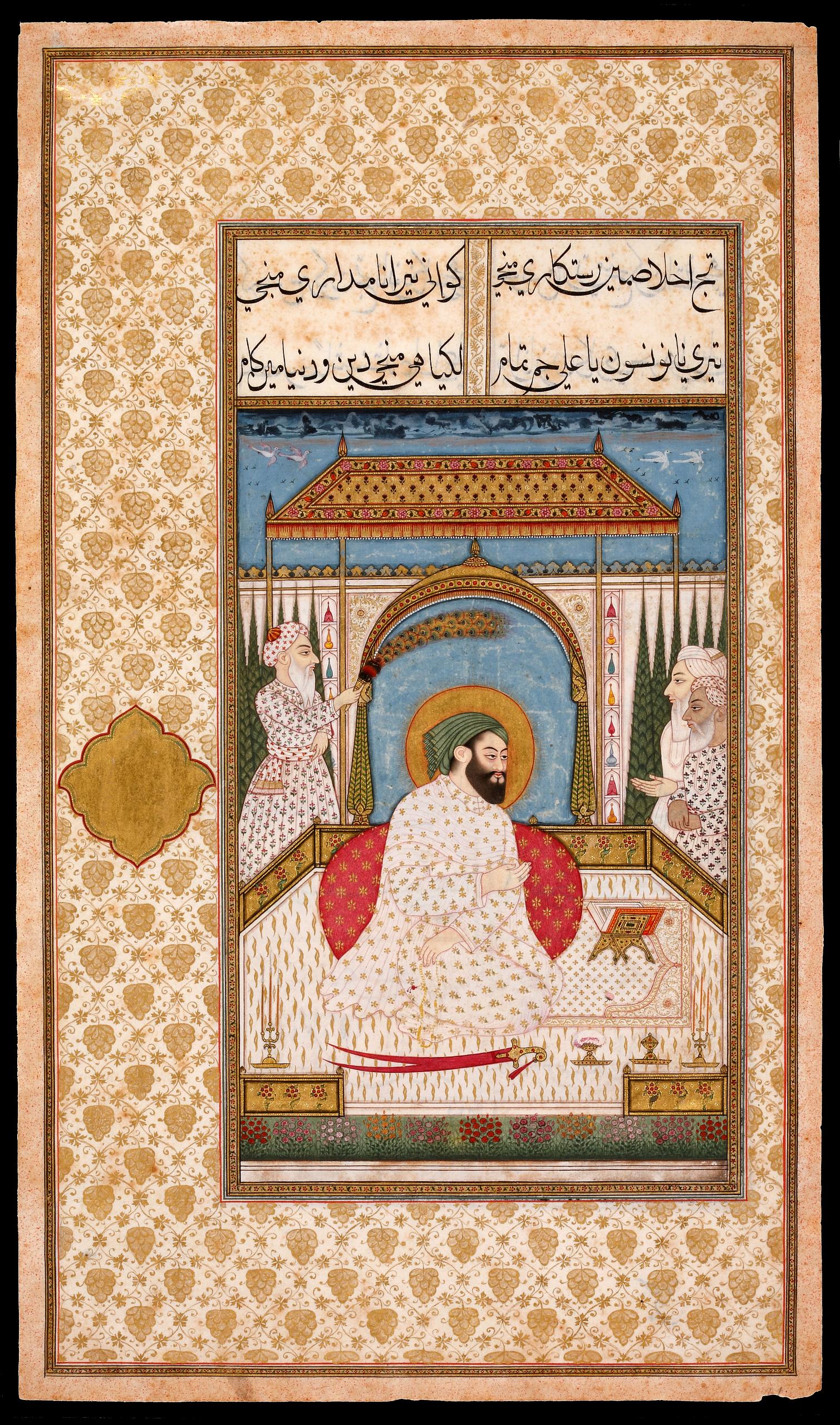
Miniature from Nusrati’s Gulshan-i Ishq. ‘Sultan Ali Adil Shah II of Bijapur’
India, Deccan, Hyderabad (?); c. 1710
Leaf: 40 × 23.5 cm
Inventory number 57/2007
This posthumous portrait of Sultan Ali Adil Shah II (1656-1672) was the frontispiece for a well-known copy of Gulshan-i Ishq (The Rose Garden of Love), a mathnavi poem written in Urdu by Ali Adil Shah’s court poet, Mian Nusrati, and dedicated to the sultan.
The Ruler is seen on his throne, and in front of him lies a replica of Imam Ali’s split-blade sword, Dhu’l-Faqar. This is a reference to his Shiite faith, an allegiance that bothered the orthodox Great Mughal Aurangzeb and one of the reasons why he conquered the Deccan in 1686, when Bijapur was ruled by Ali’s young son Sikander.
After Aurangzeb’s death in 1707, a new state was founded in Hyderabad in the Deccan, where this manuscript was probably made.
The Ruler is seen on his throne, and in front of him lies a replica of Imam Ali’s split-blade sword, Dhu’l-Faqar. This is a reference to his Shiite faith, an allegiance that bothered the orthodox Great Mughal Aurangzeb and one of the reasons why he conquered the Deccan in 1686, when Bijapur was ruled by Ali’s young son Sikander.
After Aurangzeb’s death in 1707, a new state was founded in Hyderabad in the Deccan, where this manuscript was probably made.
Published in
Published in
Christie’s, London 28/11 1983, lot 141;
Daniel J. Ehnbom: Indian miniatures: the Ehrenfeld Collection, New York 1985, cat.no. 37, pp. 90-91;
Ravinder Reddy: Arms and armour of India, Nepal and Sri Lanka: types, decoration and symbolism, London 2018, p. 247;
Daniel J. Ehnbom: Indian miniatures: the Ehrenfeld Collection, New York 1985, cat.no. 37, pp. 90-91;
Ravinder Reddy: Arms and armour of India, Nepal and Sri Lanka: types, decoration and symbolism, London 2018, p. 247;
The Indian Sultanates