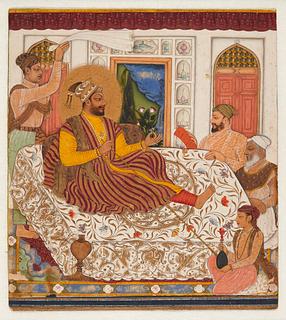
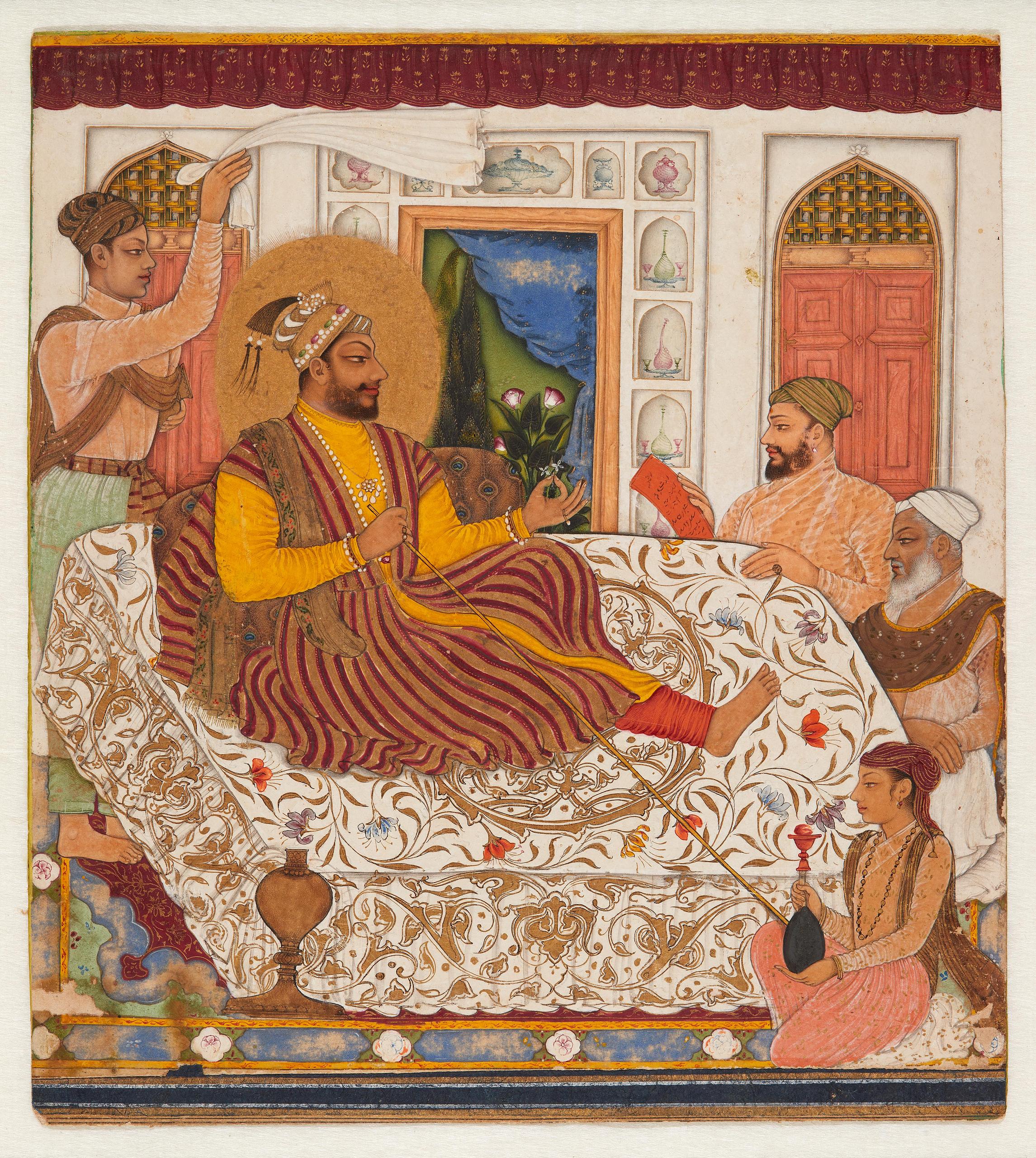
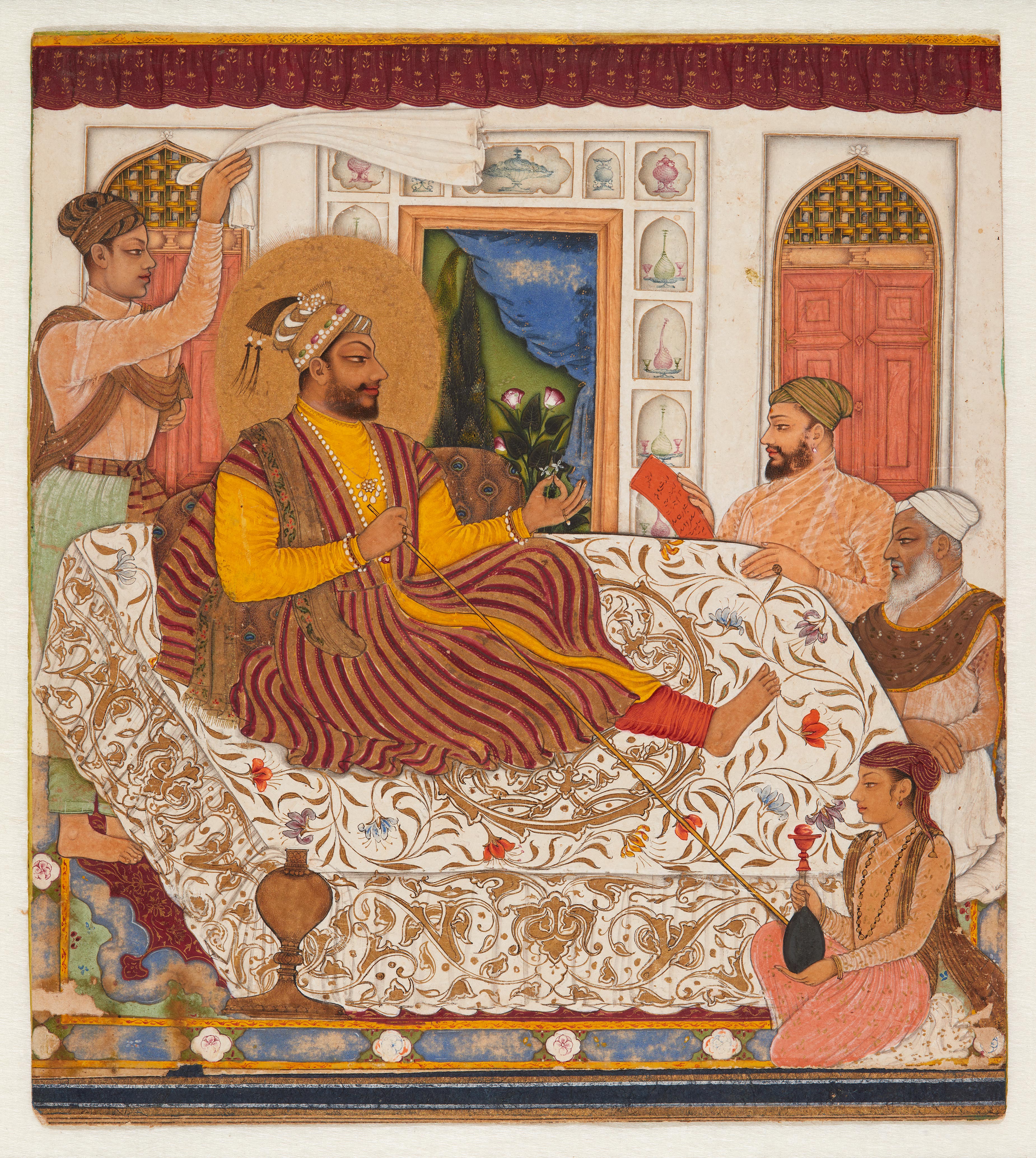
Miniature pasted on cardboard. ‘Sultan Ali Adil Shah II with courtiers’
India, Deccan, Bijapur; c. 1660
Leaf: 18.6 x 16.8 cm
Inventory number 2/2020
Ali Adil Shah II ruled the Sultanate of Bijapur in the Deccan from 1656 to 1672 as the penultimate regent of the Adil Shah dynasty. The family had ruled Bijapur since the beginning of the sixteenth century, but during Ali’s reign the sultanate came under increasing pressure from local Hindu warriors, the Marathas, as well as from the Mughal emperor Aurangzeb, who conquered Bijapur in 1686.
However, this painting shows no trace of the serious situation in which the sultanate found itself: the sultan is seen reclining on soft cushions while smoking a hookah and contemplating a small flower held in his left hand. His half-closed eyes, raised eyebrows and subtle smile also contribute to giving the scene a dreamy, carefree air.
This relaxed atmosphere is typical of sixteenth- and seventeenth-century Bijapur paintings, where the Adil Shahs often appear in informal scenes of revelry or hunting, celebrating the pleasures of the good life and the lushness of nature (12/2016). The style is a stark contrast to the more serious atmosphere infusing many Mughal paintings from the same period (e.g. 20/1979).
The sultan is being attended by two beardless youths, and in front of him is an older and a younger man, the latter of whom holds a document in Arabic/Persian script. The younger man also wears a red caste mark (tilak) on his forehead, revealing that he is a Hindu. It has been suggested that the figure may be the Maratha leader Shivaji (d. 1680).1
The painting is attributed to Abd al-Hamid Naqqash, also known as the ‘Bombay painter’, who is considered the greatest master of late Bijapur painting. Among other things, the artist is famous for his unsurpassed talent for depicting luxurious fabrics, conferring a real sense of their splendour and lightness. His skill is evidenced here in details such as the sultan’s robe, striped in red and gold, falling in vividly rendered folds across the bed’s richly decorated covers.
However, this painting shows no trace of the serious situation in which the sultanate found itself: the sultan is seen reclining on soft cushions while smoking a hookah and contemplating a small flower held in his left hand. His half-closed eyes, raised eyebrows and subtle smile also contribute to giving the scene a dreamy, carefree air.
This relaxed atmosphere is typical of sixteenth- and seventeenth-century Bijapur paintings, where the Adil Shahs often appear in informal scenes of revelry or hunting, celebrating the pleasures of the good life and the lushness of nature (12/2016). The style is a stark contrast to the more serious atmosphere infusing many Mughal paintings from the same period (e.g. 20/1979).
The sultan is being attended by two beardless youths, and in front of him is an older and a younger man, the latter of whom holds a document in Arabic/Persian script. The younger man also wears a red caste mark (tilak) on his forehead, revealing that he is a Hindu. It has been suggested that the figure may be the Maratha leader Shivaji (d. 1680).1
The painting is attributed to Abd al-Hamid Naqqash, also known as the ‘Bombay painter’, who is considered the greatest master of late Bijapur painting. Among other things, the artist is famous for his unsurpassed talent for depicting luxurious fabrics, conferring a real sense of their splendour and lightness. His skill is evidenced here in details such as the sultan’s robe, striped in red and gold, falling in vividly rendered folds across the bed’s richly decorated covers.
Published in
Published in
Barrett, D.: "Some unpublished Deccan miniatures" in Lalit Kala, 7, 1960, frontispiece p. 8;
Mark Zebrowski: Deccani painting, London 1983, fig. 107, pp. 139-140;
Navina Najat Haidar and Marika Sardar: Sultans of Deccan India, 1500-1700: opulence and fantasy, Metropolitan Museum of Art, New York, New Haven 2015, cat.no. 67;
J. P. Losty: Of royal patronage: Indian paintings from the 16th to 19th centuries, Carlton Rochell Asian Art, New York 2020, cat.no. 17, pp. 48-49 and 4;
Mark Zebrowski: Deccani painting, London 1983, fig. 107, pp. 139-140;
Navina Najat Haidar and Marika Sardar: Sultans of Deccan India, 1500-1700: opulence and fantasy, Metropolitan Museum of Art, New York, New Haven 2015, cat.no. 67;
J. P. Losty: Of royal patronage: Indian paintings from the 16th to 19th centuries, Carlton Rochell Asian Art, New York 2020, cat.no. 17, pp. 48-49 and 4;
Footnotes
Footnotes
1.
Mark Zebrowski: Deccani Painting, London 1983, p. 139; Navina Najat Haidar and Marika Sardar: Sultans of Deccan India, 1500-1700: Opulence and Fantasy, Metropolitan Museum of Art, New York, New Haven 2015, pp. 148-151.
The Indian Sultanates
.jpg)
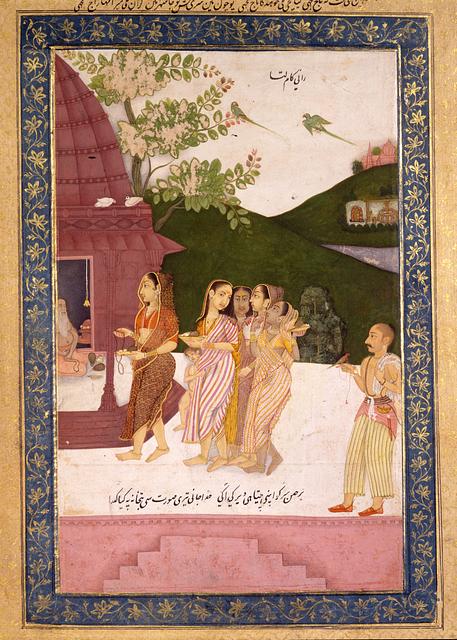
Miniature pasted on an album leaf. ‘A Group of Women Visiting a Hindu Shrine’
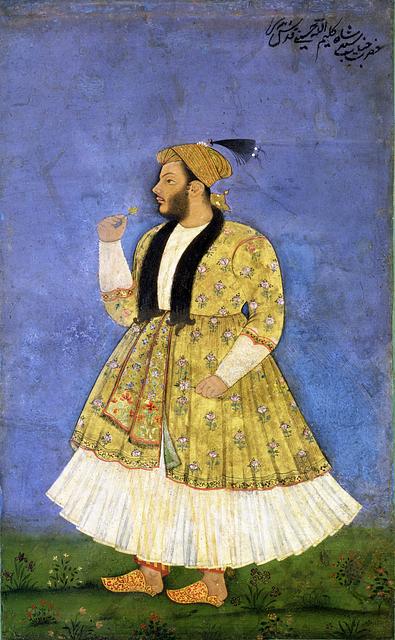
Miniature pasted on an album leaf. ‘Portrait of Sayyid Shah Kallimullah Husayni’
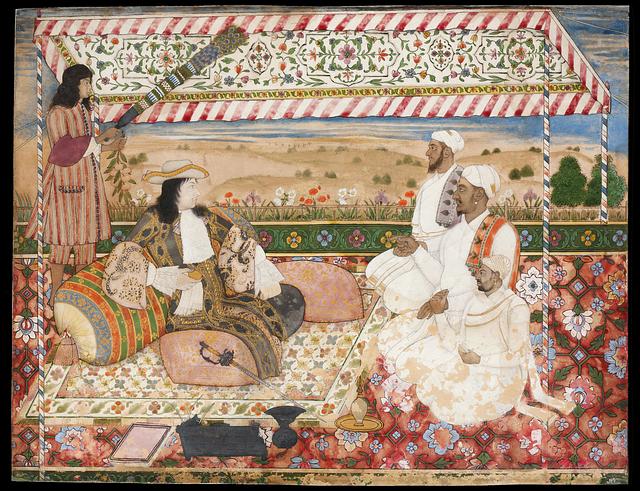
Two miniatures. ‘The Darbar of Cornelis van den Bogaerde’ and ‘The procession of Cornelis van den Bogaerde’
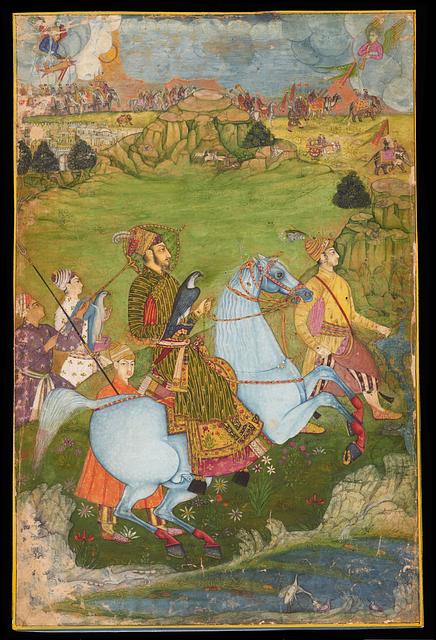
Miniature. ’A Mounted Prince Hunting with a Falcon’