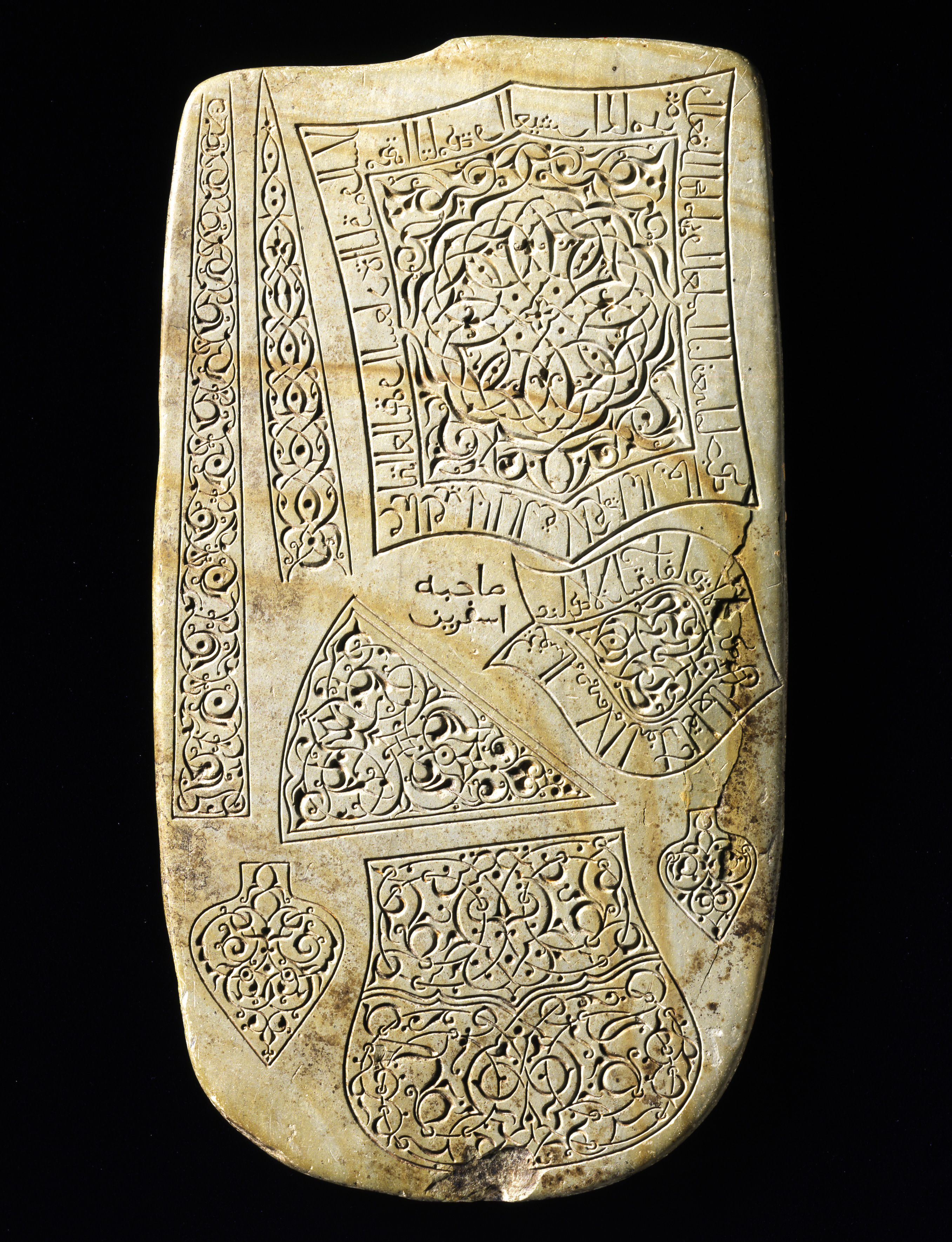
Matrix of greenish limestone for stamping leather
Afghanistan; end of 12th – beginning of 13th century
H: 33.5; W: 18.5 cm
Inventory number 4/2000
The matrix belongs to a little group that can be dated and localized thanks to its patterns, on the one hand, and because the name of a Ghurid general is found on one of the matrices, on the other. He died in c. 1210 as governor of Herat, and the mountains north of this Afghan city in particular have an abundance of the greenish limestone from which most of these matrices were made.
They were especially used to stamp leather wallets, of which the David Collection owns examples (see 14/2001). The large patterns covered an entire front or back while the smaller ones could also have embellished other forms of leather, for example harnesses and belts.
They were especially used to stamp leather wallets, of which the David Collection owns examples (see 14/2001). The large patterns covered an entire front or back while the smaller ones could also have embellished other forms of leather, for example harnesses and belts.
Published in
Published in
Kjeld von Folsach: “Three eastern Islamic leather wallets and three related stone press-moulds in the David Collection” in Kjeld von Folsach, Henrik Thrane and Ingolf Thuesen (eds.): From handaxe to khan : essays presented to Peder Mortensen on the occasion of his 70th birthday, Aarhus 2004, figs. 8a-b;
Sheila S. Blair and Jonathan M. Bloom (eds.): Cosmophilia. Islamic Art from the David Collection, Copenhagen, McMullen Museum of Art, Boston College, Boston 2006, cat. 100;
Kjeld von Folsach: Flora islamica: plantemotiver i islamisk kunst, Davids Samling, København 2013, cat. 25;
Joachim Meyer, Rasmus Bech Olsen and Peter Wandel: Beyond words: calligraphy from the World of Islam, The David Collection, Copenhagen 2024, cat. 107, pp. 274-275;
Mark Kerr-Smiley: Mamluks, Conquest and Culture: The Ghurid Empire and Early Delhi Sultanate C.1150-1236, London 2025, fig. 12;
Sheila S. Blair and Jonathan M. Bloom (eds.): Cosmophilia. Islamic Art from the David Collection, Copenhagen, McMullen Museum of Art, Boston College, Boston 2006, cat. 100;
Kjeld von Folsach: Flora islamica: plantemotiver i islamisk kunst, Davids Samling, København 2013, cat. 25;
Joachim Meyer, Rasmus Bech Olsen and Peter Wandel: Beyond words: calligraphy from the World of Islam, The David Collection, Copenhagen 2024, cat. 107, pp. 274-275;
Mark Kerr-Smiley: Mamluks, Conquest and Culture: The Ghurid Empire and Early Delhi Sultanate C.1150-1236, London 2025, fig. 12;
The Ghaznavids and the Ghurids