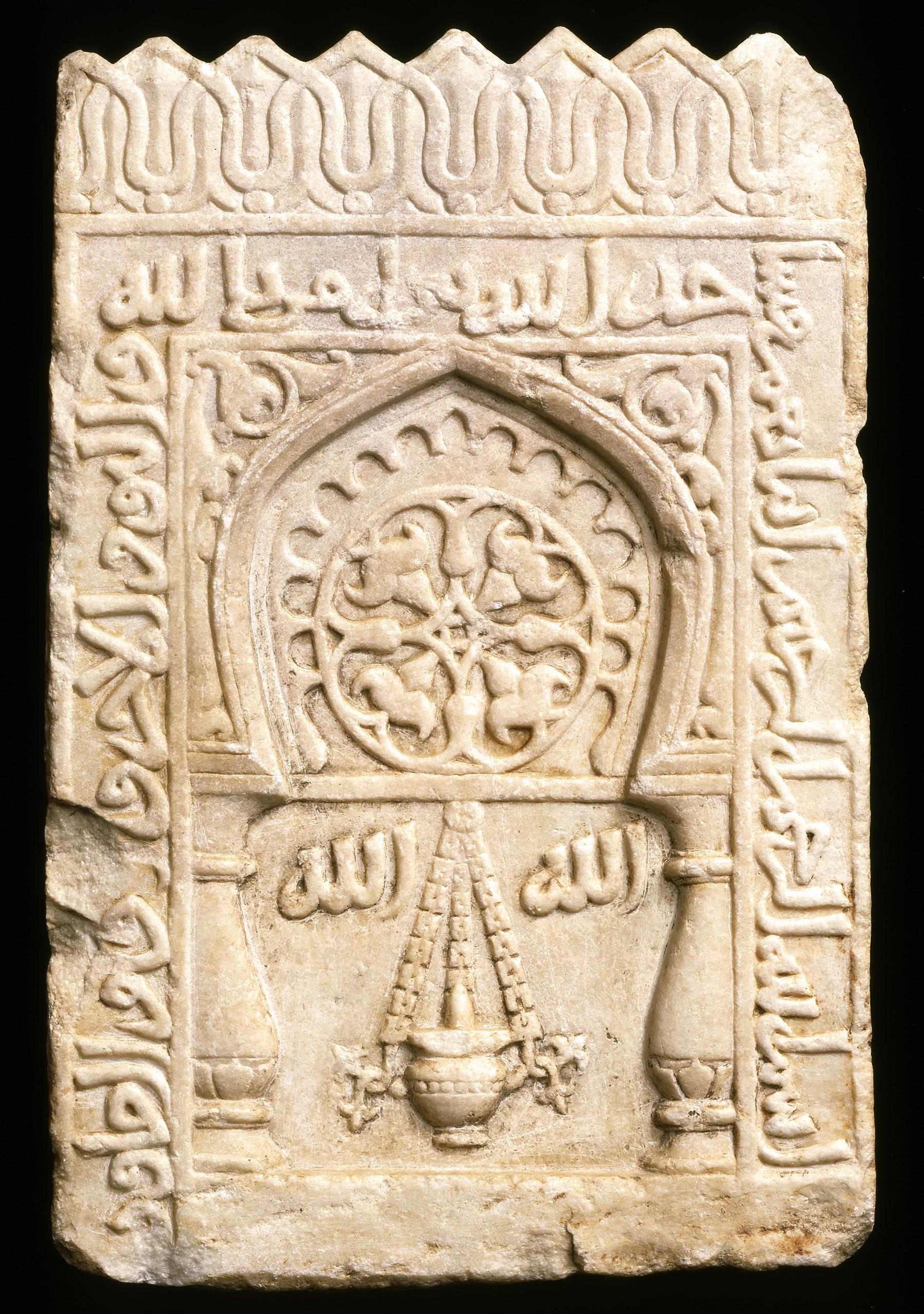
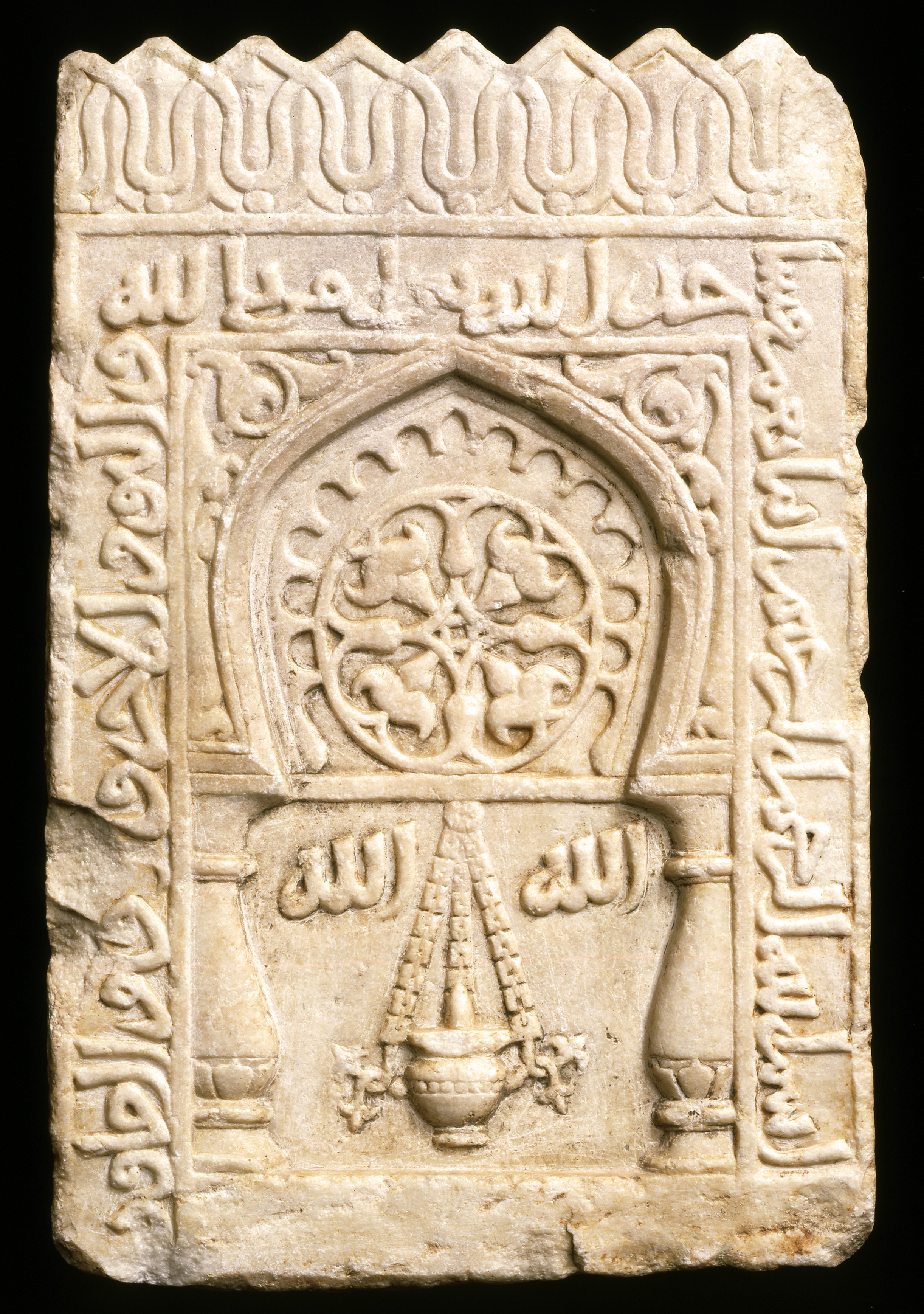
Mihrab tile, carved marble
Afghanistan, Ghazna; c. 1100
H: 52; W: 34 cm
Inventory number 74/1979
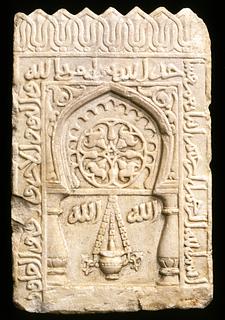
This marble tile features a niche with an oil lamp whose burning flame rises high above the lamp’s edge. The name of God, “Allah,” is repeated on each side of the lamp. This motif has a symbolic significance because of the Koran’s sura 24, “the Light Verse.” While God is compared there to the light of the heavens and earth, according to the early Muslim theologians, a burning oil lamp in a niche is a metaphor of Muhammad’s prophetic light.
The marble tile was probably used as a mihrab – the prayer niche in a mosque toward which the devout Muslim turns in prayer.
The sturdy palmettes in the central wheel ornament are a special Ghaznavid variant of the form of decoration that evolved in Abbasid Iraq. The two short columns, in contrast, exhibit the influence of Indian culture.
The marble tile was probably used as a mihrab – the prayer niche in a mosque toward which the devout Muslim turns in prayer.
The sturdy palmettes in the central wheel ornament are a special Ghaznavid variant of the form of decoration that evolved in Abbasid Iraq. The two short columns, in contrast, exhibit the influence of Indian culture.
Published in
Published in
Art from the World of Islam. 8th-18th century, Louisiana, Humlebæk 1987, cat. 46;
Kjeld von Folsach: Islamic art. The David Collection, Copenhagen 1990, cat. 272;
Kjeld von Folsach, Torben Lundbæk and Peder Mortensen (eds.): Sultan, Shah and Great Mughal: the history and culture of the Islamic world, The National Museum, Copenhagen 1996, cat. 24;
Kjeld von Folsach: Art from the World of Islam in The David Collection, Copenhagen 2001, cat. 393;
James W. Allan: “”My father is a sun, and I am the star”: Fatimid symbols in Ayyubid and Mamluk metalwork. The C.L. David Lecture 2000” in Journal of the David Collection, 1, 2003, p. 26, fig. 4;
Sheila S. Blair and Jonathan M. Bloom (eds.): Cosmophilia. Islamic Art from the David Collection, Copenhagen, McMullen Museum of Art, Boston College, Boston 2006, cat. 23;
Catherine B. Asher: Delhi's Qutb complex : the minar, mosque and Mehrauli, Mumbai 2017, fig. 1.12, p. 33;
Joachim Meyer: “Ornament or symbol. Around an early group of silver amulet cases in the David Collection” in Journal of the David Collection, 2021, 5, fig. 8, p. 14;
Joachim Meyer, Rasmus Bech Olsen and Peter Wandel: Beyond words: calligraphy from the World of Islam, The David Collection, Copenhagen 2024, fig. 46, pp. 70-71;
Kjeld von Folsach: Islamic art. The David Collection, Copenhagen 1990, cat. 272;
Kjeld von Folsach, Torben Lundbæk and Peder Mortensen (eds.): Sultan, Shah and Great Mughal: the history and culture of the Islamic world, The National Museum, Copenhagen 1996, cat. 24;
Kjeld von Folsach: Art from the World of Islam in The David Collection, Copenhagen 2001, cat. 393;
James W. Allan: “”My father is a sun, and I am the star”: Fatimid symbols in Ayyubid and Mamluk metalwork. The C.L. David Lecture 2000” in Journal of the David Collection, 1, 2003, p. 26, fig. 4;
Sheila S. Blair and Jonathan M. Bloom (eds.): Cosmophilia. Islamic Art from the David Collection, Copenhagen, McMullen Museum of Art, Boston College, Boston 2006, cat. 23;
Catherine B. Asher: Delhi's Qutb complex : the minar, mosque and Mehrauli, Mumbai 2017, fig. 1.12, p. 33;
Joachim Meyer: “Ornament or symbol. Around an early group of silver amulet cases in the David Collection” in Journal of the David Collection, 2021, 5, fig. 8, p. 14;
Joachim Meyer, Rasmus Bech Olsen and Peter Wandel: Beyond words: calligraphy from the World of Islam, The David Collection, Copenhagen 2024, fig. 46, pp. 70-71;