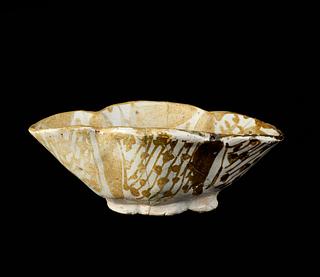
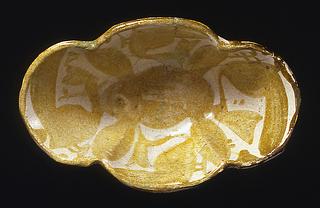
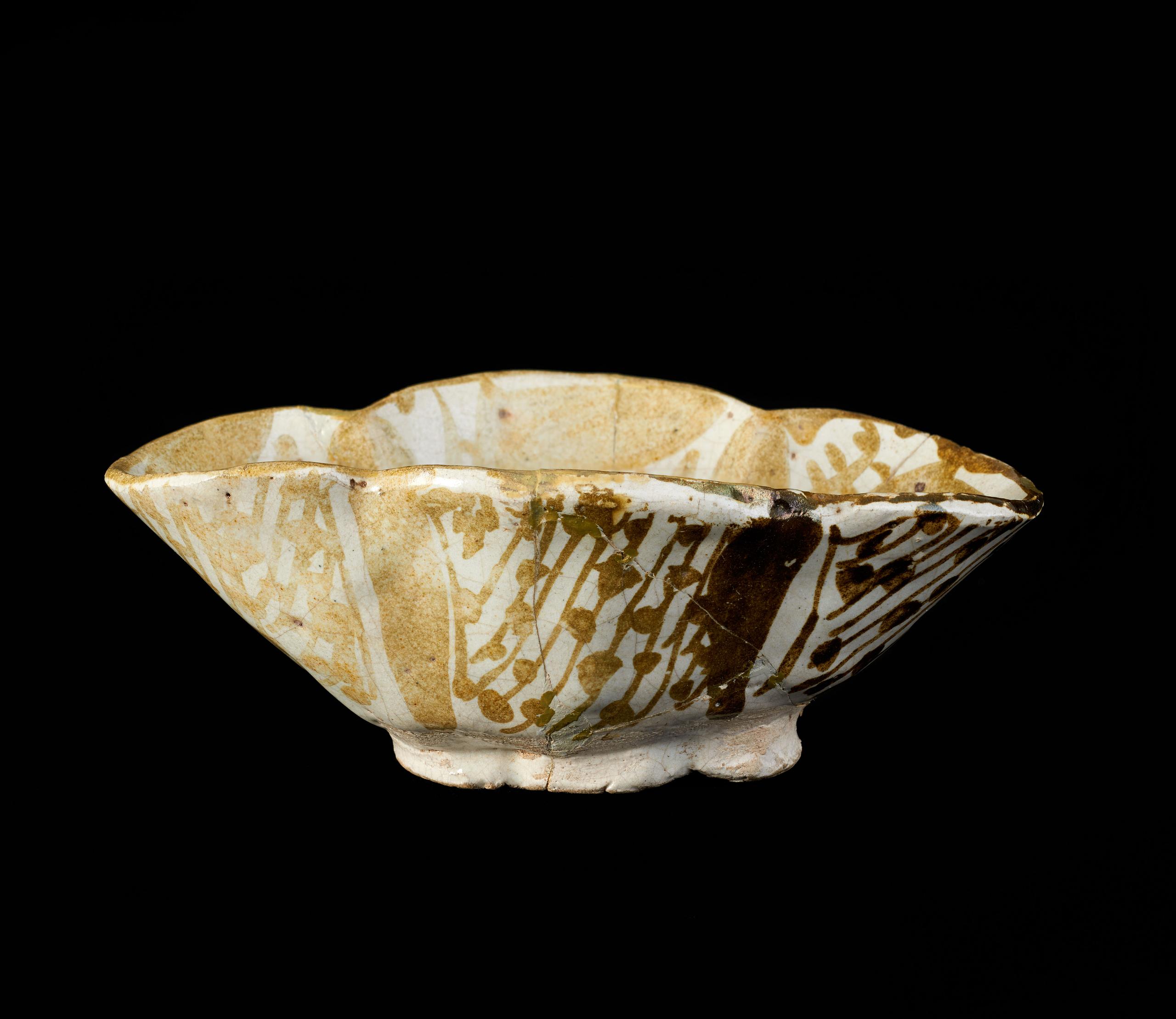
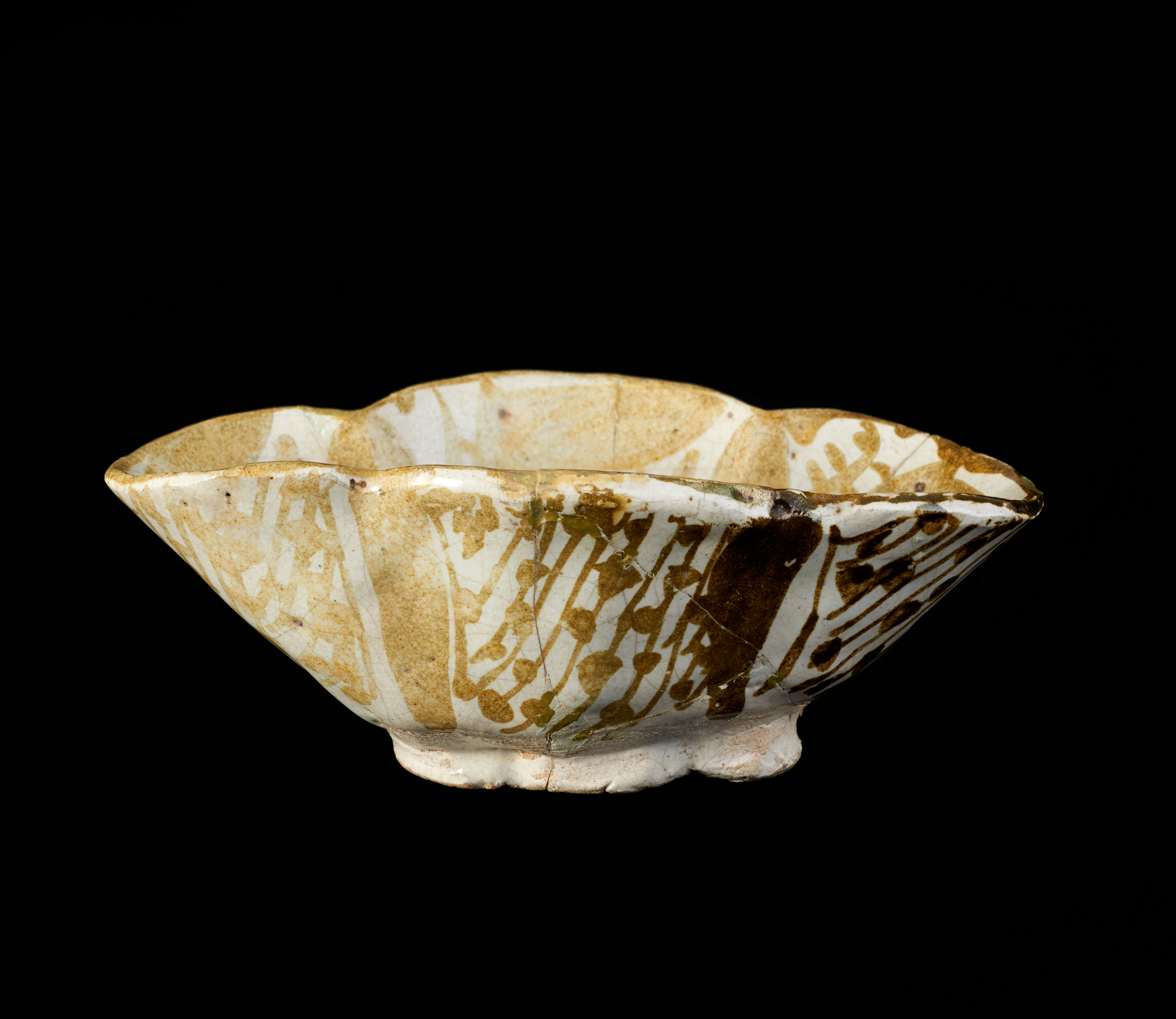
Small earthenware bowl, painted in lustre over an opaque, white glaze
Iraq; 10th century
H: 5; L: 13.5 cm
Inventory number 7/1970
This small earthenware bowl painted in lustre has a quatrefoil shape that is atypical of the period’s Islamic art. It does, in contrast, reflect Chinese influence during the Tang period (618-906), when silver bowls of this shape were made as well as cheaper variants in the era’s porcelain-like stoneware.
Fragments of Chinese stoneware bowls of this kind have been excavated in the Abbasid capital of Samarra. Chinese imports provided the technical and in some cases also aesthetic ideals that local potters tried to imitate in different ways.
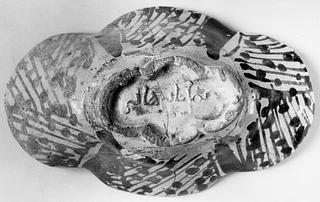
Like its Chinese models, this bowl is also stamped on the base. The Arabic text reads “made by ibn Hani.”
Fragments of Chinese stoneware bowls of this kind have been excavated in the Abbasid capital of Samarra. Chinese imports provided the technical and in some cases also aesthetic ideals that local potters tried to imitate in different ways.
Like its Chinese models, this bowl is also stamped on the base. The Arabic text reads “made by ibn Hani.”
Published in
Published in
Christie’s, London, 23/6-1970, lot 34;
Adalbert Klein [et al.]: Islamische Keramik, Hetjens-Museum, Düsseldorf 1973, cat.no. 99;
Adalbert Klein: Islamische Keramik, Baden-Baden 1976, Abb.2, p. 14;
Kjeld von Folsach: Islamic art. The David Collection, Copenhagen 1990, cat.no. 68;
Kjeld von Folsach, Torben Lundbæk and Peder Mortensen (eds.): Sultan, Shah and Great Mughal: the history and culture of the Islamic world, The National Museum, Copenhagen 1996, cat.no. 288;
Kjeld von Folsach: Art from the World of Islam in The David Collection, Copenhagen 2001, cat.no. 109;
Assadullah Souren Melikian-Chirvani (ed.): The world of the Fatimids, Aga Khan Museum, Toronto [2018], pp. 301 and 356-357;
Adalbert Klein [et al.]: Islamische Keramik, Hetjens-Museum, Düsseldorf 1973, cat.no. 99;
Adalbert Klein: Islamische Keramik, Baden-Baden 1976, Abb.2, p. 14;
Kjeld von Folsach: Islamic art. The David Collection, Copenhagen 1990, cat.no. 68;
Kjeld von Folsach, Torben Lundbæk and Peder Mortensen (eds.): Sultan, Shah and Great Mughal: the history and culture of the Islamic world, The National Museum, Copenhagen 1996, cat.no. 288;
Kjeld von Folsach: Art from the World of Islam in The David Collection, Copenhagen 2001, cat.no. 109;
Assadullah Souren Melikian-Chirvani (ed.): The world of the Fatimids, Aga Khan Museum, Toronto [2018], pp. 301 and 356-357;
Ceramics
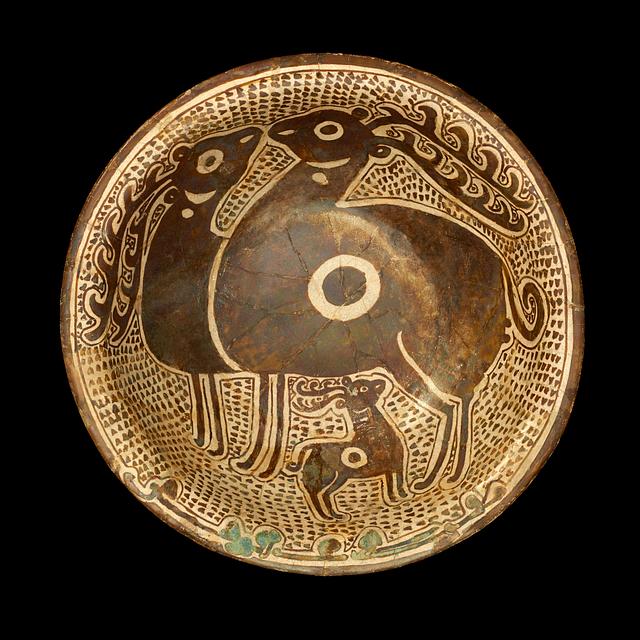
Earthenware bowl, painted in lustre over an opaque, white glaze
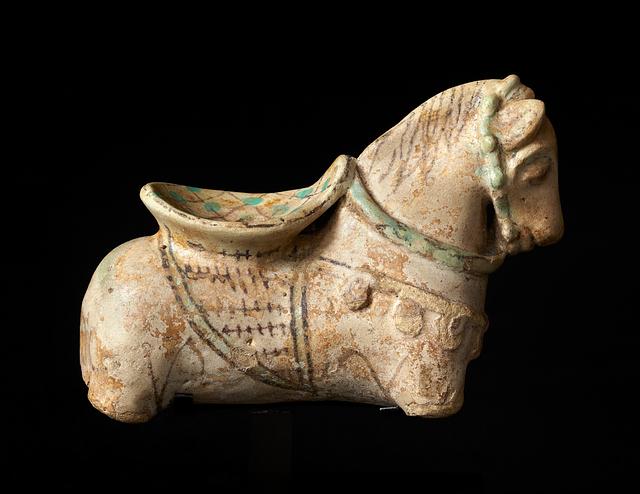
Fragmented figure of a horse, earthenware covered with a whitish slip and painted in green and manganese under a slightly toned, poorly preserved glaze
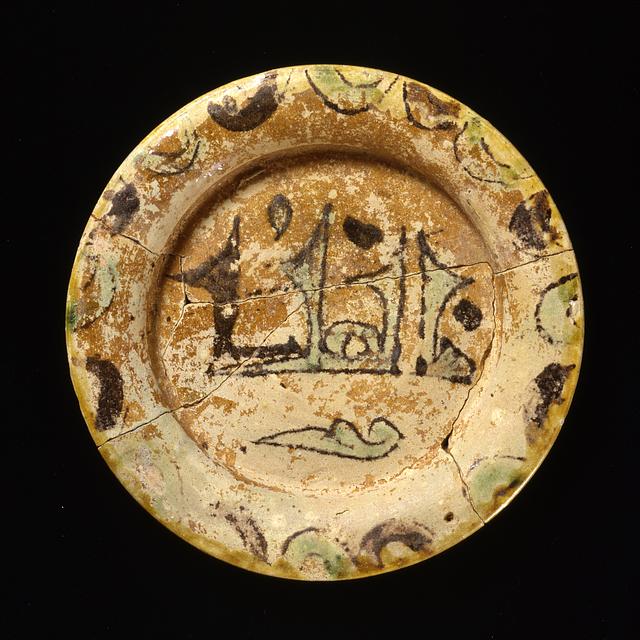
Earthenware dish, decorated with green and manganese
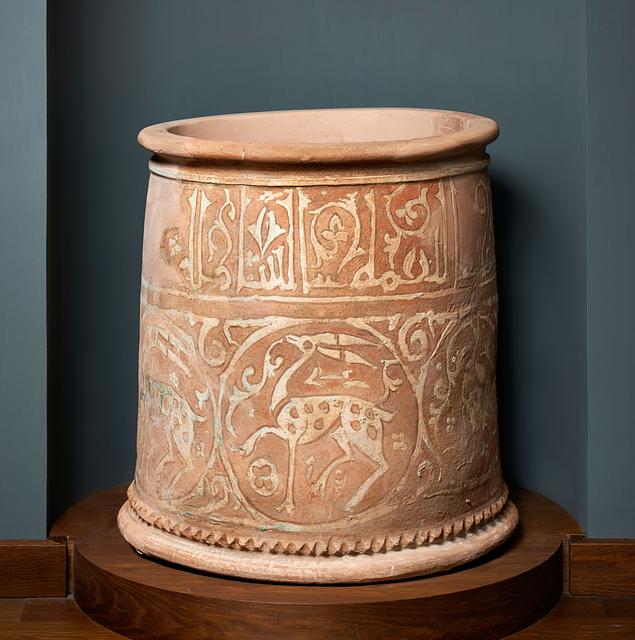
Wellhead, earthenware painted in green and a manganese-colored glaze