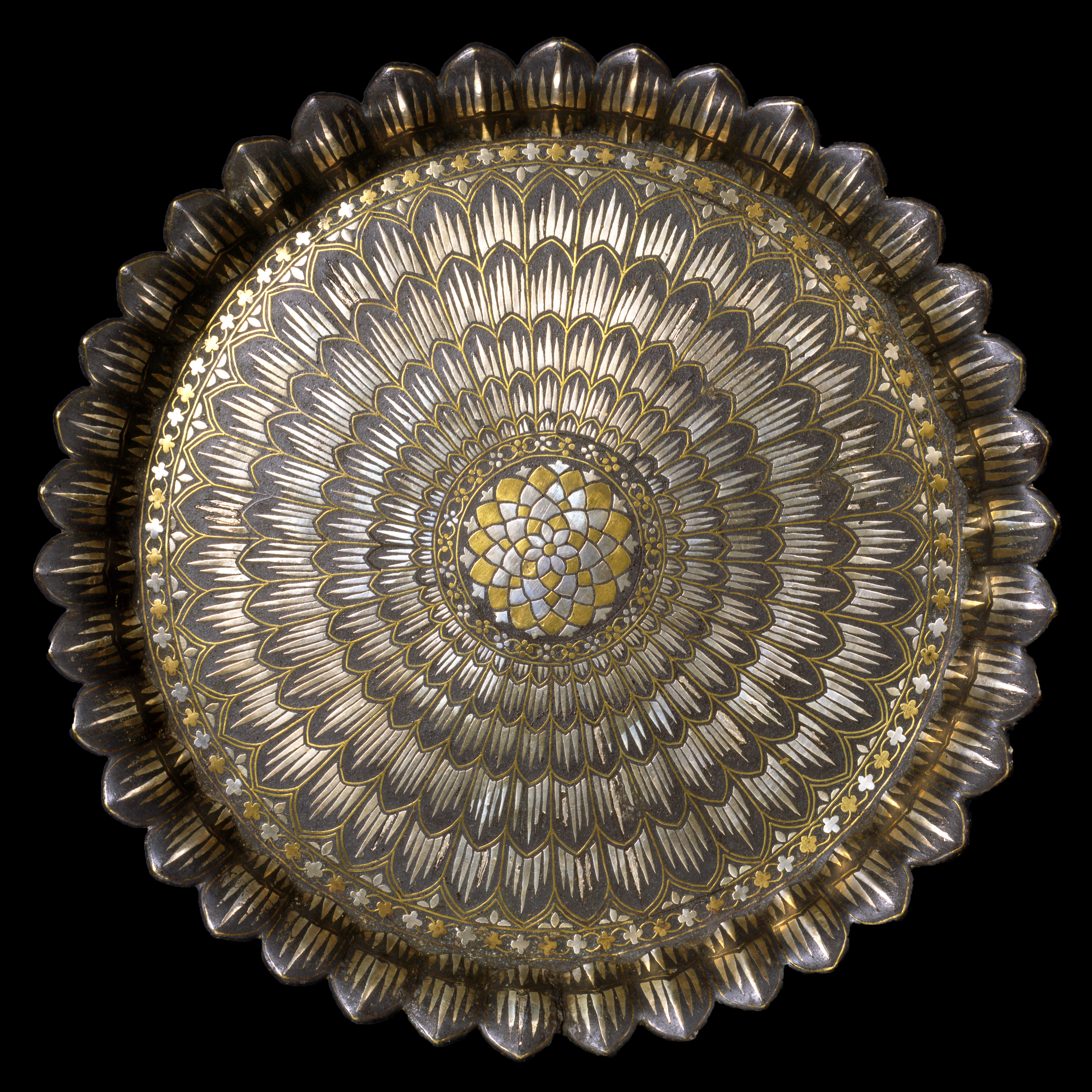
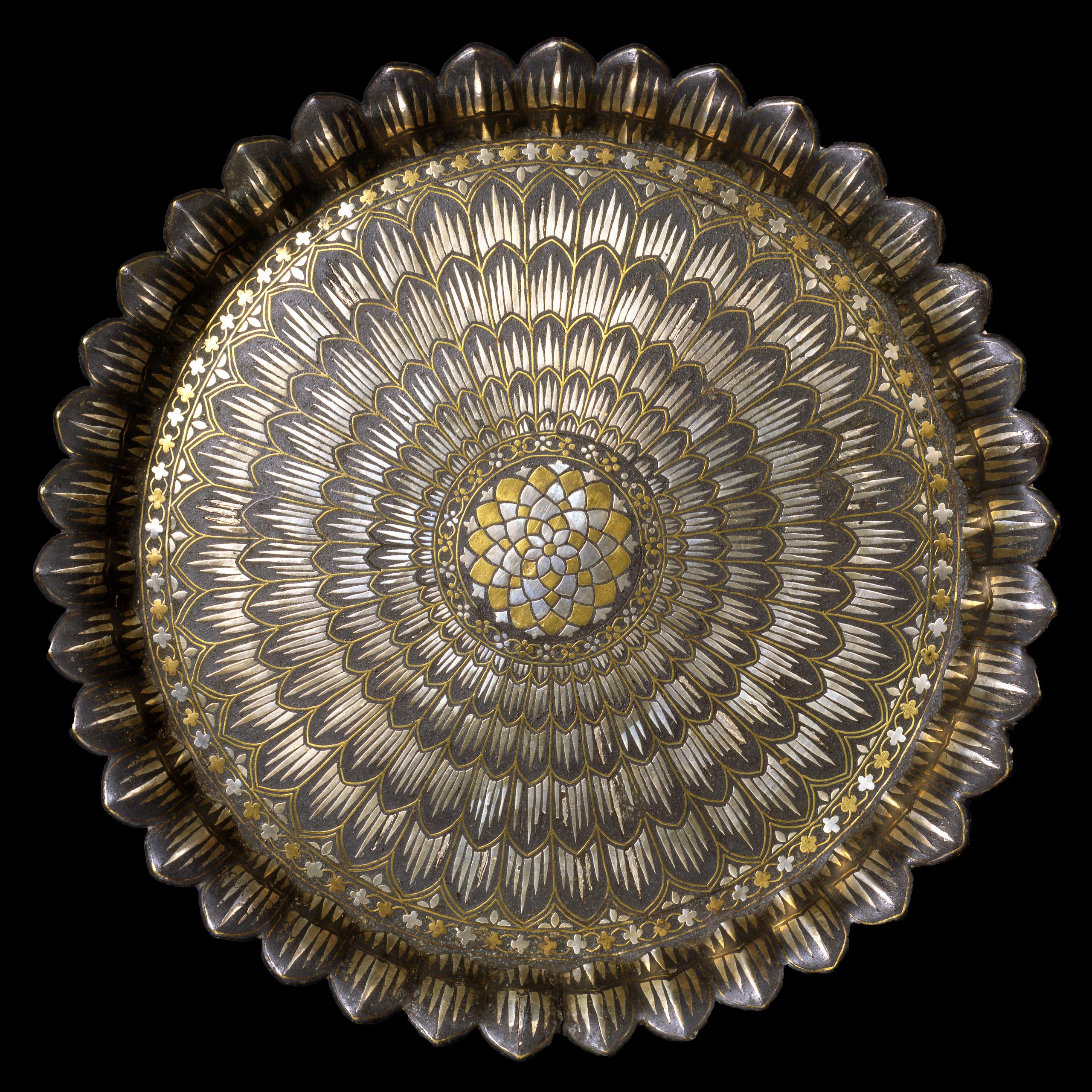
Dish of bidri metal, inlaid with silver and brass
India, Deccan; 2nd half of 17th century
H: 3.5; Diam: 31 cm
Inventory number 16/1987
The pattern on this dish made of bidri metal is evidently unique and at the same time very striking. At the very center is a flower with seven petals, surrounded by intricately arranged little leaves that seem to form a two-colored peony. A quatrefoil frieze is followed by five concentric rows of leaves with silver stripes and brass contours. The two-dimensional leaves finally give way to similar three-dimensional leaves, which make up the rim of the dish. The dish can thus be viewed as a large flower, but also as a shining sun or a stylized explosion of fireworks.
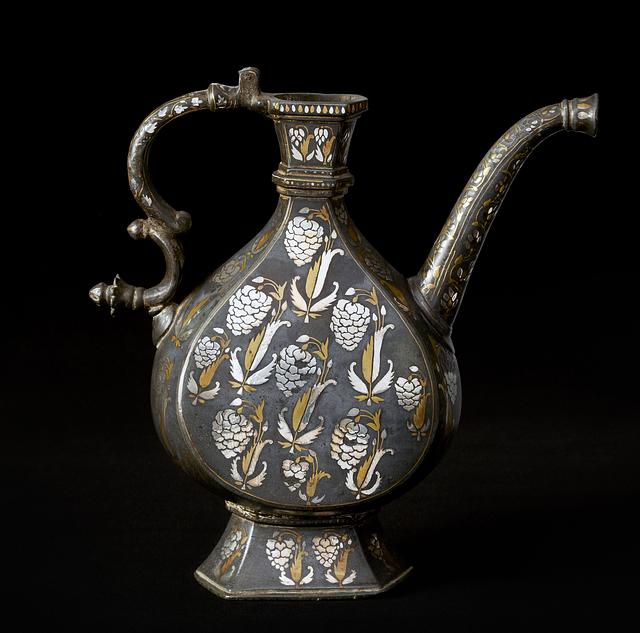
Trays of this kind were often made for ewers or water pipes with matching patterns.
Trays of this kind were often made for ewers or water pipes with matching patterns.
Published in
Published in
Kjeld von Folsach: Islamic art. The David Collection, Copenhagen 1990, cat.no. 357;
Kjeld von Folsach, Torben Lundbæk and Peder Mortensen (eds.): Sultan, Shah and Great Mughal: the history and culture of the Islamic world, The National Museum, Copenhagen 1996, cat.no. 348;
Mark Zebrowski: Gold, silver and bronze from Mughal India, London 1997, fig. 512;
George Michell and Mark Zebrowski: Architecture and art of the Deccan Sultanates, Cambridge 1999, fig. 180, p. 241;
Kjeld von Folsach: Art from the World of Islam in The David Collection, Copenhagen 2001, cat.no. 538;
Sheila S. Blair and Jonathan M. Bloom (eds.): Cosmophilia. Islamic Art from the David Collection, Copenhagen, McMullen Museum of Art, Boston College, Boston 2006, cat.no. 56;
Navina Najat Haidar and Marika Sardar: Sultans of Deccan India, 1500-1700: opulence and fantasy, Metropolitan Museum of Art, New York, New Haven 2015, cat.no. 94;
Linda Komaroff (ed.): Dining with the Sultan: the fine art of feasting, Los Angeles County Museum of Art, Los Angeles 2023, p. 80 and cat. 47b, pp. 196-197;
Kjeld von Folsach, Torben Lundbæk and Peder Mortensen (eds.): Sultan, Shah and Great Mughal: the history and culture of the Islamic world, The National Museum, Copenhagen 1996, cat.no. 348;
Mark Zebrowski: Gold, silver and bronze from Mughal India, London 1997, fig. 512;
George Michell and Mark Zebrowski: Architecture and art of the Deccan Sultanates, Cambridge 1999, fig. 180, p. 241;
Kjeld von Folsach: Art from the World of Islam in The David Collection, Copenhagen 2001, cat.no. 538;
Sheila S. Blair and Jonathan M. Bloom (eds.): Cosmophilia. Islamic Art from the David Collection, Copenhagen, McMullen Museum of Art, Boston College, Boston 2006, cat.no. 56;
Navina Najat Haidar and Marika Sardar: Sultans of Deccan India, 1500-1700: opulence and fantasy, Metropolitan Museum of Art, New York, New Haven 2015, cat.no. 94;
Linda Komaroff (ed.): Dining with the Sultan: the fine art of feasting, Los Angeles County Museum of Art, Los Angeles 2023, p. 80 and cat. 47b, pp. 196-197;
Metalwork, Weapons and Jewelry
.-The-David-Collection_Copenhagen_photo-Pernille-Klemp.jpg)