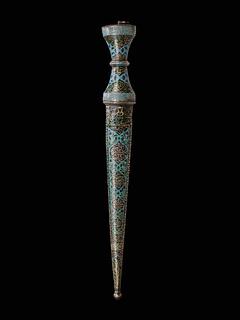
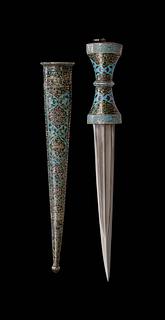
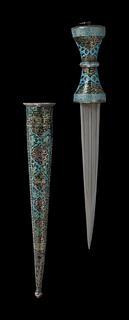
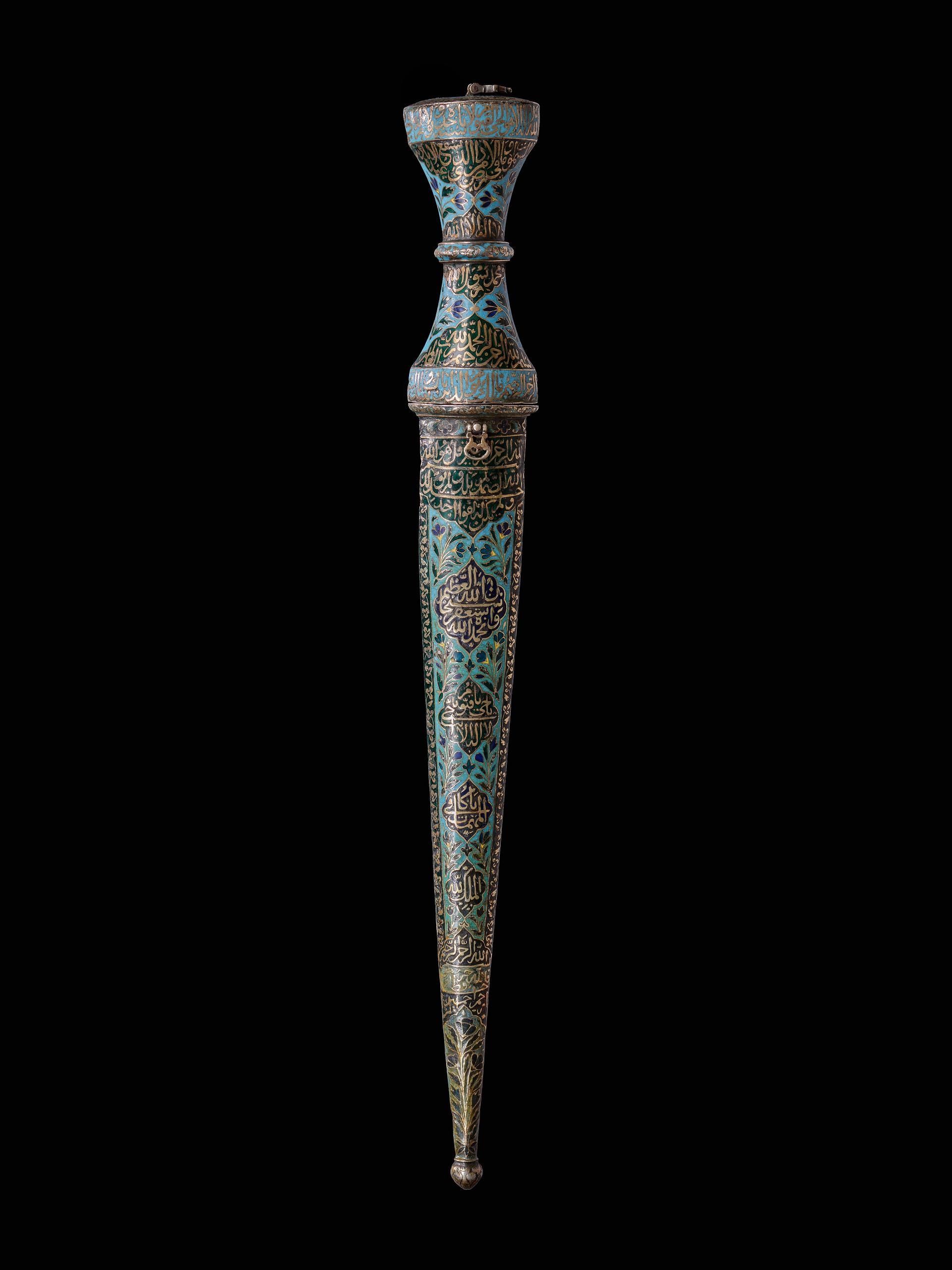
Dagger with blade of wootz steel and hilt and scabbard of gilt silver inlaid with opaque and transparent enamel
India, Deccan; c. 1700
Total L: 42; W (top): 5; Dagger L: 34.7 cm
Inventory number 1a/2022 & 1b/2022
Daggers with hourglass-shaped handles are known from many places in the Islamic world. This dagger has a champlevé enamel and silver decoration that forms a uniform design across the hilt and scabbard, and the composition is the same on the front and back. Apart from a few flowering plants and plant ornaments, the dagger is completely covered with section featuring inscriptions of a religious nature. These are quotations from the Koran as well as prayers and invocations that mention Ali.1 Hidden on the upper side of the scabbard’s horizontal opening – and visible only when the dagger is out of its scabbard – is the engraved name of its creator: ‘Ramazan Beg son of Kalb Ali Beg’.
The dagger’s many references to Ali reveal that it must have been created in a Shiite context, and it has previously been suggested that it originated in Iran.2 Two other daggers with hilts of similar technique and decoration (the scabbards are lost) have also been attributed to Iran.3 One of these bears the date 1696. However, there is much to suggest that the entire group was instead made in the Deccan in southern India around 1700, as has also been proposed for yet another related dagger in the al-Sabbah collection;4 unlike the others, this latter dagger is fitted with a typical Indian hilt. Shia Islam was also widespread in the Deccan, and the region is the point of origin of another group of related metalworks generally dated to the mid- to late seventeenth century. These are begging bowls and other bowls in bronze and copper, whose decoration consists exclusively of inscriptions, often with Shiite wording (61/1998).5
As regards the champlevé technique, the Portuguese colony of Goa to the west had, from the second half of the sixteenth century onwards, served as a bridgehead for the spread of this European enamel technique on the Indian subcontinent (see 34/2019). A few silver works decorated with enamel and distinctive inscriptions such as those on this dagger have also previously been attributed to seventeenth-century Deccan.6
The dagger’s many references to Ali reveal that it must have been created in a Shiite context, and it has previously been suggested that it originated in Iran.2 Two other daggers with hilts of similar technique and decoration (the scabbards are lost) have also been attributed to Iran.3 One of these bears the date 1696. However, there is much to suggest that the entire group was instead made in the Deccan in southern India around 1700, as has also been proposed for yet another related dagger in the al-Sabbah collection;4 unlike the others, this latter dagger is fitted with a typical Indian hilt. Shia Islam was also widespread in the Deccan, and the region is the point of origin of another group of related metalworks generally dated to the mid- to late seventeenth century. These are begging bowls and other bowls in bronze and copper, whose decoration consists exclusively of inscriptions, often with Shiite wording (61/1998).5
As regards the champlevé technique, the Portuguese colony of Goa to the west had, from the second half of the sixteenth century onwards, served as a bridgehead for the spread of this European enamel technique on the Indian subcontinent (see 34/2019). A few silver works decorated with enamel and distinctive inscriptions such as those on this dagger have also previously been attributed to seventeenth-century Deccan.6
Published in
Published in
Davids Samling: Islamiske våben i dansk privateje = Islamic arms and armour from private Danish collections, Davids Samling, København 1982, cat. 74;
Kjeld von Folsach, Joachim Meyer and Peter Wandel: Fighting, Hunting, Impressing; Arms and Armour from the Islamic World 1500–1850, The David Collection, Copenhagen 2021, cat. 5;
chim Meyer, Rasmus Bech Olsen and Peter Wandel: Beyond words: calligraphy from the World of Islam, The David Collection, Copenhagen 2024, cat. 60, p. 201;
Kjeld von Folsach, Joachim Meyer and Peter Wandel: Fighting, Hunting, Impressing; Arms and Armour from the Islamic World 1500–1850, The David Collection, Copenhagen 2021, cat. 5;
chim Meyer, Rasmus Bech Olsen and Peter Wandel: Beyond words: calligraphy from the World of Islam, The David Collection, Copenhagen 2024, cat. 60, p. 201;
Footnotes
Footnotes
1.
Salam Kaoukji: Precious Indian Weapons, and other Princely Accoutrements, The al-Sabah Collection, Kuwait, London 2017, cat.no. 59.
2.
Navina Najat Haidar and Marika Sardar: Sultans of Deccan India, 1500-1700: Opulence and Fantasy, Metropolitan Museum of Art New York, New Haven 2015, pp. 259–266.
3.
Mark Zebrowski: Gold, Silver and Bronze from Mughal India, London 1997, pp. 82–83.
4.
Kjeld von Folsach, Joachim Meyer and Peter Wandel: Fighting, Hunting, Impressing; Arms and Armour from the Islamic World 1500–1850, The David Collection, Copenhagen 2021, cat.no. 5 and pp. 272–273.
5.
Davids Samling: Islamiske våben i dansk privateje = Islamic arms and armour from private Danish collections, The David Collection, Copenhagen 1982, cat.no. 74.
6.
Robert Hales: Islamic and Oriental Arms and Armour. A Lifetime’s Passion, [S.l.] 2013, cat.no. 197 and Bashir Mohamed: The Arts of the Muslim Knight. The Furusiyya Art Foundation Collection, Institut du Monde Arabe, Paris, Milano 2008, cat.no. 151.
.-The-David-Collection_Copenhagen_photo-Pernille-Klemp.jpg)
.-The-David-Collection_Copenhagen_photo-Pernille-Klemp.jpg)
.-The-David-Collection_Copenhagen_photo-Pernille-Klemp.jpg)
.jpg)
.-The-David-Collection_Copenhagen_photo-Pernille-Klemp.jpg?disposition=attachment)