Ewer of cast and engraved bronze
North-western India or Afghanistan; 16th–17th century
Maximum H: 37.5; Maximum W: 20.5 cm
Inventory number 15/2011
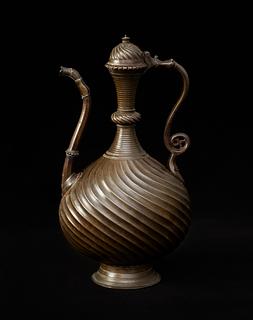
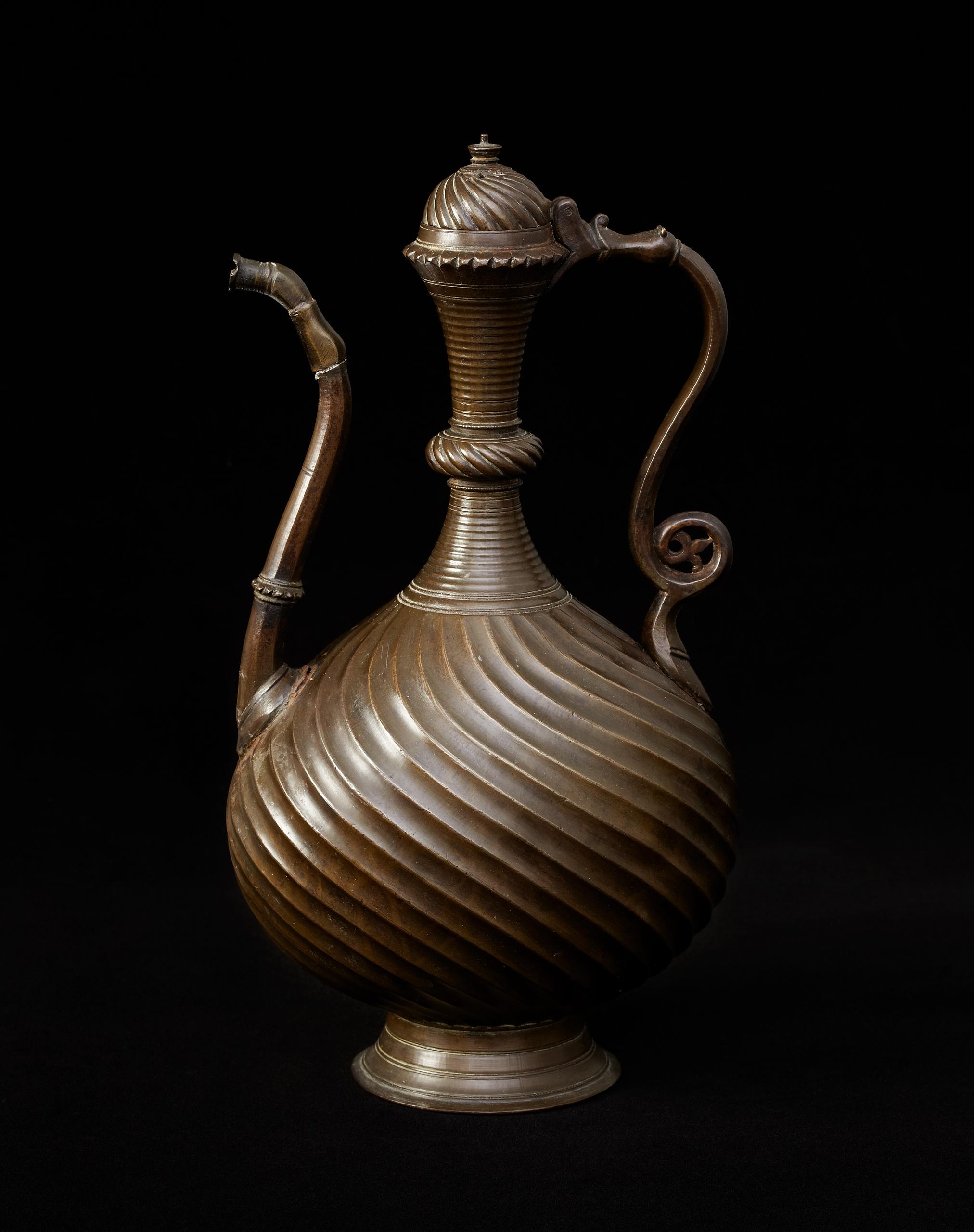
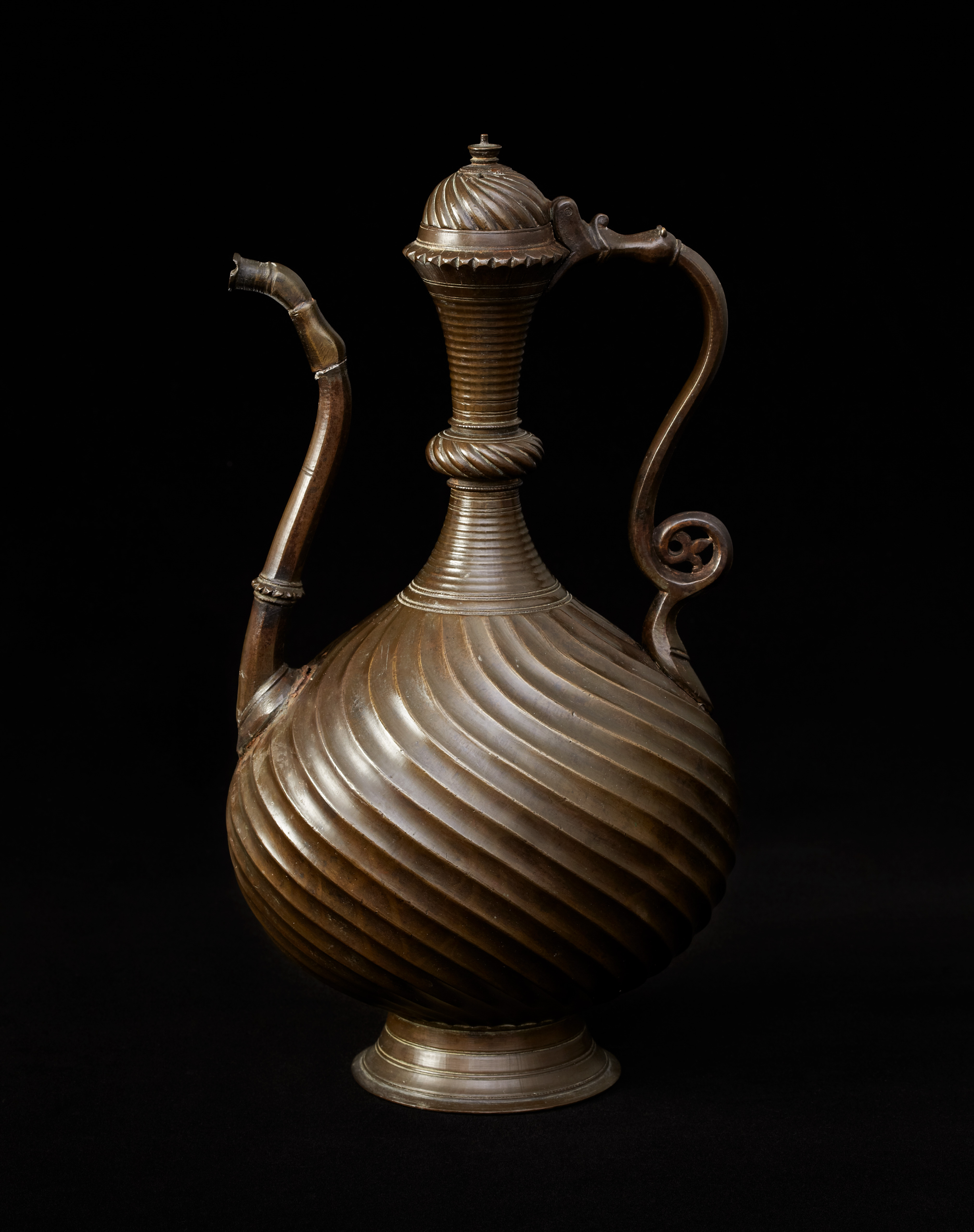
The body and neck of this jug have been moulded as a single piece fitted with a handle and spout attached with rivets as well as a dome-shaped lid. The surface of the body is covered in swirling fluted ornamentation, a pattern repeated in the ribs on the central bead of the neck and on the lid.
The shape and decoration of the jug shows the fusion of Iranian/Central Asian and Indian art found in Mughal India. The shape of the ewer’s neck, spout and handle is influenced by Iranian metalwork, where slender ewers are known all the way back to the pre-Islamic period. On the other hand, the pear-shaped and slightly flattened body has a close affinity with Indian metal ewers, which are generally wider and lower than their Iranian counterparts (17/2011).
The S-shaped handle, terminating in a dragon’s head and a small, trilobed leaf, is reminiscent of the handles on Timurid ewers from Central Asia dated to the fifteenth and early sixteenth centuries (34/1986). However, the dragon’s head on the present ewer is notably elongated, and its snout curled upwards, suggesting that it represents the head of the Indian river monster known as the makara rather than an East Asian dragon.1
Sculptural ewers like this one appear to have been a fixture at Indian courts. Miniature paintings often depict them as part of the interior of palaces and pavilions (3/1999).
The shape and decoration of the jug shows the fusion of Iranian/Central Asian and Indian art found in Mughal India. The shape of the ewer’s neck, spout and handle is influenced by Iranian metalwork, where slender ewers are known all the way back to the pre-Islamic period. On the other hand, the pear-shaped and slightly flattened body has a close affinity with Indian metal ewers, which are generally wider and lower than their Iranian counterparts (17/2011).
The S-shaped handle, terminating in a dragon’s head and a small, trilobed leaf, is reminiscent of the handles on Timurid ewers from Central Asia dated to the fifteenth and early sixteenth centuries (34/1986). However, the dragon’s head on the present ewer is notably elongated, and its snout curled upwards, suggesting that it represents the head of the Indian river monster known as the makara rather than an East Asian dragon.1
Sculptural ewers like this one appear to have been a fixture at Indian courts. Miniature paintings often depict them as part of the interior of palaces and pavilions (3/1999).
Published in
Published in
Christie's, London 7/4 2011, lot 219;
Mark Zebrowski: Gold, Silver and Bronze from Mughal India, London 1997, pp. 141-142, 144, pl. 177;
Mentioned in Bernd Augustin: ”Drachenköpfe und spiralige Wirbel in der timuridischen Tradition. Ein eiserner Ständer für Waffen-Regalien als Stummer Diener neben dem Thron,” Eothen Magazin. Beiträge zu Sammlungen und Projekten der Freunde Islamischer Kunst, 2025, p. 18;
Mark Zebrowski: Gold, Silver and Bronze from Mughal India, London 1997, pp. 141-142, 144, pl. 177;
Mentioned in Bernd Augustin: ”Drachenköpfe und spiralige Wirbel in der timuridischen Tradition. Ein eiserner Ständer für Waffen-Regalien als Stummer Diener neben dem Thron,” Eothen Magazin. Beiträge zu Sammlungen und Projekten der Freunde Islamischer Kunst, 2025, p. 18;
Footnotes
Footnotes
1.
Mark Zebrowski: Gold, silver and bronze from Mughal India, London 1997, pp. 141–142, 144 + plate 177.
Metalwork, Weapons and Jewelry
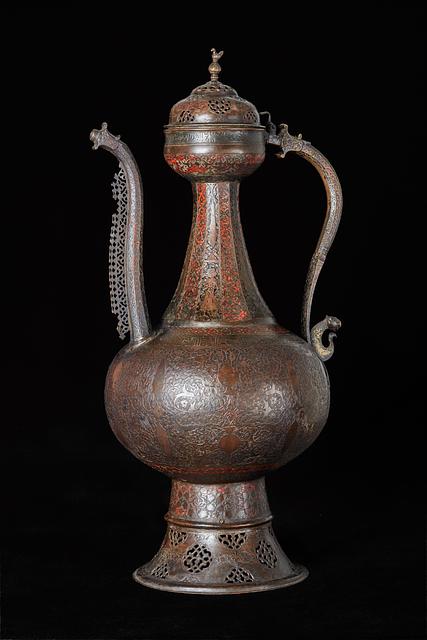
Ewer, brass, with openwork and engraved decoration and inlaid with a red, black, and blue substance
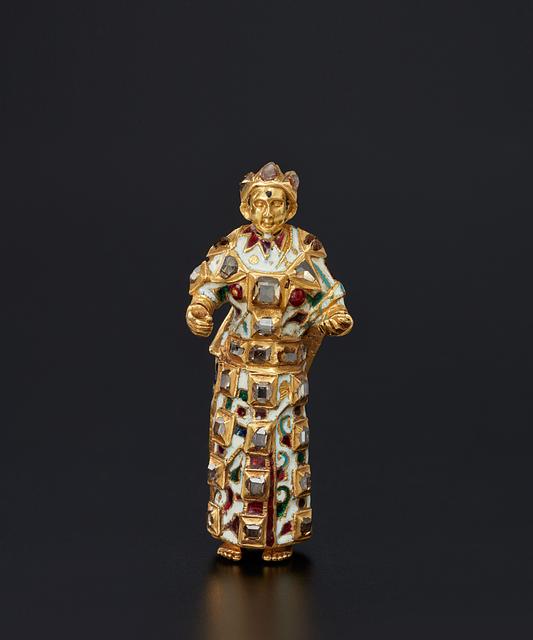
Figure of gold inlaid with opaque and transparent enamel and set with diamonds
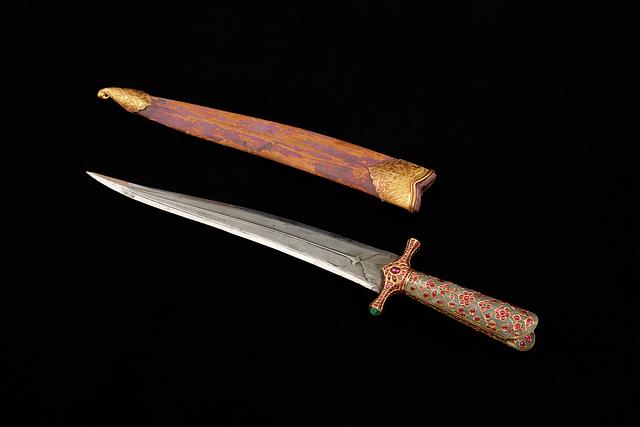
Dagger with steel blade and hilt of carved jade and gold set with rubies and emeralds, with wooden scabbard covered in silk and gilt copper
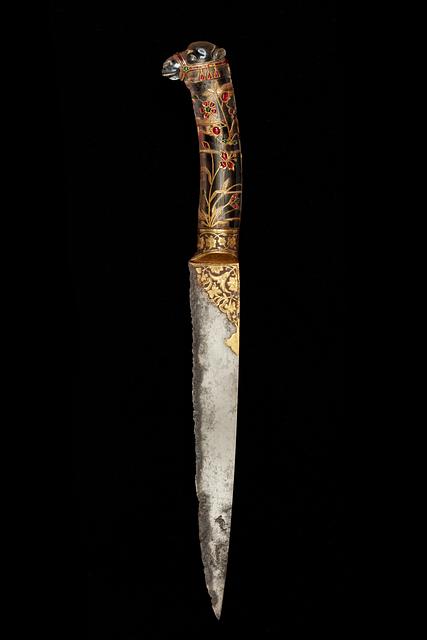
Dagger with a carved rock-crystal hilt, inlaid with gold, rubies, and emeralds