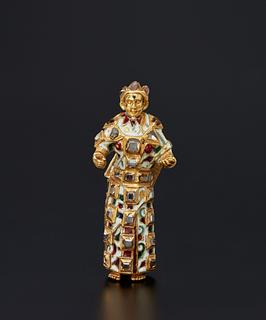
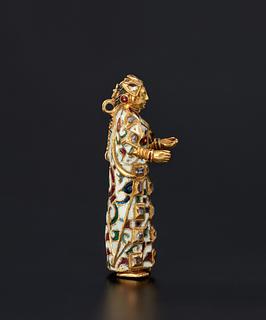
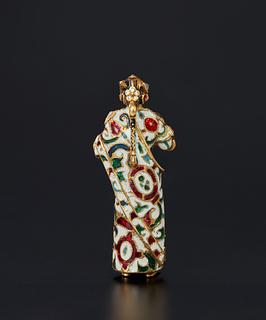
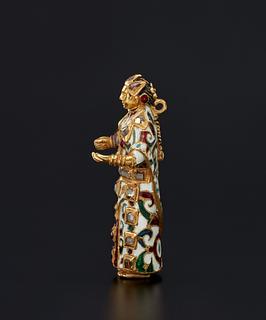
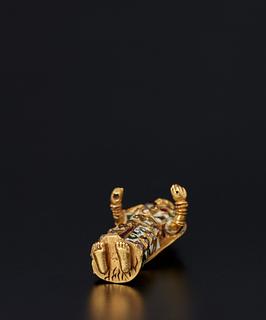
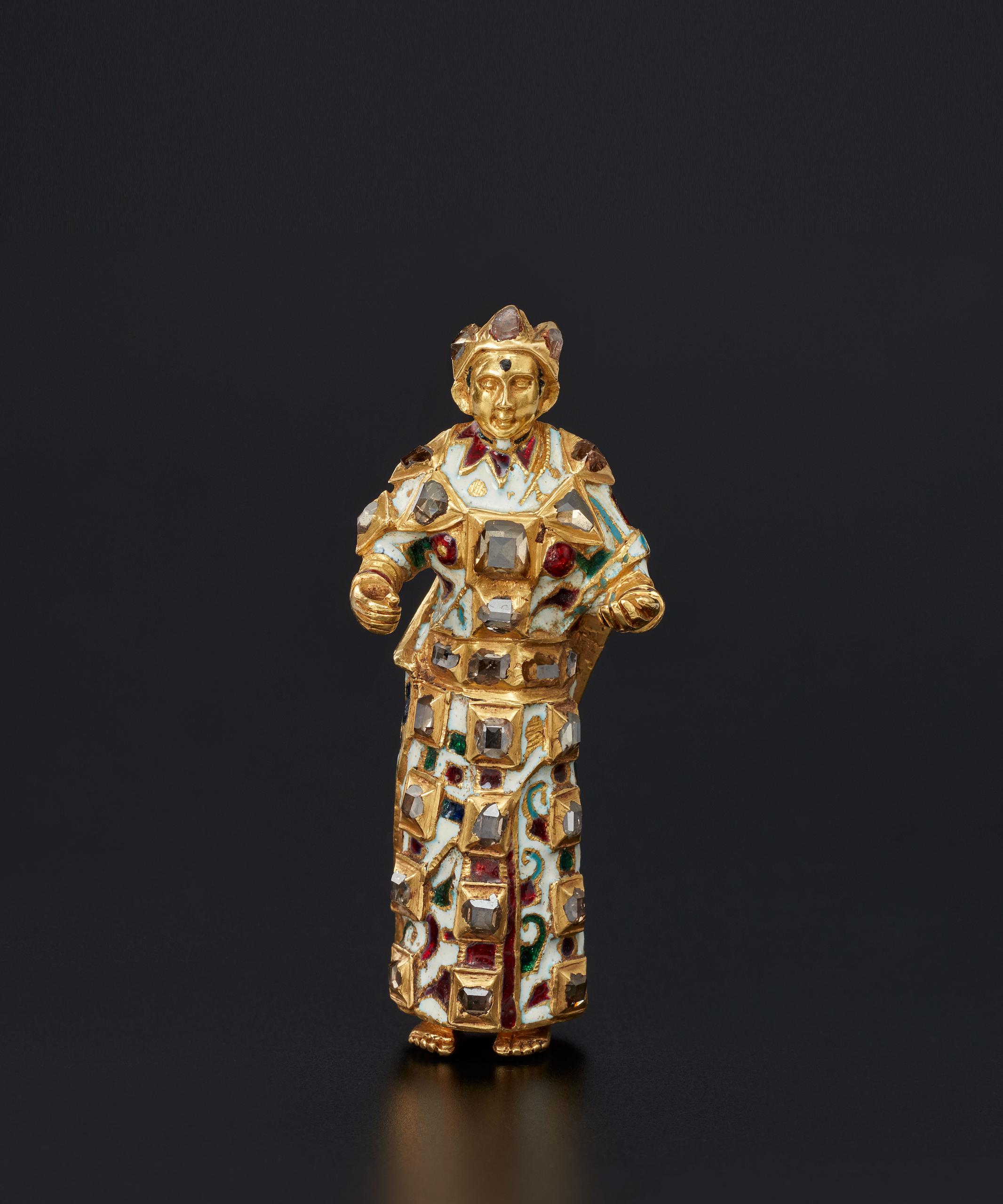
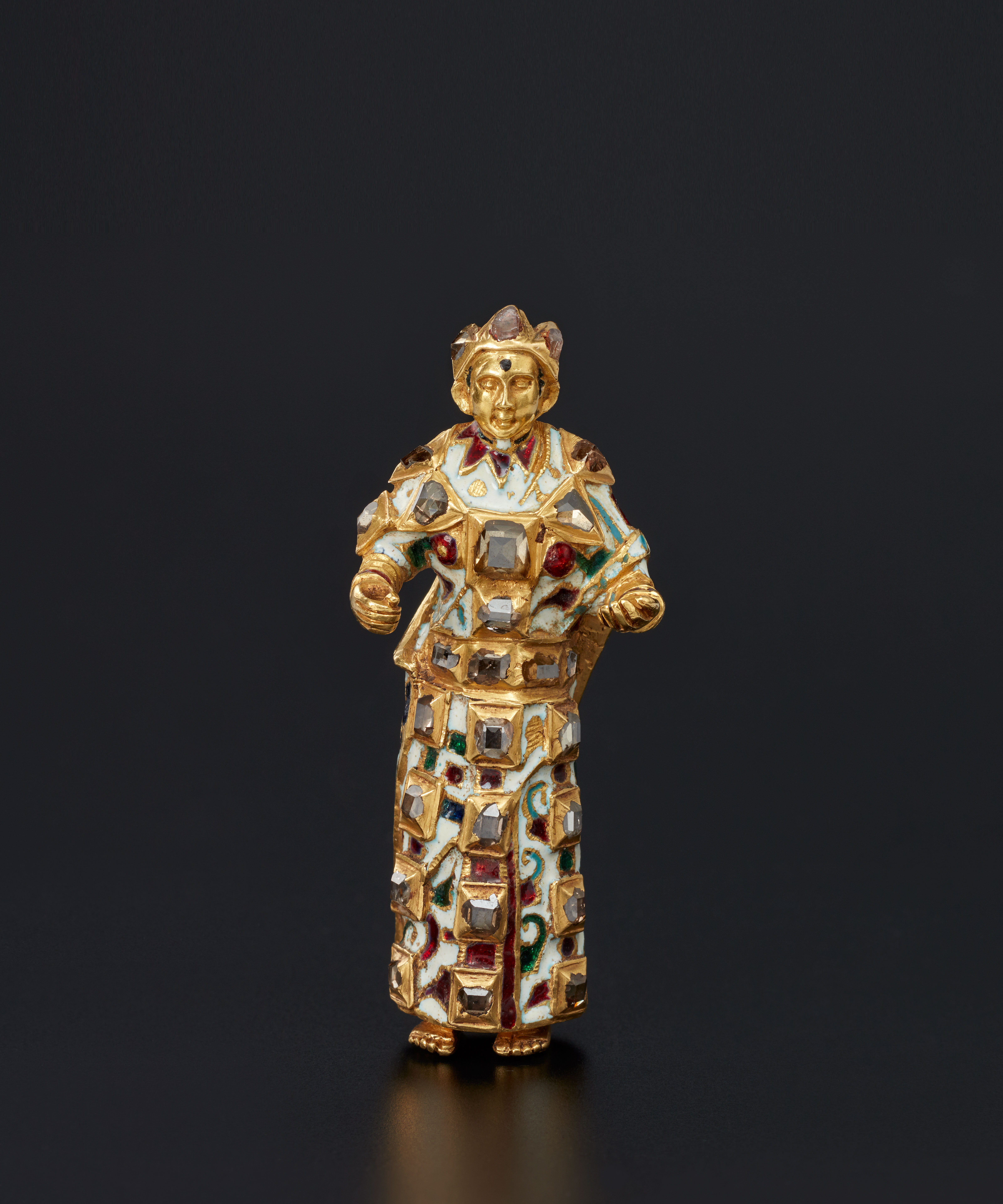
Figure of gold inlaid with opaque and transparent enamel and set with diamonds
This figure depicts a barefooted Indian woman dressed in a flowered sari and with arm rings, a crown and a pointed necklace. The figure’s original function is unknown, but she probably held two smaller objects in her hands and she might have been fixed or suspended from the eyelet placed at the back of the head.
Even though it is clearly an Indian woman, the figure in several ways reflects the influence of European art. Her sari, hair, jewelry, and black caste mark are thus colored with opaque and transparent enamel, a form of decoration that was unknown in India until it was introduced from Europe in the course of the 16th century.
Considering their asymmetric form, the 26 diamonds that decorate the woman’s dress and crown seem to have been cut in the Indian style. The pyramid-shaped gold settings that keep the stones in place are, however, reminiscent of European goldwork.
Moreover, the very shape of the figure seems to be related to the small, carved Madonnas and saint figures that were created in the Portuguese colony of Goa in southern India in the 16th-17th centuries. Most of these figures have European clothing and facial features, but they often assume the same posture with outstretched hands holding small objects. It is possible that the artists responsible for this figure tried to create an Indian interpretation of the saintly figures from Goa.
The European influence is also found in other art forms of the period. Several Indian miniature paintings of the same era are thus modelled on European paintings and engravings (6/1981 and 31/2001).
Published in
Published in
Amin Jaffer (ed.): Jewels of the Mughal Emperors and Maharajas. Treasures from the Al Thani Collection, Miho Museum, Kōka 2016, pp. 19, 56, 260, cat. 30;
Amin Jaffer (ed.): Treasures from the Al Thani Collection. The Palace Museum and the Al Thani Collection, vol. 1, Beijing 2018, p. 219, cat. 134;
Martin Chapman og Amin Jaffer (ed.): East Meets West. Jewels of the Maharajas from the Al Thani Collection, Fine Arts Museums of San Francisco, San Francisco 2018, p. 99, pl. 39 og p. 177, cat. 75;
Amin Jaffer (ed.): Beyond Extravagance. A Royal Collection of Gems and Jewels, The Al Thani Collection, 2nd ed., New York 2019, pp. 117-118, cat. 23;
Christie’s, New York 19/6 2019, lot 292;
Christie’s, London 24/10 2019, lot 99;
Mentioned in Bernd Augustin: ”Drachenköpfe und spiralige Wirbel in der timuridischen Tradition. Ein eiserner Ständer für Waffen-Regalien als Stummer Diener neben dem Thron,” Eothen Magazin. Beiträge zu Sammlungen und Projekten der Freunde Islamischer Kunst, 2025, p. 12;
.-The-David-Collection_Copenhagen_Photo-Pernille-Klemp.jpg)