Mail shirt of steel and iron
India, presumably the Deccan; 17th century, before 1691
H: 107 cm
Inventory number 1/2019
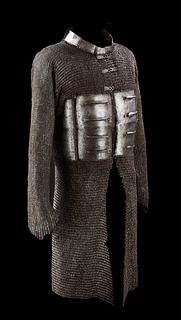
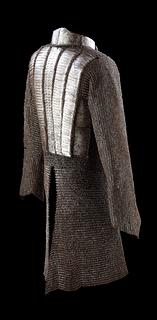
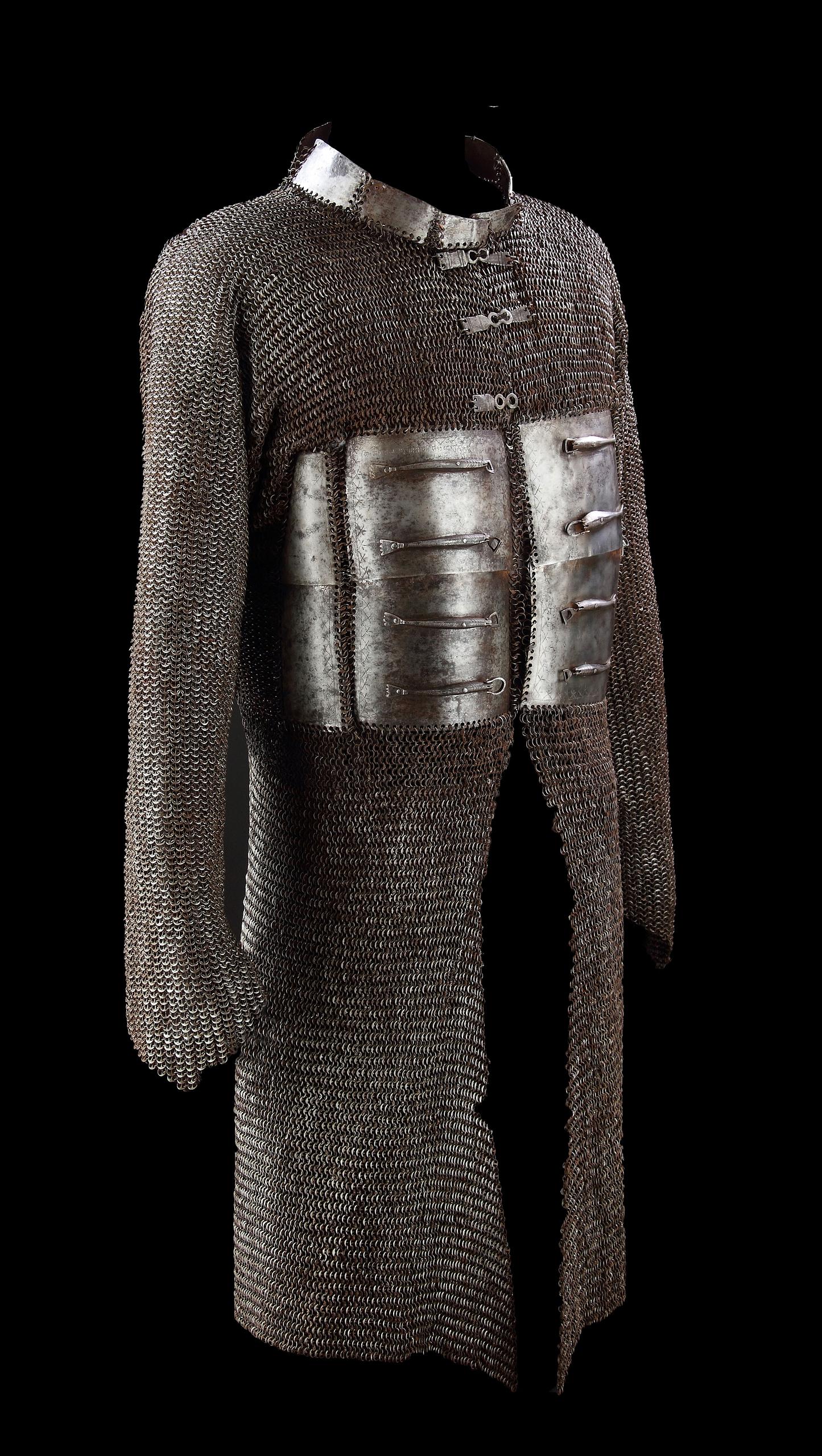
This over-the-knee-length mail shirt was intended for a heavily armed rider. It has slits at the front and back which would have caused it to fall down over the horse’s sides, protecting the rider’s legs.
The mail shirt is made of a combination of riveted and punched-out rings, which made the coat extremely solid, but also very time-consuming and expensive to make.
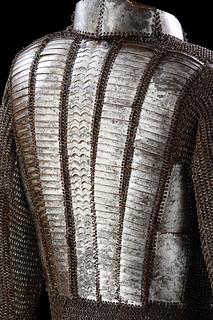
Mail provided good protection against the cutting blows of sabres, but was vulnerable to thrusts and stabs made by lances or arrowheads. Accordingly, steel plates have been inserted on the chest and under the arms of this shirt. Along the back run several rows of thin steel lamellae, which were less inhibiting to the rider’s mobility than larger steel plates.
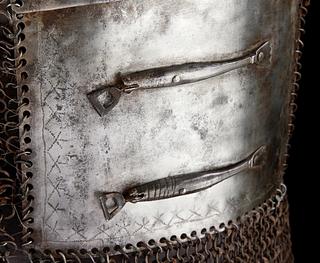
Shirts such as this were widespread in the Middle East, Iran, Central Asia and India from the fifteenth to the eighteenth century. In India, the type was presumably introduced by the Mughals during the sixteenth century, but it spread across the subcontinent and was worn by both Muslims and Hindus. A special feature of the Indian versions are the elongated fish-shaped buckles seen here. Such buckles can also be observed in several depictions of similar shirts in Indian miniature painting (4/1980).
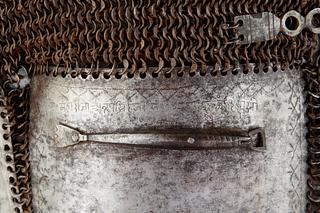
An inscription on the upper right breastplate of the shirt mentions the Maharaja of Bikaner, Anup Singh, as well as the year 1691.1 The shirt was presumably part of the war booty brought home by Anup Singh from the Mughal campaigns in the Deccan in the 1680s.
The mail shirt is made of a combination of riveted and punched-out rings, which made the coat extremely solid, but also very time-consuming and expensive to make.
Mail provided good protection against the cutting blows of sabres, but was vulnerable to thrusts and stabs made by lances or arrowheads. Accordingly, steel plates have been inserted on the chest and under the arms of this shirt. Along the back run several rows of thin steel lamellae, which were less inhibiting to the rider’s mobility than larger steel plates.
Shirts such as this were widespread in the Middle East, Iran, Central Asia and India from the fifteenth to the eighteenth century. In India, the type was presumably introduced by the Mughals during the sixteenth century, but it spread across the subcontinent and was worn by both Muslims and Hindus. A special feature of the Indian versions are the elongated fish-shaped buckles seen here. Such buckles can also be observed in several depictions of similar shirts in Indian miniature painting (4/1980).
An inscription on the upper right breastplate of the shirt mentions the Maharaja of Bikaner, Anup Singh, as well as the year 1691.1 The shirt was presumably part of the war booty brought home by Anup Singh from the Mughal campaigns in the Deccan in the 1680s.
Published in
Published in
Runjeet Singh: The Goddess : arms and armour from the Rajputs, November 2018, Coventry 2018, cat. 30, p. 89;
Kjeld von Folsach, Joachim Meyer and Peter Wandel: Fighting, Hunting, Impressing: Arms and Armour from the Islamic World 1500–1850, The David Collection, Copenhagen, cat.no. 55 and Appendix,, p. 276;
Kjeld von Folsach, Joachim Meyer and Peter Wandel: Fighting, Hunting, Impressing: Arms and Armour from the Islamic World 1500–1850, The David Collection, Copenhagen, cat.no. 55 and Appendix,, p. 276;
Footnotes
Footnotes
1.
Kjeld von Folsach, Joachim Meyer, Peter Wandel: Fighting, Hunting, Impressing: Arms and Armour from the Islamic World 1500–1850, Copenhagen 2021, p. 276.
.jpg)
.jpg)
.jpg)
.jpg)
.jpg)
.jpg)
.jpg?disposition=attachment)